The Most Common Types of Interviews in the Education Sector

Do you know the most common types of interviews in the education sector? The most common interview process in the education sector is the one-on-one interview. Please read this post to learn more about different types of interviews and how to handle them.

Informal Interviews

During an informal interview, the interviewer knows which questions they want to ask. Still, sometimes the interviewer will converse with the candidate and not ask many educational questions. After this interview, you may wonder what just happened.

These interviews may take place early in hiring a candidate, or it may be a final conversation at the end to ensure the interviewer has a full opportunity to get to know the candidates before deciding on who to hire.

Structured Interviews

In a structured interview, a list of questions has been prepared based on the job requirements. The same questions are asked of every candidate, and notes are taken. In a structured interview, you can anticipate that your interviewer(s) won’t have much opportunity to deviate from a standard question formula. You’ll know that all candidates will be put through a very similar process.

Unstructured Interviews

An unstructured interview can be very stressful. The interviewer may ask a question or two and then pause. An elevator speech or a quick introduction is essential to showcase your strengths and passion for teaching.

You’ll be more likely to be successful in an interview like this if you come in with a list of questions you are prepared to ask the interviewer with specific information about the school that isn’t available on their website, the specifics of the position, and the students you’ll be working with.

Sequential Interviews

A sequential interview is where you will be interviewed by several people, one at a time. They could be other teachers, potential supervisors, board members, parents, or resource people. Treat each one as a separate interview. Be prepared to answer the same questions over and over.

If you can ask questions, don’t worry about asking the same questions to each interviewer. It can be an excellent way to get diverse perspectives on things you want to know about the job and the school.

Panel or Group Interviews

The panel interview is the following most common interview in the education sector. This could be called a group interview. The interview board comprises people with whom you will work to get a job offer. The interview committee has a list of prepared questions, and panelists will usually take turns asking questions. The purpose is to see how others react to you.

Make eye contact with different group members throughout your conversation, and direct your answers to the larger group to keep everyone engaged. Be sure to make a good impression.

Interview Stages

All teacher job interviews have four different stages.

Introduction

The first stage is the introduction. This step is crucial because it helps create a favorable first impression in the interviewer’s mind. This interview phase will set the tone for the rest of the interview.

This phase includes introductions and a chance for the interviewer(s) to assess your appearance, confidence, and speech. Appear calm, confident, and alert. Greet the interviewer(s) with a firm handshake, smile, and sit when asked to do so.

Skills Interview Questions

During the second stage, you should expect questions on your academic background, work experience, accomplishments, and future goals. The interviewer is trying to determine if you have the skills for the available position.

Let your passion for teaching show. When asked about your accomplishments, explain them without sounding arrogant.

Stand-Out Questions

The third stage of the interview will determine whether you stand out from the other candidates. In this stage, the interviewer will decide whether or not you are the best candidate for the job.

Expect a few difficult questions, such as why you should be considered for the teaching post. The interview committee will want to know the value you will bring to the school, your philosophies of education and classroom management, how you deal with discipline and parents, and how to improve academic results. Include keywords specific to teaching in your replies.

Add real-life examples from your teaching experience to justify your strengths and points of view. Try to correlate your answers to the school’s philosophies on education and discipline.

Conclusion

The final stage of the interview is the conclusion. In this phase, you may ask questions about the position available, challenges faced by teachers, the school’s philosophies on education and discipline, and so forth.

Asking a couple of questions will demonstrate your interest in the job and give the interviewers further evidence of your research, your ability to think critically when provided with information, and your attention to detail.

What to Bring and What to Do

Present your portfolio/brag book during the interview, preferably after the first question is asked to give the interviewer(s) time to look at it. It should be about five pages long, divided into separate sections, in a three-ring binder. It should show your development in teaching skills over time.

Key things to do to set you apart from other job applicants. Smile, act relaxed, make eye contact, dress professionally, and be prepared to answer the questions. Understanding different types of interview styles will be helpful.

Demonstrate you have researched the school to provide knowledge about the district, its students, and the community it serves. Show enthusiasm and passion for teaching, and treat everyone with respect. Communicate your personality, sell yourself, and send a thank-you letter within 24 hours of the interview.

What to Avoid:

There are some key things not to do:

  • Dress casually – in jeans and a T-shirt
  • Use foul language
  • Forget to shake hands and make eye contact.
  • Act arrogant or be critical of other teachers
  • Show up late
  • Ramble on
  • Ignore or be disrespectful to the receptionist
  • Focus every answer on your children
  • Act surprised and upset by the requirements of the job

The worst things to say during an interview include:

  • “I’m desperate to get a job…”
  • “I don’t know the answer to that question.”
  • “I will only teach _____________.”
  • “I don’t know anything about this district.”
  • “I hated my last boss.”
  • “I will need to take these days off….”
  • “Have you been saved?”
  • “You know what I hate about teaching (or kids)?”

Contact us if you need help preparing for the interview or creating an accomplishment-based, keyword-rich, visually appealing resume and cover letter. Candace enjoys ensuring teachers and other educators have the tools to make their next career move.

Are you prepared for your upcoming interview? Do you want to learn what questions you can expect?

Visit our career eBook store to learn more about the eBooks we sell, containing 152 interview questions and answers for teachers or school administrators.

The Purpose of a Resume is to Get an Interview Not a Job

Remember to think of your resume as a marketing tool. Your job is to market yourself to potential employers through your resume. The purpose of a resume is to get an interview, not a job.

To effectively accomplish this, think of yourself as a product, potential employers as your customers, and your resume as a brochure about you.

Think about your unique selling features:

What are your features and benefits?

What makes you unique?

Why should the school district hire you over the other teaching candidates?

Once you know these answers, be sure to convey this information in your resume effectively.

What to Include on Your Resume

First of all, don’t get ahead of yourself. Your resume generates buzz and interest around you so that you have the chance to stun in an interview. Some job seekers will tell you that getting to the interview is over half of the battle. The fact that you’re there means you’re at least minimally qualified and are being considered. This means the hard part is getting there. Make sure to highlight information that gets you into the interview.

So, you don’t need to go into detail about every accomplishment you’ve ever had. Your goal should be to be clear and concise. The purpose of your resume is to generate enough interest in you to have an employer contact you for an interview. Therefore, list your best accomplishments that are most relevant to the teaching area you are seeking.

Use the job interview to provide a more detailed explanation of your accomplishments and to land the job offer.

Show the Reader Your ROI (Return on Investment)

When you are writing your resume, you are using it to market yourself to a prospective employer; for this reason, you need to show the return on investment. What will the hiring manager get by hiring you for a teaching position?

When creating your resume, ask yourself questions similar to the following:

Did you help increase student achievement, and if so, how?

Have you developed new curricula or new programs, and if so, what were the results?

Did you turn around an educational program?

Did you troubleshoot a major problem?

Have you increased student test scores?

These questions will definitely depend on the position that you are seeking, but this should give you an idea of accomplishments to put in your resume. Think of it this way, what was the challenge, what were your actions and what was the result?

After you answer those questions, you will have a solid accomplishment – and that is what sells.

The following things are what your resume needs to include:

  • Clear Target
  • Qualifications
  • Core Competencies
  • Key Achievements
  • Relevant Experience
  • Related Education or Professional Development
  • Association Memberships

The reason employers require all job applicants to submit a resume is so that they have a method of separating applicants who are qualified for the position from the ones who lack the necessary qualifications. The challenge for job seekers is to compose a top-quality resume that will interview a prospective employer. After all, the sole purpose of a resume is to get the reader to pick up the phone.


How Do You Make Classroom Lessons Interesting and Interactive?

If you were asked this teacher interview question, would you know how to answer it: How do you make lessons exciting and interactive?

It is essential the response you give to the job interview question is truthful, relevant to the position, and shows value to the school district. The following could be a possible answer, or it may provide ideas for you to tailor your response:

One of the basics of teaching is to conduct lessons that interest students. Bored students won’t remember much of the experience and won’t remain focused and active. A meaningful way of keeping lessons interesting is to include interactive activities.

Lecture-based lessons are not interactive and can easily make students bored and disinterested in the material. Students will optimize their learning when they are actively engaged and when the activities are based on their interests and learning levels.

I, therefore, try to refrain from giving lecture-based lessons. Although it is sometimes necessary to incorporate some lectures into a lesson, I either break up the lecture time by incorporating activities and games in between. I limit my lecture time to no more than 20 minutes while including questions and class discussions to keep it interactive.

I create engaging lessons by adding games and real-life objects such as props, manipulatives, and art activities. I make lessons more interesting by applying content to applicable contextual meanings. I relate my teaching materials to daily usage and practical examples.

By providing appropriate applications, students will be able to remember them better and longer and see the relevance of learning the material.

It is vital to students’ socialization and development to interact with each other and in whole-class settings regularly. To this end, I incorporate: class discussions; group discussions; pair work; cooperative learning groups; learning stations; whole class educational games such as jeopardy, trivial pursuit, and around-the-world; class plays; role-playing; and circle time to encourage cooperation, participation, active learning, and fun in my lessons.

Students learn best when they are interested and fully engaged in the lesson. I always try my best to incorporate fun and different activities into my lessons to achieve the results needed.

What Items Do I Need to Bring to a Teacher Interview?

Congratulations! You’ve landed that coveted teacher interview. Now comes the task of impressing the school district interviewers. To make the best possible impression, you’ll want to prepare; this will involve having an inventory of necessary things to bring to the interview.

We often focus so much on getting ourselves to the interview, dressing correctly, being prompt when we arrive, or the teacher interview questions asked at the end of the interview that we don’t emphasize what’s in our briefcase.

“What do I need to bring to my interview?” you may be asking yourself.

Well, ask no more because we’ve prepared a list of things that will help you to seem like the qualified, capable candidate you are.

If you have a teaching portfolio, remember to take your precious work of art with you, it has many benefits. The interview panel may not have time to review your portfolio, but at least they will see you have one.

Bringing These Items to Your Next Teacher Interview will Help to Land a Job Offer. 

Current Resume – Multiple Copies

If you need to distribute them to the panel, you should have enough to do this. Most likely, they will have a copy, but they may be testing you to see if you are prepared. Even if they already have a copy of your resume, be sure to ask if they would like a copy when you introduce yourself.  That way, you can still demonstrate that you came prepared even if they already have your information in front of them.

Letter of Intent/Cover Letter Your Submitted

Bring these with copies of your resume if the interview panel doesn’t have a copy of them. If you submitted a document, like a cover letter, a list of employment references, or a reference letter from a former colleague or supervisor, it’s smart to have a copy on hand just if your committee wants an extra copy.

Philosophy of Education Statement

Although you may have submitted this with the rest of your application package, it is always good to come prepared with extra copies. Even if you have handed it in, the interviewer may ask you for an extra copy or ask you a question regarding your teaching philosophy. Having a copy handy will help if you need to refer to it.

Copies of Degrees, Transcripts, Licenses, and Certifications

All of these are a vital group of documents to bring with you to the interview. You need to back up all the claims you make on your resume regarding your education and qualifications.

Even if you photocopied these and sent them through email, hiring managers may want to see them in the flesh to ensure that they are indeed authentic. It is also always better to proactive in these instances. If you have documents like official transcripts, they may need to be submitted in a signed and sealed envelope. Have a signed, sealed envelope on hand so that your interviewer can open an official copy for review if needed.

A Listing of Professional Development Courses Taken

If you didn’t include a complete list on your resume, you need to bring this information to the interview. You want to show the interview panel your latest accomplishments in your professional development to demonstrate you are dedicated to staying current in the teaching profession.

If it’s been an unusually drawn-out hiring process and you have attended a conference or earned a new credential since you submitted your application, this information becomes doubly important because it gives your interviewers an updated picture of your skills and abilities.

Certifications/Paperwork to Confirm Awards or Honors Earned

As with the copies of your degrees and other qualifications, you need to back up the authenticity of any awards or honors you’ve stated that you’ve earned in your teacher resume.  In essence, if you make a statement about yourself, be sure to back it up with documentation whenever you can.

Copies of Letters of Recommendation

You should bring two or three great letters of recommendation if you have them. Letters from supervisors, cooperating teachers, and principals are all good choices. The more specific they are in covering your instructional techniques, creativity, collegiality, and classroom climate, the better.

Copies of References

If a hiring manager hasn’t already requested your references, you can rest assured that they will look at your interview.  Always have a printed reference sheet ready, with extra copies in case the panel requests copies. As always, ensure that your reference information is correct and up-to-date.

If you haven’t done so already, contact your references to inform them that you will be submitting your contact details as part of an interview and confirm that they are still comfortable speaking to your qualifications and answering questions. Otherwise, qualified candidates have lost out on job offers because references were caught off guard when called after the interview. Don’t let this happen to you.

Teaching Portfolio to Show a Reflection of Your Skills, Accomplishments, and Passion

If you have one, bring it. Don’t bring it if they explicitly stated on the phone or in a confirmation letter that teaching portfolios are not allowed. The interview may refer to this as examples of teaching artifacts.

Try to avoid jamming your portfolio full of examples. It should contain just a few of your best samples of lessons and student work. Choose the examples that best reflect the skills, abilities, and experiences that tie into this particular job, and tailor your portfolio to your teacher interview.

Materials for Your Sample Lesson or Presentation

If you have been asked to participate in a mock classroom lesson or to prepare a presentation for the interview, be sure to make a checklist of everything you will need to complete that portion of the interview successfully.

Determine what materials you will need, how many people will be participating, and create a separate list of quantities of materials, technology needs, and other essential items that will be required.

If you have an obligation to give a presentation, make sure that you have multiple ways to access your slides. Put them on a thumb drive, email them to yourself, and save them using a site like Google Slides or Slide Share to ensure that you will have what you need to be successful regardless of technical difficulties.

An Appropriate Bag to Carry It All

Layout your documents, portfolio, sample lesson materials, and other required items and determine the bag’s size you will need to carry it all.

If you are not supposed to bring a hard copy of your teaching portfolio or if you aren’t asked to give a presentation, you could be in good shape with copies of appropriate documents and a pen and paper to take notes. If you have been asked to bring a portfolio and a lesson plan for a larger group, you may need a larger briefcase or tote bag.

Be sure to find an appropriately professional carrying case for your materials, as you don’t want to show up in professional dress toting your old college backpack.

Bring a Can-Do Attitude to a Teacher Interview

It may sound cliché, but you cannot forget to bring your enthusiasm and a positive attitude with you to the interview. Your energy, vitality, and passion for teaching need to be clearly evident in your attitude.

Principals are looking for teachers with self-confidence and enthusiasm, someone they can trust with a room full of students. Incorporate effective interview strategies into your preparation to ace the job interview and secure a job offer

Be the kind of teacher you’d want to learn from, and your interviewers will begin to see the possibilities that could be unlocked with you supporting their students.

Proven Methods for Finding International Teaching Positions Available

Are you interested in finding international teaching positions available? There are many ways to find credible overseas teacher jobs.

Learning the secret of finding job opportunities overseas for teaching positions will significantly speed up your international education job search.

Use a variety of search methods to located job openings for teaching overseas. If you are looking to teach at an international school, you can search for job postings on the internet or in your local newspapers. You can also apply to attend an international job fair or contact potential schools directly.

Finding International teaching jobs will involve reviewing job postings on the internet and also in newspapers. Some newspapers even have a special section devoted to finding international teaching positions.

Newspapers are excellent sources of information that are often overlooked nowadays because of online job boards. Many local newspapers have online job boards and classifieds as well as their print versions. Many recruiters prefer to advertise in them to search for certified teachers.

If you plan on working with a recruiter specializing in overseas jobs, there are some steps you can take to make the relationship beneficial.

They rely mostly on professional networks, personal contacts, and direct applications to fill their spots. Many of the best schools will have an employment page directly on their websites to advertise their open positions. The best way to find these schools is by searching for international schools by region. The top international schools’ websites will likely come up in these internet searches, and then you will be able to apply directly to each of them.

Methods to finding international teaching positions #ESL #TESOL #EFL Share on X

If you want to work in a particular region, narrow down your search to schools in that area and contact them directly. Be aware that restricting you to only one or two countries will severely impact your chances of finding employment, especially if the country you’ve chosen is a country that is in high demand by teachers. It’s important to keep an open mind while searching for positions; you might be surprised at the opportunities that come up.

Some schools choose to hire only through job fairs since they pay the organization a fee to attend and gain access to the organizers’ database of applicants. Therefore, having the added expense of advertising either on the internet or in newspapers can be unnecessary for these schools. If you live in one of the areas where there are international job fairs, it would be worth the time to attend one.

Participating in a job fair will give you a rare opportunity to speak to the school representative directly and gain a lot of helpful and relevant information regarding each school. If you choose not to attend a job fair, you may still be able to get a phone or video interview if you directly contact some of these schools.

Don’t forget the power of LinkedIn for finding International teaching positions. To leverage the power of this social media professional network, you need a keyword-rich, well-written LinkedIn profile including a targeted heading. When writing your LinkedIn profile, you may use our LinkedIn profile development service to get noticed.


How Do You Develop and Implement Creative Lesson Plans?

Do you know how to answer this teacher interview question: What ways do you develop and implement creative lesson plans?

Although lecturing remains a critical way to communicate information to students, research has proven that learning happens more effectively if combined with active learning teaching strategies.

Nowadays, you will frequently hear this question being asked during job interviews. This question clearly wants to help the interviewers assess what techniques and hands-on learning strategies you include when developing lessons and have up-to-date knowledge about these techniques.

When giving relevant examples from your past, you will prove:

  • First, that you are an informed person who gets the information from different sources (like the internet, books, newspapers, training, presentations, workshops, and peers)
  • Second, you have defined for yourself a process by which you develop creative lesson plans.
  • And third, this job is not only to support you but enjoyable that you are eager to learn new things regularly.

This question uncovers your ability to manage group dynamics in the classroom, choose age-appropriate techniques, and motivate students to participate and learn.

Within this context, you might respond:

I’m always concerned with innovation and interaction in my classroom. And that’s because I understand that nowadays, with so much information available, effective learning involves using new learning strategies that involve the students in the process.

I personally have defined for myself a learning process for writing creative lesson plans. I find new information I can examine and use appropriately. The internet is generally the most valuable source for me in this regard, although teaching magazines, classes, and peers provide good sources for creative ideas.

I rarely lecture, and I generally include interactive techniques as part of my lesson plans. I do this to motivate students because I enjoy renewing old teaching materials by changing delivery strategies and altering methods. I consider my student’s learning styles, understand what they would enjoy doing, and decide how the content will be delivered using hands-on activities. Then, I plan activities and experiences to get my students excited about and involved in the lesson.

Their involvement is truly rewarding for me. Some techniques I use are: {choose according to the subject and grade you are applying for} debates, cooperative learning, videos, peer learning, use of manipulatives, recitation, projects, reports, experiments, music, dance, guest speakers, art, discussion, games, photography, role-play, drama, computer tasks, and so forth.

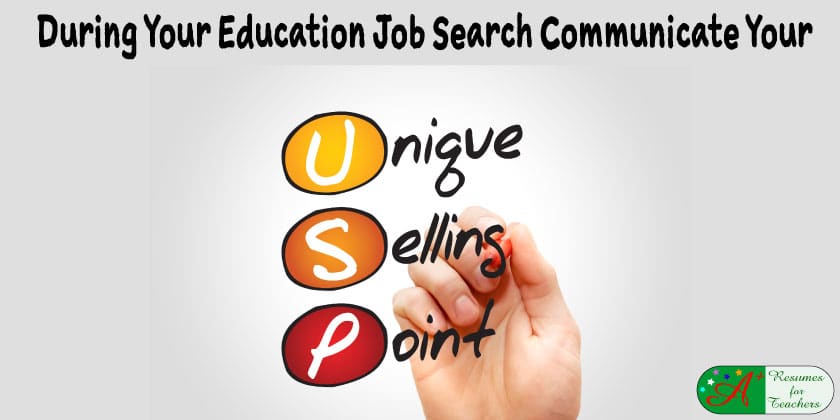
During Your Education Job Search Communicate Your Unique Selling Point

Are you preparing for an education job search? Review and implement these tips and steps to uncover your unique selling point as a teacher or any position in the education sector.

As a job seeker, you must communicate your value as an educator, a critical aspect of a successful educational job search.

Meet the minimum requirements mentioned in a teaching job posting and demonstrate what exceptional relevant qualities, teaching skills, or achievements you can bring to the school or organization.

Your unique selling proposition, referred to as your personal brand, is used to communicate your genuine value in an education job search. This selling point should be about 10 – 12 words short and include your biggest, most relevant strength and the primary benefit a school district or organization will receive by hiring you.

Communicate Your Unique Selling Point in a Resume

Let’s take a school teacher as an example:

All classroom teachers must develop and instruct lesson plans that adhere to the curriculum and benchmarks. But how are your lesson plans different?

Do you create engaging and hands-on lesson plans?

Do you bring a real-life connection to the classroom?

Are you able to differentiate the instruction using technology?

Do they relate to the real world and leave students wanting to learn more?

If so, mention this in your resume and cover letter.

What makes your behavior management plan so effective?

Do you implement innovative teaching methods for keeping students well-behaved and focused?

Do you go the extra mile to maintain communication with parents?

Are there team-building techniques you apply to boost morale amongst fellow teachers?

A trick to find your unique selling point to use throughout your education job search.

Start by outlining the typical tasks that teachers face daily. Besides each regular responsibility, write down what makes your method more practical or creative than an average teacher. Next, analyze how these techniques impact the overall learning process.

Turn these innovations into selling points and highlight them in your job search documents. If your teaching methods can be assessed via a data-based form, bullet them as achievements under each appropriate job position listed on your résumé. For example:

  • Incorporated literature-based units and reader’s workshops to raise students’ reading levels by at least 1 ½ grade levels.
  • Introduced a reward program for class attendance and participation, thus achieving a 100% attendance rate year-round.
  • Used math manipulatives and real-world connections to increase students’ math scores to a minimum grade of 85% on state testing.

In addition to the time spent during regular classroom hours, mention if you participate in extra-curricular activities. School districts love to see their teachers are flexible and willing to put in extra time to help establish a well-rounded and successful school community. Highlight your time spent on boards or committees, coaching sports, sponsoring clubs, or providing after-school tutoring. This information can be bulleted to make it stand out from your responsibilities.

A Successful Education Job Search Requires Uncovering Teaching Accomplishments

These items must be considered when formulating your resume and academic application letter. The cover letter is your chance to let your true personality and passion for the profession shine through. Explain your exceptional teaching techniques and how they positively influence student learning.

If you have attained accomplishments with specific numbers like those listed above, bullet them in your cover letter. Throughout your job search for the perfect education job, let the reader know your unique qualities or methods work and truly be an asset to a hiring school district.

You should craft the perfect school teacher or administrator resume and cover letter to turn your dream job into reality.

If you need a competitive advantage during your education job search to secure a job interview for a dream position, contact Candace or call toll-free: 1 877 738-8052, the owner of A+ Resumes for Teachers. 

We have been writing education resumes that get results even in a competitive and challenging job market for 20+ years.

Visit our resume services page to see what we offer to help you surpass the competition. 


Attitude and Mindset at an Education Job Interview Are Pivotal to Success

Whether you receive a job offer after your education interview depends on many factors. The hiring decision will depend on:

  • How your skills and talents align with the school’s needs and requirements.
  • If you effectively communicate your value proposition.
  • Your ability to share your relevant success stories to show the value you can bring to the school district.
  • The other qualified candidates’ ability to interview compared to your performance?
  • The unpredictability of the hiring authorities, including school principals and superintendents.

Attitude Matters During the Education Job Interview

One of the pivotal components for interview success you may not have considered is your attitude. By this, I mean what you are thinking about as you prepare for, go through, and reflect on a job interview.

Many people underestimate the importance of keeping a positive attitude during an interview. A candidate’s attitude can be the key to your success in a job interview.

The degree to which you think optimistically, keep the right things in perspective, and maintain a poised mental attitude will directly affect the outcome you are hoping for—a solid teaching job offer.

What do you think about as you prepare for a job interview?

I’m not talking about researching the school and the teaching position, coming up with your fundamental messages about yourself and your value proposition, or the thinking it takes to practice answering the toughest interview questions to alleviate stress during the interview. I’m talking, more specifically, about your attitude.

Get in the Right Mindset

Do you view the education job interview as a “sink or swim,” “do or die” proposition? Are you telling yourself how this one probably won’t work out? Are you worried you won’t communicate what the interviewers want to hear? All of these kinds of thoughts raise your anxiety level and work against you.

When you walk into the interview room, all of these anxious thoughts and feelings will be communicated through your body language and overall attitude to your interviewers. Your interviewers will easily pick up on this, and it will affect your interview chances. For instance, if you prepare for and enter a teaching interview feeling defeated, this attitude will permeate the entire interview process.

Confidence Matters

What school would want to hire a teacher with a defeatist attitude? When in doubt, remember: “Mind over matter.” Use your willpower, your drive to land a dream job, to push yourself through any nerves or doubts you may have. Even if you’re not feeling 100% confident, do as they say and “fake it till you make it!”

What you need to be feeling going into an interview is confidence, curiosity, and openness. To keep your thoughts in check, pay attention to where your mind wanders.

If your mind wanders to negative thoughts, proactively stop it. Distract yourself from other thoughts or tell yourself: “No. I’m prepared. I deserve this opportunity. And if it doesn’t work out, there’s always tomorrow”. Don’t allow yourself to sabotage your chances before you even get into the interview room. Keep a positive attitude!

Education Job Interview Tips to Kick the Nerves

If you feel a bunch of nerves coming on, reassure yourself using the steps above and take a deep breath. If you become easily paranoid by the potential negative outcome, sit down the evening before your interview with a pen and paper.

List out the worst possible outcome of not getting the job. After a while of doing this exercise, you’ll notice that not only is “the world ending” not on that list, but the list you have generated looks a little silly after all! Putting the absurd places, your mind wanders to down on paper can help normalize the thoughts in your brain. Once you’ve calmed down a bit, if it helps, rip up the paper and throw it in the trash!

Eliminate the negative thoughts and anxiety that might hinder you during your interview performance.

We hope this article has helped give you interviewing tips and tricks on overcoming pre-interview butterflies best, so you’re at your best while searching for a job.

If you need help with any aspect of your job search, reach out to Candace today via email or call toll-free at 1 877 738 8052!

Teachers, How Do You Make a Difficult Phone Call to a Parent About Their Child?

Do you know how you would answer this interview question?

How would you make a difficult phone call to a parent?

It is important that the response you give to the job interview question is truthful, relevant to the position, and shows value to the school district. The following could be a possible answer… or it may provide some ideas for you to tailor your response:

The time to prepare for talking to a parent about a difficult matter is before a problem presents itself. A teacher calling to talk to a parent about academic or behavioral difficulties has a great advantage if the parent already has some familiarity with the teacher. The best way to prepare for this situation is for teachers to contact all parents in the first weeks of school. This can and should be a short phone call, welcoming them as parents of your students and making a positive comment about the student.

In the initial phone call, teachers should:

1. Introduce themselves.

2. Describe one activity in the classroom, such as “We’re making masks this week.”

3. Describe one positive attribute about the student, as in, “Charlie seems to really enjoy asking questions.”

4. Encourage the parent to contact you whenever a question or concern comes up.

Once this groundwork has been laid, a teacher should feel more confident about contacting parents again if a difficult matter comes up. When/if this happens:

1. Do research. What is the problem? What are the facts behind the problem?

2. What possible solutions can you suggest? Think of at least two.

Then you are ready to make the call.

1. Introduce yourself.

2. Mention that a problem has come up at school that you wanted to talk to the parent about.

3. Give the parents the facts.

4. Tell the parent what the problem is.

5. Ask the parent if they had heard about the problem. If so, ask what they’ve heard?

6. Ask the parent to meet with you to solve the problem or suggest a phone solution. (This does not mean that you should suggest a punishment for the child.)

7. Ask what they think of the solution.

8. If they accept the solution, thank the parent and say “Good-bye.”

9. If they don’t like the solution, suggest another solution.

10. Hopefully, the parent will accept that solution. If not, ask if the two of you could meet to discuss the matter further.

If the child has misbehaved and is going to receive a punishment, such as detention:

Make the call.

1. Introduce yourself.

2. Mention that a disciplinary problem has come up at school that you wanted to talk to them about.

3. Tell the parent what the problem is, e.g., “Johnny got into a fight on the playground.”

4. Give the parents the facts; be sure to present both sides.

5. Ask the parent if they had heard about the problem. If so, ask what they’ve heard?

6. Tell the parent how you handled the problem and what your final decision was as to who was at fault, etc. If appropriate, citing school policy, “At Washington School, all children involved in fights are required to serve a one-hour detention.”

7. Explain what the punishment will be and when it will take place.

8. If the parent accepts the situation, thank the parent and say “Good-bye.”

9. If the parent gets upset, ask if the two of you could meet to discuss the matter further. Making a difficult phone call requires you to stay call at all times.

10. Give the principal a “heads up” about the situation, as many parents will go directly to the principal to try to get their child out of trouble.


Always Include a Cover Letter for a Teaching Position

When applying for an education position, some educators wonder whether a cover letter for a teaching position is necessary. The answer is yes!

A cover letter is your first form of correspondence and should provide an introduction to your resume.

Using the correct application letter format is essential when applying for any teaching job. People often ask the questions, “why can’t I just post or email my resume or application form and let it speak for itself?”

“Is it necessary to include a cover letter?” Yes, include a cover letter.

Those in the ‘know’ say the first impression of someone is made within approx. Eight seconds. Even scarier is if a first impression is formed; it’s doubtful to change.

If the selection committee chair opens your resume and discovers that you haven’t bothered to include a cover letter, your application may end up in a “do not interview” pile.

Helpful Writing Tips on What to Include in a Cover Letter

Appearance Counts:

Spelling or grammatical errors are unacceptable in a cover letter for any teaching job application. Give your letter a thorough proofread. Once completed, your letter should be printed out using a standard font style on resume bond white or off-white paper. Show you are a professional by keeping it neat, correct, and straightforward. Ensure that you spell the school principal’s name and the school correctly and include your full name and contact details.

Quote a Job Reference Number Or Be Specific:

The first paragraph of your application letter should include some vital details. You will want to include the job you are applying for, the job reference number, and where you heard about the vacancy.

Research Before Writing:

It’s important to show in your letter that you have some background information on the school to which you are applying. A letter that sounds like a mass-produced copy emailed to 10 different schools just won’t cut it. If the school has its website, this can be a great starting point. Find out as much as you can and make a point of explaining what specifically interested you in this school.

Explain What You Have to Offer:

Knowing as much as possible about the school can make a difference. Explain why your teaching skills and attributes would benefit the school. Communicate what kind of contribution you could make. Incorporate what is relevant, for example: If you discover the school is big on music and languages, mentioning you coach a local basketball team may not be beneficial!

Let Your Personality Shine Through:

The beauty of a cover letter is that it’s personal to you. It’s a chance for the selection committee to get a glimpse of your personality characteristics. Don’t be tempted to download a second-hand template and use it to create yours. It will be quite apparent to the person reading it. You’ll come across as lazy and unimaginative.

Injecting personality and passion into your letter doesn’t mean filling it with irrelevant anecdotes. It means putting time, thought, and creativity into what you write. Try to make a connection with the reader and let your personality shine through what you say.

Review these application letter writing mistakes to ensure you don’t make the same errors.