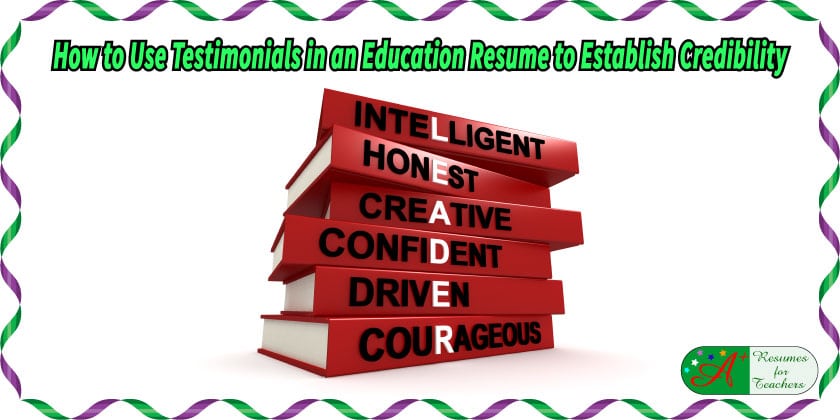
How to Use Testimonials in an Education Resume to Establish Credibility

Incorporating testimonials in an educational resume can grab readers’ attention by highlighting and supporting your strengths or accomplishments. When an employer writes an annual performance review, a letter of recommendation, or even a nice verbal compliment about your work, establish a file including these for future use.

These verbal statements or written documents can be powerful tools to help your teacher- or administrator-focused resume stand out from the other candidates applying for education jobs.

Draw quotes or testimonials from your letters of recommendation and incorporate one or two into your resume and cover letter. These excerpts immediately capture the reader’s attention, signalling the tangible nature of your skills and validating your worth to previous school districts or organizations.

The best places to include these quotes in a resume are either after your areas of expertise or at the end of the document. Consider incorporating one into appropriate resume sections to fill extra space. Protect them by sparing accolades (perhaps one or two per document) and avoid looking awkward or out of place.

A testimonial from a past employer or co-worker should be in quotation marks and italicized, followed by a dash, the person’s name, position title, and place of work (all in regular lettering), and light background shading to make the lines stand out even further. Don’t let the testimonials detract from your solid credentials and experience; instead, you want them to serve as an excellent complement to your resume.

Merge relatively up-to-date testimonials in your educational resume. It is superior to use an applicable endorsement from the past few years rather than one from 20 years ago.

If you have many different quotes, find one or two that are most relevant to the targeted position. For example, if you recently switched careers, transitioning from a sales representative to a teacher, find a testimonial that highlights your leadership and instructional skills.

Finally, suppose more than one individual has provided you with the material you can reference. In that case, selecting someone with a higher position or your direct supervisor may be more influential. For example, using a testimonial from a manager directly above you or a school principal is more appropriate than one from a co-worker in a lateral position.

If you do not have testimonials but want to use a quote, you can always research something online that suits your philosophy. For instance, many teacher resumes include direct quotes from famous theorists or researchers.

Think of critical names you hear in the industry, i.e., Gardner, Bloom, Canter, etc., for education. Applying these quotes to your resume or cover letter follows the steps outlined above for incorporating testimonials (quotation marks, italicized writing, the name of the author, and background shading).

Speaking of quotes, you can review our customers’ success stories and appreciation for A+ Resumes for Teachers for helping them advance their careers.

Feel free to contact us if you need assistance gaining a competitive edge and securing a job interview for your desired position. We’ve crafted education resumes with over 20 years of experience that consistently yield positive outcomes, even amidst challenging job markets. Review our services and prices here.   

How Do You Use Technology in Your Classroom?

When discussing the integration of technology in my classroom, I recognize its pivotal role in modern education. Staying abreast of technological advancements is crucial, shaping how students learn and preparing them for the future. I ensure that I am well-versed in the latest educational technologies and how to implement them in teaching practices effectively.

I utilize various technological resources in my classroom to create an engaging and dynamic learning environment. For instance, I employ interactive whiteboards, such as SMART Notebook, to deliver visually stimulating lessons that cater to different learning styles. Through these boards, powered by software like Nearpod, I can incorporate multimedia elements, interactive quizzes, and real-time feedback, fostering active participation and comprehension among students.

Additionally, I integrate educational software and apps tailored to meet the diverse needs of my students. For example, I leverage adaptive learning platforms like Khan Academy or Duolingo that adjust content based on student progress, providing personalized learning experiences. This approach enhances student engagement and allows me to differentiate instruction effectively, addressing varying learning paces and abilities within the classroom.

Furthermore, I encourage student collaboration and communication by utilizing online platforms and tools. Platforms like Google Classroom or Microsoft Teams facilitate seamless communication, file sharing, and collaborative projects, breaking down physical barriers and promoting teamwork regardless of location. By harnessing these tools, students can work together on assignments, share ideas, and provide feedback, fostering a sense of community and collective learning.

In terms of professional development, I actively seek opportunities to enhance my proficiency in educational technology. I have completed courses and workshops on integrating technology into instruction, earning certifications to validate my expertise. Moreover, I am always eager to share my knowledge and experiences with colleagues, participating in collaborative learning communities and leading workshops on effective technology integration strategies.

The impact of technology on student learning outcomes is evident in various aspects of their academic journey. Through technology-enhanced lessons, students demonstrate increased engagement, a deeper understanding of concepts, and improved academic performance. I regularly collect data and feedback to assess the effectiveness of technology integration, adjusting my approach based on insights gained from student progress and feedback.

Looking ahead, I am excited about the possibilities of emerging technologies for education. From virtual reality simulations to artificial intelligence-driven adaptive learning systems, I am committed to exploring innovative tools and pedagogical approaches that enhance the teaching and learning experience. I aim to empower students with essential digital skills, critical thinking abilities, and creativity, equipping them for success in an increasingly technology-driven world.

My approach to technology integration in the classroom is multifaceted, emphasizing innovation, collaboration, and personalized learning. By effectively leveraging technology, I aim to create a dynamic and inclusive learning environment that empowers students to thrive in the digital age.

Experienced Teacher Resume – Choosing the Right Style

If you apply at a school for a position you know will have multiple applicants, you may want to choose the shortest, most concise resume format.    

Choose the best style of resume to match your background and the teaching position you wish to secure.

If a teaching job requires a lot of information to prove you can do the job, you might opt for a longer, more detailed resume.

Many things separate an impressive, experienced teacher resume from a poorly written resume. A few of these essential parts are the resume style and format, career focus, keyword-rich resume profile, and relevant accomplishments. If these areas of your resume are done well, you will stand out for all the right reasons.

There are three major types of resumes. Give your thoughts on deciding which one is the right one for you. Take into consideration the position to which you are submitting your application. If you apply for different positions at different schools, you might want to compose one of each kind to choose and print the right one for the right job.

Chronological Style Resume

Many job seekers use a chronological resume. In this type of resume, everything is listed chronologically, starting with your education and then your employment experience. At the beginning of the chronological listings, you will want to include a small professional profile paragraph highlighting your accomplishments, talents, and added skills that would qualify you for the teaching position you are applying for. List the education and employment with the most recent first.

Including accomplishments is always crucial to any job seeker, whether you are a reading specialist, educational leader, school principal, assistant principal, or teacher assistant. Including accomplishments in any style of an experienced teacher resume is paramount to get the reader’s interest. Achievements build your credibility and identify you as a valuable asset to the school community.

Some prospective school principals prefer a combination resume or chronological resume to a functional resume because it allows them to quickly read down the list to see your education, work history, and other valuable career-related information.

If you have an extensive employment history, you should plan on only listing the five most recent jobs you have had. If a prospective school principal wants a more in-depth employment history from you, they will ask for one.

Don’t leave blanks. List your employment in the correct order—blanks between jobs alert schools to the possibility of problems or lack of commitment.

If you have gaps in your work history, address this in your cover letter or professional statement. For example, you may say: “After my 13-year tenure with the school district, I opted to take four years away from the workforce to raise my family.”

Functional-Style Resume

The second type of resume you should familiarize yourself with is a functional resume. Recent graduates commonly use it, people with little professional or related work experience, or someone interested in making a career change.

When drafting a functional resume, instead of listing your employment and educational history in order, the focus shifts to your personal and professional qualifications. The aim is to draw attention to the highlights of skills you have experienced.

Include a section where you can list specific skills relevant to the job you are applying for. A functional resume allows you to elaborate more on the tasks, skills, and accomplishments you’ve gained from prior employment.

Combination Style Experience Teacher Resume

The third type of resume you might want to consider is a style incorporating chronological and functional layouts.

This type of resume is appropriately called a combination resume and is becoming increasingly popular. Professionals are starting to use a combination-style resume; it allows them to draw a prospective school principal’s attention to their skills while showing they have a solid educational and employment history.

Once you have decided on the type of teacher resume you want to produce, ensure the information is clear and concise. Don’t overload your experienced teacher resume with information. Otherwise, it will ruin your chances of getting an interview. Prospective schools are limited on time and have other tasks, so they prefer to scan an organized, precise, and easy-to-read resume.

We hope this article has been helpful! Don’t hesitate to contact Candace today if you need assistance with any aspect of your job search. Learn more about her extensive history of helping job seekers just like you.

You’ve Arrived at Your International Teaching Job. Now What?

Arriving at your international teaching job marks the beginning of an exciting journey filled with new experiences and opportunities. However, adjusting to life in a foreign country can be overwhelming at first. Here’s a comprehensive guide to help you navigate your transition smoothly:

1. Water Safety: One of the first things to consider is the safety of the drinking water in your new location. In many countries, tap water may not be safe for consumption due to differences in sanitation standards. It’s essential to research and determine whether you can drink the local water or if you need to rely on bottled water for drinking and cooking.

2. Packing Essentials: Make sure you have all the necessary items packed for your move abroad. From important documents like your passport and visa to personal items and teaching materials, create a checklist and double-check to ensure you haven’t overlooked anything crucial. Consider cultural differences and climate variations when packing clothing and other essentials.

3. Social Integration: Building a social network in your new community can greatly enhance your experience abroad. Seek opportunities to meet locals and fellow expatriates through social gatherings, community events, and cultural activities. Your school, local clubs, and expat groups can be excellent places to start making connections and forming friendships.

4. Housing: If your school doesn’t provide accommodation, you’ll need to find suitable housing. Start your search early and consider factors like location, amenities, and proximity to your workplace. Temporary housing options such as serviced apartments or Airbnb can provide a comfortable transition while you search for a permanent residence.

5. Financial Management: Set up a local bank account to manage your finances efficiently. Consult with your school or employer for guidance on banking procedures and services available to expatriates. Obtain local currency and familiarize yourself with banking fees, exchange rates, and electronic banking options to facilitate seamless transactions.

6. Internet Access: Stay connected by arranging internet access in your new home. Explore options such as setting up a broadband connection or using mobile data services. Internet cafes and public Wi-Fi hotspots can also provide temporary connectivity until you establish a reliable internet connection.

7. Cultural Adaptation: Embrace the local culture and customs to integrate seamlessly into your new environment. Learn the language, respect local traditions, and immerse yourself in the community to gain a deeper understanding of your surroundings. Be open-minded, flexible, and willing to embrace new experiences and perspectives.

By following these steps and remaining proactive and adaptable, you can ease the transition into your international teaching job and make the most of your time abroad. Embrace the adventure, embrace the adventure, and embrace the adventure!

A Teacher Job Fair Interview Can Secure a Teaching Job

A teacher job fair interview could land you a teaching job offer on the spot or at least secure a formal interview at the school or school district.

Take advantage of attending an education career fair, and implement these job search tips to find the best teaching job leads.

First and foremost, research the school districts that will be present. Before you even head out to a teacher job fair, list the school communities of interest and conduct research to learn critical points about each one.

Learn how to stand out at a teacher job fair by being prepared for any interview questions you could be asked.

Pinpoint the school districts and determine what they seek in a new teacher and the required teaching skills and credentials.

What do you want to achieve by attending a teacher job fair?

The next step in preparing for a recruitment event for a teaching career is to plan appropriately.

Preparing to meet and speak with the school district representatives at the career fair will empower you to confidently walk up to the booth and interview the hiring authorities or school principal.

Before Attending a Teaching Job Fair, Ask Yourself These Questions

Are you:

  • Going to discover the employment opportunities available in the current teacher job market?
  • Are you seriously considering applying for a teaching job?
  • An excellent education candidate for the positions of interest?

Once you have established which category you fall into,  you can mentally prepare yourself by adequately researching the school districts you want to interview. Hundreds of thousands of new preservice, career changers, and experienced veteran teachers will attend career fairs, so standing out for the right reasons is vital to getting results.

If you seek employment as a teacher, you must dress the part, wearing appropriate business attire. Slacks, collared shirts, and blazers are suitable if you are a male. A business dress, blouse, pants, or skirt and a suit jacket would be good choices if you are a female. Choose a comfortable and appropriate interviewing outfit based on the type of position. Double-check to ensure the buttons and zippers are not loose.

Anything too short, tight, or revealing is inappropriate—no excessive jewelry, hairspray, perfume, or “wild” hairstyles. Wear good-fitting, comfortable shoes; you will probably be on your feet all day.

Questions to Ask While at a School District’s Booth.

Once you have pinpointed the school districts with teacher jobs available that are of interest and are qualified for, prepare a few questions that you would like to ask the hiring representative, the school principal. The questions you will ask the school hiring representatives will depend on what you learned from researching the school before the job fair.

Researching the school and school district is critical to landing a second interview or a teaching position.

Don’t inquire about something where the answer is available on the school district’s website.

If you do, they will know you didn’t do your homework. A question may be:

  • Can you tell me about the students that attend the schools within the school district?
  • How can I best reach you to follow up on available positions?
  • Do you have a business card?

Before Submitting the Teaching Resume, You Create Double Check It

Assure your resume is in tip-top shape and up to date with your skills, credentials, education, recent employment, and accomplishments. Ensure your resume is free of grammatical, spelling, and punctuation errors and that its content flows smoothly and is visually appealing and professional. Make an excellent impression when you meet the hiring representative by professionally presenting your current teacher-focused resume and letter of intent.

The resume and cover letter you create should communicate your personality, include relevant keywords and accomplishments, and highlight your unique selling points. If they do, you can get a formal teaching job interview later or even land a position on the spot.

Triple Check the Resume Contact Information.

If you do not update your resume regularly and revise it before a job fair, as simple as it may seem, you can overlook your contact details. Include your city, state/province, phone number, and email address.

Triple-check your information; you do not want to miss an opportunity because a school district representative couldn’t contact you.

There is an enormous benefit from preparing for a teacher job fair interview – you may just get offered a new teaching position on the spot.

Interview Questions Asked by Job Fair Recruitment Specialists

The job interview questions the school principal or hiring representatives could ask you are vast. These interviewers want to determine your education philosophy, thoughts on the classroom environment, strengths and weaknesses, and experience with lesson plans.

Common questions asked at a career fair:

Describe your ideas in the classroom.

What are your weaknesses?

Tell me a little bit about yourself.

What grade level do you prefer to teach and why?

Why do you want to work for our school or school district?

Tell me what you know about our school district.

What are your top three strengths?

How do these strengths benefit the students and school community?

Please provide an example that confirms you have those three strengths.

Why are you looking for a new teaching position?

Can you describe a challenging work situation and how you managed it?

What is your philosophy of classroom management?

How do you prioritize and manage your time?

How do you handle pressure and stress?

What are your career goals?

If you want more teacher-specific interview questions and potential answers, you should consider purchasing the A+ Teachers’ Interview Edge; it contains 152 teaching-related interview questions with sample responses.

The eBook includes five MS-Word thank you letter templates to send to the interviewer after the job interview, plus other resources and checklists.

It’s an instant PDF download.

How to Write an Effective University Professor Resume or CV

It’s important to know how to write a university professor’s resume or CV to secure a prestigious university’s higher education position.

All too frequently, people graduate from college and expect to step right into their dream job teaching at a university. Most people know this idealized plan rarely occurs.

When you are looking to establish yourself in higher education, a major first step is to get related teaching experience. If you do not currently have any educational experience, the best way to gain some is by obtaining a job as an adjunct professor.

To clarify, an adjunct instructor is a teacher on a temporary, contractual basis. These individuals are not tenured, so their jobs are not as secure as those who have permanent instructor positions. Universities and colleges are frequently hiring adjunct professors because it is a better financial choice. 

College adjunct professors provide the college with the option of shifting or eliminating staff when financially necessary or as course enrollment changes. There are more adjunct professor jobs than full-time instructor positions. It is significantly easier for an individual with no previous teaching experience to obtain an adjunct professor position.

Creating a strong university professor resume and cover letter is the first step in securing a position as an adjunct professor. If you have an accomplishment-based, well-organized resume with rich keywords to convey your core competencies, you can submit it to various higher education institutions.

When writing your university professor resume or CV, be sure to include the following:

Write a Strong Resume Profile or Career Summary Targeting a University Professor Position:

Start your university professor’s resume or CV with an objective tailored to the scope of the position. Don’t state your objective is to be tenured or you have any other long-term goal. If you do, the employer will be more likely to dismiss your resume because your goal and the job are not aligned.

The CV objective should be the position you wish to secure. It should be something that you will be able to achieve by getting the job you are applying for. An example objective could be “College Adjunct Business Instructor” or “University Business Professor.” The resume or CV profile and core competencies need to go next, filled with relevant keywords.

List Any Teaching or Training Experience

If you don’t have at least some related education background or real-life business experience relevant to the position, you will not be a very desirable candidate. List any experience you have clarity on your university professor resume.

If you only have a small amount of experience, beef up that proof without being dishonest. Elaborate on your duties in your previous tutoring or part-time teaching jobs to help the college understand how your experience qualifies you for the position. Adding relevant content to your resume or CV will allow you to incorporate keywords that are vital to be selected for an interview. 

Don’t List Relevant References on the Resume.

When composing your professor’s resume, include references on a separate sheet of paper using the same letterhead. Try to ensure the people you list as references can attest to your teaching ability or specific knowledge.

If possible, select people who directly supervised you while you performed a job where you used teaching, mentoring, or presentation skills. Of course, let your references know you are in an active job search, so they are ready when contacted by the potential employer.

Few people will want to put their long-term goals on the back burner because they want their dream job now. Many employers want to recruit individuals who can bring tangible skills to the work environment. Try your best to show you have these hard skills.

Although it may seem like taking a job as an adjunct professor is settling for less than you wanted, this is far from the truth. You can gain many skills and achievements in an adjunct professor role and quickly advance to a full-time position.

Teacher Job Interview Question and Answer On Motivating Students

Is motivating students one of your strengths? Read on to find a job interview question and answer specific to motivating students. As I am sure you know, this is a vital teaching skill. Your response must be concise and concise and show your knowledge and passion for motivating students.

The interview panel may ask this job interview question to candidates interviewing for a teaching position since keeping your students’ at a high level of learning is critical.

Be specific and avoid generalizing. Instead of discussing the importance of working with motivated students, explain precisely how you motivate students.

Addressing this inquiry will strengthen your reputation as an effective educator. Provide examples of successful strategies you have used with individual students or groups.

Research indicates that motivation hinges on educators’ ability to fulfill students’ needs, empower them in their learning, and demonstrate competency and engagement. Hence, it’s recommended to highlight practices that align with these aspects. Sharing specific examples of how you’ve applied these principles in your teaching can further bolster your credibility and showcase your expertise in motivating students effectively.

Considerations for Encouraging Student Engagement

Here’s a sample response to guide you in crafting your own:

“I recognize the paramount significance of fostering a motivated cohort of learners. By granting students autonomy over their learning, nurturing their competence, and fostering connections, I cultivate a collaborative learning atmosphere that ignites their motivation. Consequently, the dividends of my efforts yield successful, driven students.”

I inspire student learning through the following:

  • Establishing rigorous standards
  • Employing diverse teaching methods and exercises
  • Aligning learning objectives with student interests
  • Monitoring student advancement
  • Delivering constructive feedback
  • Offering praise and positive reinforcement
  • Introducing role models and guest speakers
  • Demonstrating learning models
  • Cultivating confidence in all students
  • Fostering a student-centered classroom
  • Clearly articulating learning objectives and tasks
  • Articulating the significance of learning a concept or skill
  • Employing external incentives such as rewards
  • Sharing personal learning experiences, including challenges or setbacks
  • Nurturing student-teacher relationships, showing genuine interest in students beyond academics
  • Integrating interactive activities
  • Prioritizing self-directed discovery opportunities
  • Infusing enjoyment into educational games and exercises
  • Engaging students with immersive experiences like field trips, hands-on materials, multimedia resources, and guest speakers.

Demonstrating genuine enthusiasm for the subject matter is crucial, as it sets the tone for student engagement. If I fail to convey passion for what I teach, my students will likely not be motivated to learn.

In my experience, relinquishing control over the learning process empowers students and fosters a sense of ownership. I believe in allowing students to play a significant role in determining learning goals, selecting activities, and establishing classroom norms. This approach enhances motivation and promotes autonomy and responsibility.

While it may seem contrary to cooperative learning principles, I’ve found that allowing students to choose their learning partners can significantly boost motivation. Students feel more invested in their learning journey by respecting their preferences and fostering a sense of agency.

I also strive to design assignments that challenge students’ preconceived notions and encourage critical thinking. By creating opportunities for students to grapple with complex ideas and synthesize information, I aim to cultivate a sense of competence and mastery.

Ultimately, I seek to cultivate a classroom environment grounded in trust, empathy, and community. Recognizing students’ individuality and celebrating their milestones, such as birthdays, helps foster a supportive atmosphere where students feel valued and respected. Additionally, occasional treats are tangible rewards for their hard work and dedication, reinforcing positive behavior and motivation.

By prioritizing student agency, critical thinking, and a supportive classroom culture, I aim to inspire a love for learning that transcends the classroom walls. This holistic approach not only promotes academic achievement but also cultivates lifelong learners who are eager to explore and grow.

If you found this information valuable, we appreciate your feedback. Don’t hesitate to reach out if you need assistance with your job search journey.

How to Use Facebook for Your Teaching Job Search

Have you ever wondered if using Facebook for your teaching job search can help? The fact is that LinkedIn is considered the most widely used professional networking website, and it is also the primary tool for job seekers looking for work or wanting an online presence.

With the growing popularity of Facebook, it has become one of the hottest job search guides among social media for job-seeking professionals.

And while social networking websites like Facebook and Twitter have been designed to be highly social. Ideas and communication flow freely among users. You must still be careful about what you share.

Why Use Facebook for Job Search Networking?

Some schools are now using this social media platform to identify and screen potential employees. Don’t let them find anything on your profile viewed as unprofessional. It’s important that your students cannot view anything inappropriate on your social media channels for similar reasons.

Social media sites like Facebook can be highly advantageous to your career by elevating your online status. Through posting messages at least once or twice a week that mention your active job search or your interviews in a very positive manner can help you to get the word out about your job search to your contacts. You can also use Facebook to further your professional identity by posting teaching tips, portfolio items, and blog-like posts about your teaching area.

Tips for Making the Most of Facebook

To make your Facebook page a useful tool for your job search, below are some tips you can use:

When using your Facebook account as a platform for locating or identifying employment opportunities, you can begin by finding schools of interest.

Just type the name of the school on the site’s search bar. Most schools today have their own Facebook accounts, not to mention the fact of finding people who work in that school which you can add to your network. You can expand your network to find more relevant information about the school and see potential job opportunities.

Look for other professional individuals to include in your network. Networking is often one of the best ways to connect with other people that can help you locate job leads or recommend you to a school district or organization interested in applying for employment opportunities. Facebook can seem more casual than social media platforms like LinkedIn; it is still an excellent method to build a connection through shared interests.

Find People to Start Networking

Do not forget to identify individuals or acquaintances from your past and others from your previous educational endeavors. Locating networking buddies on Facebook is often the most productive way to expand your professional network and ultimately find the job you want.

Social media platforms like Facebook have become a convenient venue for looking for jobs and many other purposes. When you use this social media platform correctly, the possibilities are endless. Just make sure you watch out for the things you share on your wall and keep comments professional.


How to Write a Thank You Letter After Your Teaching Interview

I  trust you’ve taken the time to peruse this blog post, especially after completing your recent interview for your coveted teaching position. Your ability to provide concise, comprehensive responses to various interview questions must have left a lasting impression on the interview committee. Your performance in the mock demo lesson undoubtedly impressed the interview panel with flying colors.

If you’ve developed a fondness for the campus and eagerly anticipate a job offer, you’re likely wondering if you’ve exhausted all avenues.

However, more must be done to secure that coveted job offer!

Sending a thank-you letter following your interview is crucial in concluding the process successfully and leaving a positive impression on the committee.

Understanding the Importance of a Thank-You Letter

Why a Thank You Letter is Important

Don’t dismiss sending a thank-you letter as outdated or trivial. If you’re among a competitive group of candidates, as is often the case, it’s imperative to send one. Consider this scenario: What impression will the committee have if you neglect to express gratitude while another candidate does?

In a fiercely competitive environment where candidates go the extra mile to secure the coveted offer letter, sending a thank-you note becomes essential.

A well-crafted thank-you letter, dispatched promptly following your teaching interview, presents a golden opportunity to showcase your value and professionalism. It ensures your name remains at the forefront of the interviewers’ minds as they deliberate.

Your impactful and genuine expression of gratitude can significantly influence the outcome, potentially leading to a job offer or even another interview opportunity.

Create a Unique, Tailored Thank You Letter

Some people may refer to this as a follow-up letter. Here are a few powerful concepts you can use to construct a message matching the job requirements and your qualifications. Your teacher’s resume and thank you letter will be bookends for the interview process.

While your resume’s content and interview performance will make you the perfect fit for the position, you should not stop there. Build on your winning streak by creating a thank-you note to land you a teaching job offer.

Outstanding Thank-You Notes: Achieve the Following Objectives

  • Convey gratitude for the interviewer’s time and consideration.
  • Reinforce your potential contributions to the school district and its students.
  • Provide additional insights into your experience addressing the discussed concerns during the interview.
  • Address any topics not adequately covered in the teaching job interview to provide closure.
  • Reiterate your enthusiasm for teaching or other educational roles you have applied for.
  • Pay attention to your letter’s layout, style, readability, and visual presentation.
  • Consider typing the letter for added professionalism, especially for critical positions.
  • Hand-deliver the letter or use overnight delivery services for a memorable impression if possible.
  • Keep the thank-you letter concise, limiting it to a single page.
  • Utilize email for thank-you notes, mainly if the school district communicates electronically.
  • Maintain the same level of professionalism and attention to detail in email correspondence.
  • Send the thank-you letter within 24 hours of the interview to maximize its impact.
  • Before composing your thank-you note, it’s crucial to secure an interview.

Let us help you ensure that your resume stands out for all the right reasons. Explore our resume packages. Additionally, we offer a variety of eBooks designed to enhance your teacher job search.

How would you rank these in importance and why?

As a teacher, how would you rank these in importance and why: planning, discipline, methods, and evaluation? Of course, when answering this teaching interview question, you want to give an honest and well-thought-out response.

You probably know how you would personally rank these teaching aspects. So it’s okay to go with your instincts and answer the question based on your beliefs. Be prepared to back up why you chose to list them in that order.

It’s critical the response you give to the job interview question is truthful, relevant to the position, and shows value to the school district. The following could be a possible answer, or it may provide ideas for you to tailor your response:

First, I firmly believe that all four of these components are integral to effective teaching. If I had to choose, I think I would rank these as such: planning, methods, evaluation, and discipline.

I believe planning is the most important because it could result in complete chaos in the classroom without it. “To teach successfully, one must plan successfully” is one of my favorite quotes. Planning begins at the beginning of the year when a teacher thinks about what is to be achieved with their class.

This involves reflection on the age, needs, abilities, and interests of the students, discussion of school policy in different subject areas, review of subject matter for the year level, checking of references and resources, deciding upon teaching strategies and methods, determining classroom organization, and selecting evaluation procedures. Because you choose how to implement the other areas in this list during the planning stage, I believe this makes planning the most critical step.

Second, I believe, comes teaching methods. The teaching strategies and techniques that a teacher implements in his/her classroom are fundamental in determining how successful his/her students will be.

The methods you implement are the driving force behind students’ retention levels, achievement levels, engagement levels, interest and motivation, behavior and attention, and will ultimately determine whether they will be successful and enjoy learning.

Third, evaluations are essential for gauging students’ progress and how effective your teaching methods are. Teachers should utilize various evaluation methods just as they should implement a variety of teaching methods.

Without proper evaluations, you will never know how successful you are in reaching your students and helping them to retain lesson concepts.

I decided to put discipline last because if you are doing the first three things correctly, then behavior management shouldn’t be an issue.

If you successfully plan out your lessons, ensuring you are accommodating all your students. If you implement a variety of teaching methods that allow students to actively participate in their learning through a variety of hands-on and fun activities, then students shouldn’t be seeking fun and attention elsewhere.

Ideally, classroom and discipline management need to be part of planning. However, discipline problems will still occur occasionally, and so discipline is necessary for ensuring active learning continues for that student and all other students.

Take the time to check out our job interview questions and answers, classroom management, and teaching tips and techniques in our education career guides.