22 Tips to Unlock the Power of LinkedIn for Your Next Career Move

There’s no escaping the influence of social media in today’s job search process. Sites like LinkedIn, Twitter, and Facebook have become new tools for schools and principals seeking their next hire.

LinkedIn has grown to become the world’s largest professional network. It makes sense to have your presence on it, to greatly enhance your chances of getting noticed even without applying for a teaching job!

Here are tips for creating your LinkedIn profile and embracing the benefits of being active on this professional network. Alternatively, if you already have one, you can learn a few tricks to attract the right people’s attention and get noticed.

Don’t underestimate the power of using social media networking strategies to find job leads and enhance your career.

Tips to Write a LinkedIn Profile and Network

1. Professional LinkedIn Profile Picture

LinkedIn is for professionals; anything else is best left for Facebook. If you are unsure whether the picture you took on your last vacation fits the bill, it is time to invest in a professional photo. A clear, up-close headshot in your best formal attire should do the trick.

2. Catchy and Keyword Rich Headline

Your tagline or headline does not have to be just your current job title or last-held position. Instead, be creative and develop a few words that best describe you, keeping your target education job titles in mind. Look at other teaching profiles and examine how the best ones set themselves apart with an attention-grabbing tagline that includes their job title.

3. Include Geographic Location

Enter your target teaching job location, as that is one of the criteria schools use to find you. If you are willing to relocate, make sure you mention it prominently.

4. Short LinkedIn Summary – Your Story

Your summary needs to highlight your story – your strengths, passions, career highlights, and breadth and depth of experience in various teaching capacities or domains. The character restriction is 2000. To catch the reader’s attention, pen it in the first person. In a couple of sentences, you could also mention how/why you chose to become a teacher or made a transition to education. However, make sure it is not too lengthy – ideally, limit it to about 3-5 short paragraphs.

Note: Don’t forget to include your short-term and/or long-term goals in this section. If a prospective employer is unable to figure out what you want to do next, there is every chance you might get passed on.

5. Sprinkle Keywords Throughout Your LinkedIn Profile

Research the relevant education keywords in your target teaching job descriptions, and mention them throughout your entire profile, including the summary. These are the words schools and principals use to find educators like you.

6. Make it an All-Star LinkedIn Profile

LinkedIn gives you a score of the completeness of your profile. Score a 100% on this, as an incomplete profile reduces the chances of your profile popping up in search results. Take the time to fill in all sections of your profile – LinkedIn shows what sections you need to fill to make it an All-Star.

7. Quantify Achievements, Like Your Resume

Uncover and communicate relevant achievements to add creditably. Use numbers to highlight accomplishments whenever possible, as you do in your resume. Whether they are your career highlights in the summary of achievements in individual roles, using numbers gives the reader a context and enhances your credibility.

8. Problem-Action-Results Approach

Just as in your resume, adopt a problem-solving, achievement-based approach. Highlight a problem that you solved with your actions and the impact it had on the school.

9. Get Creative with Your Message

Try to avoid overused phrases such as ‘hard-working,’ ‘punctual,’ ‘detail-oriented,’ ‘organized,’ etc. Instead, write about instances in which these qualities of yours helped you improve a situation or overcome a challenge. Merely mentioning a quality without a story to back it up comes across as lame.

10. List Your Current Position

If you are currently unemployed, between jobs, or trying to make a comeback, do not leave the current position blank. Instead, list your target job title, along with maybe a sentence about ‘seeking new opportunities’ or ‘making a transition….’

11. Display Your Work

If you link to a past project or piece of work you are proud of, showcase it by uploading it to the Summary section or under individual job descriptions. You can also include it under the Projects section.

12. Publications, Volunteer Work, Certifications, Languages, Honors/Awards

Include any relevant volunteer work to show off additional teaching-related skills that you did not have a chance to showcase as part of your regular teaching job. If you have any papers presented at conferences, published in journals, or posted on websites, mention them too. Awards, honors, relevant certifications, and proficiency in foreign languages are all worthy of mention on your LinkedIn profile.

13. Skills and Endorsements

Display your strengths and skills most relevant to education and your specific teaching area. You can also use your target keywords to populate this field. Request your network connections to endorse your skills.

14. Request Recommendations

Recommendations from your connections add credibility to your work and validate your accomplishments. They are genuine and highlight specific qualities that are not on your resume (where achievements are sometimes inflated). When you request a recommendation, you could also specify a quality or skill you want to recommend.

15. Write/Share Posts or Updates

If you have something relevant and interesting about your teaching career that you want to share, do it! Better still, write a post on the publisher’s platform. It shows your interest and engagement in the teaching industry, and that you make an effort to stay on top of new educational information and trends, which many schools and principals look for in a job candidate.

16. Comment on Others’ Posts

Commenting on other people’s posts is another way of showcasing your industry knowledge – this goes beyond just clicking ‘like’ on someone’s post. Adding a thoughtful comment or sharing your insights is a good way to showcase your expertise in teaching.

17. Join Groups

Join education-related groups – stay abreast of what is happening in the education industry, connect with like-minded individuals, and participate in discussions, which is another way to get noticed.

18. Grow Your LinkedIn Network

The more connections you have, the better odds of finding a person in your target school or district through whom you could get your foot in the door. However, merely adding connections to your network will not be of much help. Make a professional effort to reach out and get to know them on a personal level.

19. Customize Your LinkedIn Profile URL

LinkedIn provides a default URL, which contains a string of characters and numbers. Personalize your profile URL by going to ‘Edit Public Profile URL’ under Settings.

20. Include Contact Information

Including your email ID will help people get in touch with you if they are not in your network. If you are active on Twitter or blog frequently, include links to those as well.

21. Reach Out Directly to Hiring Managers

For instance, if you target an Elementary Teacher’s position, you can search LinkedIn for the principals of certain schools you are interested in and send them an InMail. (InMails can be directed to individuals who are not in your network, only if you have a Premium subscription.)

Alternatively, you could use sites like Voila Norbert, FindAnyEmail, or download Chrome extensions like Hunter to find their email addresses. Reaching out directly via email is a great way to establish and build a genuine relationship.

22. Finally, Know Your Settings

If you are updating your profile and adding principals and superintendents to your network, chances are you do not want your current employer to know. View and change your Profile Settings to keep your job search process discreet, if necessary.

Whether you want others to see your profile updates, know who viewed your profile, or find out whether your connections are visible are all things you can control.

Although your LinkedIn profile is so important to your professional brand, it can be tough to write it yourself.

Most people find it hard to boast about themselves, and it can be hard to find the time or motivation to do so!

However, if you fail to complete your LinkedIn profile, you will be missing out on networking and teaching opportunities.

So, it’s time to transform your underperforming LinkedIn profile into a POWERFUL career tool that highlights your teaching skills, experiences, and impresses and grows your professional network.

The good news is that I’m here to help! With our professional LinkedIn profile development service, I will work directly with you to create a unique LinkedIn profile that builds your brand, grows your network, and impresses potential employers.

At A+ Resumes for Teachers, we pride ourselves on providing you with a LinkedIn profile that effectively represents your professional brand online. We know how to help you connect with your target audience.

Feel free to contact me (Candace) personally by email or phone to learn more about our LinkedIn development or ask any questions.

Toll-free: 1-877-738-8052
International / Local: (780) 513-0010
Email: candoco@telus.net

Critical Reasons to Use Keywords in a School Principal Resume [Examples]

Using the correct keywords in a school principal’s resume is critical to job search success. Applicant tracking systems frequently screen resumes. Resume design and using the proper keywords will help your resume get to the human eye.

As I am sure you know, schools and districts are posting more and more jobs on the internet with the hope of getting the best possible school principal candidate to fill their open positions. The internet has changed how the world works, including how an education job search is conducted.

Resume keywords are one component to use in your resume to make your online job search in education more fruitful. The keyword system is designed to match educational leadership C.V.s or resumes with job postings that contain the right keywords.

Why Should You Use Keywords in a School Principal Resume?

Most job seekers do not know this, but the processes of reviewing and responding to job applications are much more complex than they once were.  When you upload your resume and answer questions, the application you see is just the tip of the hiring committee or recruiter’s iceberg.  After filling out the application form and uploading your school principal’s resume, the process is taken over by special software designed to filter out irrelevant resumes.

The software determines an irrelevant resume. You could be a qualified candidate, but your resume needs to communicate your value using keywords.

Keywords include phrases or words important to the hiring manager and relevant to the experience and skills needed to succeed. The language used is the primary determining factor for screening resumes in the application process. It’s important to know where and when to use the keywords to pass a review by software (an applicant tracking system or A.T.S.) designed to scan resumes for these keywords and phrases.  This is done automatically, even before a human sees any resumes.

The Applicant Tracking System (A.T.S.) demands professionalism.

As an education professional seeking a principal school position, the competition will be intense, and you will be expected to be at your best to secure the job. The Applicant Tracking System (A.T.S.) software will scrutinize your resume and determine if it communicates your value enough for an interview.  If you review the job posting and relevant professional literature for the appropriate core competencies, you can incorporate those ideas into keywords.

Using relevant education resume buzzwords will add magic to your resume to ensure that you move your job search past the Applicant Tracking System and that your application is getting to the desk of someone who can review your qualifications more thoroughly.

Example Keywords to Use in a School Principal Resume

School Operations & Administration
Curriculum Planning & Improvements
Classroom Evaluation Methods
Standardized Testing & Scores
Educational Program Development
Learning Materials Evaluation
Teacher Mentoring & Development
Workshop & Seminar Presentations
School Administration
Student Counseling & Development
Academic Policies & Programs
Admissions & Student Enrolment
Individualized Education Programs
Curriculum Development
Staff Mentoring & Training
Student Enrollment
Public & Community Relations
Program Budgeting
School Administration
School Security & Safety
Parent Workshop Development
Academic Progress Tracking
Education Policies & Programs
Academic Progress Tracking
Strategic Planning
Training & Development
Leadership & Mentoring
Relationship Building
Project Management
Team Approach
Personnel Management & Evaluation
Staff Development
Budget Management
Data Analysis & Reporting
Public Relations

Ways to Use Applicant Tracking System Software to Your Benefit

Note that this software not only recommends you to one school but could simultaneously put your resume in front of different schools and districts, giving you leverage and freedom of choice.

This screening method is excellent because you only need to put in your effort once, and the rest is taken care of. All you need to do is write a compelling resume with the right keywords and place that information in strategic locations.

The idea is to get your resume into the right avenues so that when schools randomly search for a principal, the A.T.S. software will pick out your name, even in your absence.

Tips for Using Keywords in a School Principal Resume

  • Include relevant associations or professional groups you belong to in your resume.  If a school wants to hire a person who has participated in a particular organization, the group’s name might be included as a keyword.
  • Highlight your keywords (when possible) in bold, italics, headers, etc. Search engines easily pick these up over other places.
  • Utilize the tag option on social networking sites.
  • Spell out all acronyms. If you aren’t sure if Regional Educators’ Association or R.E.A. will be a keyword, you can use both.
  • Use keywords in your cover letter, providing the software an extra opportunity to find the relevant information. Review education cover letter writing tips before submitting yours.
  • Ensure keywords in a school principal’s resume are not too bunched up and flow well, making for an exciting read.  Remember, once your resume passes the Applicant Tracking Systems, your goal is for a natural person to read it and respond well. A good resume is easily readable by both humans and software.
  • Use keywords in the job responsibility section and the profile summary.
  • Be careful not to overuse keywords in a school principal’s resume; the software could tag your resume as spam.
  • Research education and administration keywords and use those relevant to secure your desired job.

Never underestimate the power of incorporating keywords in a school principal resume or other job search documents.

If you want to ensure your administrator or teacher resume hits all the right keywords and helps you stand out, we invite you to check out our resume writing services. We’ll ensure that your academic resume stands out for all the right reasons when hiring managers and applicant tracking software.

You can contact Candace Alstad-Davies at candoco@telus.net or call toll-free: 1-877-738-8052.

Writing a Cover Letter for a New Teacher with No Experience

Are you researching tips for writing a cover letter for a new teacher without experience? Perfect, you have come to the right place to find cover letter writing tips to create an excellent letter for a first-year teacher with no experience in the classroom.

As a new teacher, getting your job applications together can seem daunting, but it will pay off in the future.

Maybe you’ve finished your first-year teacher resume and are thinking, now what? Do you send it off and wait for your phone to ring? You can wait as long as you like, but it probably won’t ring. Why? Because you forgot to include your cover letter! Or maybe you did include a cover letter or letter of intent, but it failed to wow the reader.

So, to answer your burning question, “Is a cover letter as crucial as everyone says it is?” Yes! It is essential to you and your future career as a teacher!

An application letter introduces the applicant to the hiring manager or human resources specialist. This document piques a potential school’s interest and encourages them to read the submitted resume and other supporting documents.

A cover letter for a new teacher with no experience is your only opportunity to make a great first impression. Therefore, you must invest time and effort into crafting an appealing and convincing cover letter that shows passion and personality! As a new teacher, you want a strong cover letter to help you gain your first teaching position.

What does a cover letter for a new teaching position contain that makes it so crucial?

Writing Tips – A Winning Cover Letter for a New Teacher with No Experience Includes:

  • Education and credentials
  • Years of relevant experience
  • Related prior positions
  • Hard skill sets
  • Soft skill sets
  • Transferable skills – for career changers.
  • Greatest strengths
  • Why the job candidate would be an asset to the school or organization
  • Commitment to the school
  • Unique talents and expertise the job candidate has to move the school forward and improve student achievement.

However, sometimes, it’s not what’s written on the page that is so important, but how it is communicated.

Did you write your cover letter with passion and conviction?

Does your personality and enthusiasm for teaching shine through?

Have you sold yourself as a potential teacher and a standout human being?

Your eagerness for the teaching position must LEAP off the page!

Entice the reader to feel as excited as you are for this opportunity.

So, how do you sell your excitement and enthusiasm in your cover letter?

The key to developing an expressive cover letter for a new teaching job posting is to incorporate strategic words and phrases, such as

  • My commitment to advancing a class of learners is…
  • Based on my academic background, I can utilize the latest methods …
  • Colleagues would describe me as an enthusiastic, collaborative, and driven team member…
  • Being a diligent and results-oriented professional…
  • The greatest assets I bring are my unique experience, passion, and self-motivation…
  • I have a proven talent for collaborating with and motivating colleagues…
  • With a solid track record for building a highly driven and engaged group of learners…

When writing a cover letter for a new teaching position, developing solid sentences to sell yourself may be difficult when you lack concrete teaching experience.

Here are some sentences you might include to help you make a strong letter.

  • Please consider this letter and enclosed resume as my official candidacy to help maintain your school’s essential and rigid elementary education standards. If you are looking for someone positive, personable, and able to perform various tasks in an ever-changing environment, look no further.
  • I possess a calm attitude and a superb understanding of students’ needs.
  • Family and friends always notice how comfortable their children feel with me.
  • I have a tremendous love for children and will place a high standard of learning.
  • I hope to instill a love of learning and a desire for constant knowledge within each student.
  • Be sure to contact me at your convenience to set up a meeting so we may discuss in greater detail how my qualifications would best meet the needs of your educational program.

Incorporate These Items into Your Cover Letter for a New Teacher

  • Greatest relevant accomplishments
  • Goals for a classroom
  • Teaching methods that you utilize
  • Teaching style
  • Quotes or testimonials

Include the Greatest Relevant Accomplishments

When digging up your best accomplishments to highlight in your letter of intent, make sure they are relevant, impressive, and well-explained. They should demonstrate problem-solving, critical thinking, classroom management, collaboration, etc. These professional achievements should describe what the challenge was, what action was taken, and the result. You can use the CAR acronym to help you write your accomplishments: Challenge, Action, Result.

If you can incorporate facts and figures, the better off you will be. Since facts are easy to break down and comprehend, they mean a great deal to a hiring school district. Furthermore, you can demonstrate your talents and skills by using figures and expanding upon your achievements. This means you can show that your methods directly affected students’ performance on testing. Therefore, you can prove your worth to the school district you are applying to.

When deciding to include a few of your most impressive accomplishments, you can incorporate them in paragraph format in one of your letter’s body paragraphs or by listing 3 to 4 accomplishments in a shorter, bullet-point form.

As a new teacher, you may think developing relevant accomplishments is difficult when you lack teaching experience; however, you can still use experiences to highlight your teaching-related talents. These include:

  • Student teaching internship
  • Tutoring
  • Camp counseling
  • Coaching
  • Academic accomplishments
  • Volunteering
  • Customer service jobs
  • Training experience

Quotes/testimonials are perfect for including in a cover letter for a new teacher with no experience.

Speaking of proving your worth… incorporating quotes and testimonials into your cover letter or resume can be an invaluable tool for marketing yourself. Consider including a testimonial from a past boss, lead teacher, or professor at the bottom of your cover letter, demonstrating your hard work, dedication, and past performance. If you decide between a few quotes, choose the most recent or most relevant to teaching.

Additional notes about attention-grabbing cover letters for a new or experienced teacher.

Regardless of the teaching position you are applying for, you want to ensure your letter of intent looks tidy, professional, and well-thought-out. Keep the document to one page, using appropriate titles and the correct person/school of interest address.

Make sure you use complete sentences and compelling wording. Do not include fluff or filler to lengthen your document – the reader will surely notice that trick and will not be held in your favor. Furthermore, ensure your document is spaced correctly and easy to read – spaces between paragraphs, or white space, is an excellent tool to make the document easier to peruse.

A Final Writing Tip When Creating Your Cover Letter for a New Teacher

Show Consistency in Your Cover Letter and Resume

For your new teacher’s resume and cover letter to match, they must have the following:

  • The same header/contact information at the top
  • Same font style and size for the text in the body of both documents
  • The same margins for both documents
  • Similar content and highlights, but worded differently

After completing your cover letter for a new teacher posting, you should ensure that someone with an excellent literacy standard proofreads it. Even if you are confident in your abilities, it’s easy to be blind to your mistakes – always get it checked over before sending.

Hopefully, after reading these cover letter writing tips, you will feel more confident about writing your cover letter for a new teaching position.

Don’t let an absent or poorly written cover letter for a new teacher post hold you back from landing your dream teaching job! 

If you would like more information, we have a variety of application letter samples that you can view to gain insights into how to write your cover letter for a new teaching position.

Learn more about me (Candace Alstad-Davies) by reviewing this ‘about me page.’ From that page, you can review testimonials and frequently asked questions.

Need some writing help making a stellar cover letter for a new teacher, a resume, or CV curriculum vitae?

You can send an email or call me toll-free at 1 877 738-8052. I would enjoy chatting with you.

How to Write Entry-Level Fresher Resumes with Examples of Teaching Skills

Are you researching how to write fresher resumes to secure teaching job interviews? Maybe you are fresh out of school and ready to start your new teaching career but lack professional experience or teaching skills.

If this sounds like you, you may be struggling with putting relevant critical details on your new resume as a fresher graduate.

An entry-level fresher resume is specifically geared toward new graduates and future teachers like you who have yet to gain professional work experience.

New teachers without experience often feel their fresher resumes are incomplete. There is no need to be staring at a blank page. Most of us leave half of our related expertise in our heads when we write a new teacher resume. Follow these guidelines on how to write entry-level fresher resumes, and when you are done; you will have a full page of teaching skills and accomplishments you can be proud of.

Fresher Resumes for Teachers Need Professional Formatting

Plus, using a unique design and being searchable in a database is critical to landing a teaching job interview.

A plain generic template for your fresher resume is not the answer if you wish to land interviews. Think of it this way: when you go shopping, chances are you purchase because you have seen the product advertised. What grabbed your attention?

The ad, the product description, the benefits, or the packaging?

Top Resume Writing Tips for Fresher Teacher Resumes

Your entry-level fresher resume should be presented like an advertisement – it should highlight your relevant skills and accomplishments in a visually appealing format that stands out.

If you are looking for your favorite cereal, you scan the cereal boxes for Cheerios’s main box title. You would never look in the smaller print for your favorite cereal brand. Similarly, if a school seeks an elementary school teacher who can teach physical education, they will scan their resume database for elementary school teacher + physical education teacher.

These teaching keywords should be in your resume and cover letter within the titles and paragraphs you incorporate. Learn how to use keywords in your teacher’s resume. Understanding how applicant tracking systems screen education candidates will help you choose the best resume language and keywords.

Match Your Teaching Skills and Experience to the School’s Needs

Start filling up your new teacher resume by matching your relevant experience, skills, and personality traits with those advertised by the school. If you are stuck, start by answering your employer’s questions:

  • What can this entry-level teacher do to create a productive, nurturing school community?
  • What can this beginning teacher do to increase our standardized test scores?
  • What teaching methods and classroom management strategies can this new teacher bring to our classrooms?
  • What types of extra-curricular activities can this entry-level teacher volunteer for?
  • You will find more matches to your capabilities once you look more closely at the requirements. Draw upon any jobs, volunteer work, or educational endeavors in which you contributed to productivity, nurtured and motivated others, or contributed to performance improvements.

It is okay if you have not motivated students in a classroom setting. If you have motivated your fellow athletes as an assistant soccer coach or player, you have the skills this teaching position is looking for. If you have worked as a camp counselor or a lifeguard, then you have experience supervising children. If you were the team leader for a class project that won an academic award, you have demonstrated your ability to improve academic performance. Use student teaching internship experience in your resume to highlight classroom experience.

Write a Fresher Teacher Resume Using Valuable and Convincing Content

Good work! You have identified a list of your skills and qualifications that meet the job requirements. Simply pointing out these teaching skills is not sufficient. It would help if you showed how you would add value to the school’s teaching programs as a future teacher.

Your examples do not have to be in the teaching domain. If you have evidence that you have motivated others and improved performance within a business field, sports, volunteering, or other positions, an accomplishment with evidence is far more powerful than a claim alone.

How convincing your statements are will be the deciding factor in whether or not you secure an education interview. Write targeted statements that match your skills, abilities, and qualifications to the school district’s needs. Provide examples, numbers, and other proof to back up your statements. A few examples include:

  • Trained new store employees in customer service and in how to meet sales goals.
  • Provided one-on-one tutoring to an autistic child, utilizing sensory methods to help him perform better academically, resulting in him raising his reading skills by one level.
  • Mentored and coached a young soccer team to a state championship.

Many educators have difficulty writing their resumes and emphasizing how their skills relate to the position. A professional resume writer can help with the resume wording in a fresher resume or any resume.

Tips on Organizing Fresher Teacher Resumes

Prioritize the New and Most Important Information

The data presented in your first teacher’s resume needs to be easy for the recipient to read and understand. Make sure they do not have to search for the information. You can have the best credentials and accomplishments for the position, but if they are poorly presented, you can easily be overlooked for the future teaching job of your dreams.

First, create an obvious and attention-grabbing summary section located at the top of the first page. Five to twenty seconds is all you get to grab the reader’s attention, making this section critical. This CV or resume summary section is where to include important education-related keywords without making them obvious.

Learning how to write a compelling resume profile or summary section could be one of the best investments you make in your career search.

Highlight any teaching-related skills, experiences, and credentials front and center. Don’t make a school go looking for this information!

Let Your Personality Shine

It is a well-known fact that school districts hire candidates for new teaching posts with pleasing personalities. Personality and presentation are so important to teaching positions that communicating who you are in an entry-level fresher resume could prioritize you over experienced teacher applications. The words you use on your resume as a new graduate should convey your personality in your absence and set you apart from the other candidates. Use vocabulary that will interest the reader rather than dull sentences that will make them put your resume in the “NO” pile.

Write a cover letter and resume that conveys your passion for teaching. For instance, this teacher aide’s resume objective statement shows dedication, creative teaching strategies, and a commitment to teaching excellence.

Fresher Resumes for Teachers – Addressing the Cover Letter

Formatting experienced teacher resumes is critical, just like entry-level fresher resumes, if you wish to land a new teaching job. Your resume must make an impressive impression and impact the reader enough for them to pick up the phone and call you for a teaching job interview.

Send a fresher teacher cover letter addressed to the principal or school district hiring manager, and make sure the name is spelled correctly. Do not fold your documents – send them in a full-sized envelope. Try and deliver your application in person. If you cannot, send it by overnight express to make a professional, powerful, lasting impression.

For ideas on how to personalize your cover letter, review our teacher resume and cover letter examples. To walk through teacher cover letter writing steps, follow our blog posts on teacher cover letter and application writing help. At the same time, review tips on teacher resumes and CV writing.

Our guidance on writing education resume and curriculum vitae has helped thousands of teachers find jobs.

Learn more about me, Candace Alstad-Davies, by reviewing this about me page. From that page, you can review testimonials and frequently asked questions.

Need some writing help making a stellar teaching application letter, cover letter, resume, or CV curriculum vitae? Take the time to review and order one of our resume packages or individual services.

Have questions? Please connect by sending an email to Candace or call toll-free at 1-877-738-8052. I would enjoy chatting with you.

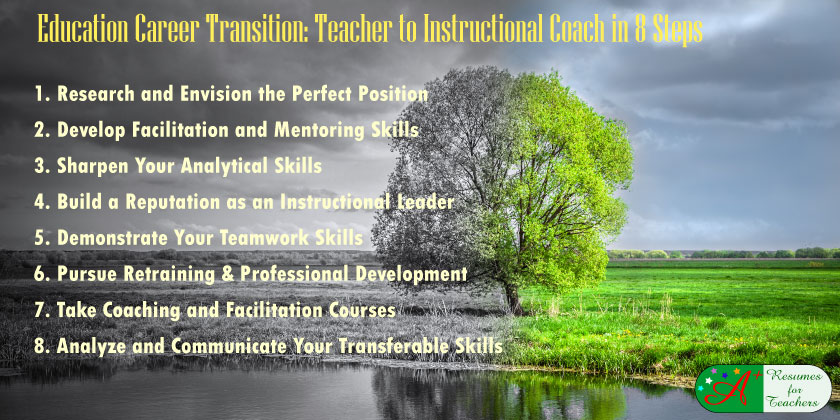
Education Career Transition: Teacher to Instructional Coach in 8 Steps

Are you considering a new career as an instructional coach? Instructional coaching is sweeping through classrooms. An instructional coach works in the classroom, observing how a teacher performs while applying teaching methods, and makes suggestions for dynamic improvements.

Instructional coaching is a form of embedded learning, and it is growing in popularity because it is shown to be highly effective. If you seek a career transition in education, making a move from teacher to instructional coach can reinvigorate your career while applying and sharing your teaching expertise and wisdom.

If you are already in the education field and seeking to bring new life to your career, consider using your teaching expertise to become an instructional coach. Teachers with strong teaching experience and an excellent track record are well qualified to monitor the performance of less experienced teachers and provide feedback on teaching style and techniques.

Administrators, principals, and headteachers who have managed many different teaching programs across various teaching methods have also shown to be adept at instructing teachers in the classroom.

These transitioning educators have an itch to return to an educational environment where they ultimately feel their talent lies. Alternatively, you may be looking to transition back or re-enter teaching.

Instructional coaching’s strength is its focus on bringing evidence-based practices into the classroom. Whether it is a literacy program or a new math teaching application, the instruction method has improved academic performance. Ideally, the coach is an experienced teacher who has successfully applied the teaching techniques she is coaching. She understands its strengths and weaknesses, as well as how different learners’ styles will interact with the instructional method.

8 Tips to Transition from a Teacher to an Instructional Coach Role

For 16 years, I have worked with educators seeking a career change; I guide them on a rewarding, stress-free path to a happy, successful life. We do more than write teacher resumes. We create many other documents and provide interview preparation and career consulting. 

Many of my career-change clients are now meeting the demand for instructional coaches and finding fulfilling careers where they can practically apply their extensive teaching experience. To help you with your own career transition, here are strategies to help you transition from teaching to instructional coaching.

Let’s get started!

1. Research and Envision the Perfect Position

As an instructional coach, you will facilitate the use of evidence-based teaching methods in the classroom by providing direct coaching to the teacher. Your objectives are to improve teaching style and effectiveness, student engagement, and learning to improve academic achievement. Instructional coaches can also play a larger consultancy role.

Initially, you may be required to work closely with headteachers, principals, and superintendents to assess current teaching methods across multiple classrooms, identify areas for improvement, and introduce new teaching methods.

Each school district and school will have its own requirements for an instructional coach, and the job responsibilities can vary greatly. Furthermore, you will be required to work in accordance with state standards and district strategic plans.

Envision how you will look in the role of an instructional coach. Ask yourself, what aspects of the job would I enjoy the most? You could be drawn on more for content expertise than for teaching methods. Ask yourself, am I interested? Qualified? To find out, conduct a career assessment, personality, and skills inventory.

2. Develop Your Facilitation and Mentoring Skills

Beyond your experience working with students, seek opportunities to coach/facilitate professionals who require less direct instruction and more facilitation.

Facilitation has a different connotation from coaching. Coaching includes the man on the sidelines of a soccer game barking commands at team players. Facilitation involves guiding others to be the best version of themselves.

The facilitator provides the support structure, knowledge, tools, and techniques to help a teacher improve her skills. Whenever possible, a good facilitator will provide prompts and direction to help a teacher identify and correct actions, if necessary. The instructional coach encourages teachers to be more reflective and to think critically and analytically.

3. Hone Analytical Skills

Your ultimate success as an instructional coach will come down to the numbers – more specifically, academic performance improvements. Instructional coach objectives will be measured. You will need to demonstrate that you can track and analyze performance and present related data in reports and charts. Evidence-based practices must be followed meticulously, and performance and achievements must be recorded. Individual class and school performance require being in alignment with state and district plans and objectives.

4. Build a Reputation as an Instructional Leader in the School District

The more credibility you have in the teaching community, the more efficient you will be as an instructional coach in the classroom. A trusted and respected teacher produces more positive learning outcomes.  Your classroom teaching record will speak for itself. Take advantage of after-school and community programs to introduce your teaching skills to a wider community.

5. Demonstrate Teamwork Skills

The hotshot coach’s model, getting paid big bucks for delivering superior performance, is rare even in sports. Instructional coaches need to be super collaborators and team players. Working collaboratively with classroom teachers is a critical aspect of the role. You will fail in your coaching endeavor if you undermine the teacher’s competency in front of the students. Implementing new teaching methods requires co-planning with principals, headteachers, and education boards.

Coaching in front of a classroom requires sensitivity and strong human relations skills. Even experienced educators could benefit from exploring how to discover and communicate on-the-job strengths and weaknesses.

6. Pursue Retraining & Professional Development as an Instructional Coach

Returning to school is a fabulous professional learning opportunity to strengthen any weak areas in your new career direction. Professional development or retraining will provide you with a greater understanding of the role and newly fortified skills to perform it. The school may also provide an employment service and help you retain employment in instructional coaching.

7. Take Coaching and Facilitation Courses

The business community is also embracing coaching in higher numbers. Because of this, numerous training programs are now available. Becoming a certified coach and/or facilitator will show that you have the ability to facilitate other teachers. Such special qualifications could get your instructional coach’s letter of interest noticed and your resume prioritized.

8. Analyze Your Transferable Skills to Include in Your Instructional Coach Resume

Establish your resume objective for instructional coaching jobs. What content or instructional areas would you enjoy coaching others in?

Take a close look at your teaching skills and identify those that transfer across different instructional coaching opportunities. Many teachers can provide teaching methods (e.g., guided reading, everyday math) and content areas (e.g., math, science).  You may have expertise in using technology (e.g., SMART Board, iPads, mobile technology) in the classroom to improve learning outcomes. Conduct a skills assessment of what skills and competencies you could offer as an instructional coach.

Developing teacher capacity can be an enriching career for a mid-career educator.

Many educators relish the opportunity to draw on their expertise and wisdom from a career in education to mentor other teachers and help them be more effective in the classroom. Coaching is also a highly transferable skill. Instructional coaching in education could prepare for a third career move, such as a transition from a school teacher to a corporate trainer, or serve as a stepping stone to education administration.

Kickstart your education career transition by reading up on job search strategies for career advancement. Read journals, attend conferences, and join associations in your areas of expertise to gather further knowledge. As an instructional coach, you are similar to an education consultant in many ways and are expected to be an expert in the domain you consult in.

For more information, explore how a career transition coach can help you launch your career change.

Please find out more about Candace Alstad-Davies by reviewing this about me page. From that page, you can review testimonials and frequently asked questions.

Need us to write a top-notch, attention-grabbing instructional coach resume, application letter, LinkedIn profile, philosophy statement, or a curriculum vitae (CV)?

Look no further.

Take the time to review and order one of our resume packages or individual services.

Have questions? Please connect by emailing Candace or calling toll-free at 1-877-738-8052. I would enjoy chatting with you.


Are you ready to craft a powerful curriculum developer resume that lands you the ideal role as a curriculum specialist or coordinator? You’re in the right place!

In this post, you’ll discover expert tips to help you write a standout resume tailored to your dream position in curriculum development.

These in-depth insights will guide you in showcasing your unique skills, experience, and the value you bring to a school district, educational institution, or organization. Let’s turn your resume into a powerful tool that opens doors to exciting career opportunities!

Challenges and Opportunities for Curriculum Specialists

Curriculum developers often feel like they are juggling many areas. They must keep many learning elements active in coordination with other education professionals to deliver practical lessons.

Like music, the curriculum must remain in sync with the school’s educational philosophy while meeting foundational learning goals. Schools always demand teachers and administrators who can fulfill this challenging—yet fundamental—supervisory role.

Your challenge in writing an effective curriculum developer resume is communicating how you dynamically integrate teaching approaches, learning styles, and education materials into engaging classroom lessons that meet learning outcomes. Depending on the school or organization that is hiring, this position can be referred to as an instructional coordinator.

Don’t forget to read and implement teachers’ many cover letter writing tips on this website. The cover letter is essential to make an excellent first impression.

Target Your Curriculum Developer Resume by Including Relevant Skills and Information

Districts and schools look for balanced competencies when assessing job candidates for curriculum development positions. Identify these abilities in your curriculum developer resume by working backward.

So, what does that mean?

First, define what an excellent curriculum includes. The quality and effectiveness of learning are tied to the curriculum and its continuous improvement. Learning as an ongoing development process can only be supported if the curriculum is responsive and adaptive to learning needs.

Therefore, an excellent curriculum must:

Integrate a performance assessment system

Employ feedback mechanisms

Be systematic and also progressive.

Maintain continuity

Uphold quality and specialized areas of content

Present a logical learning process

Reflect the school’s education philosophy

Respond to the individual as well as inclusive classroom learning needs

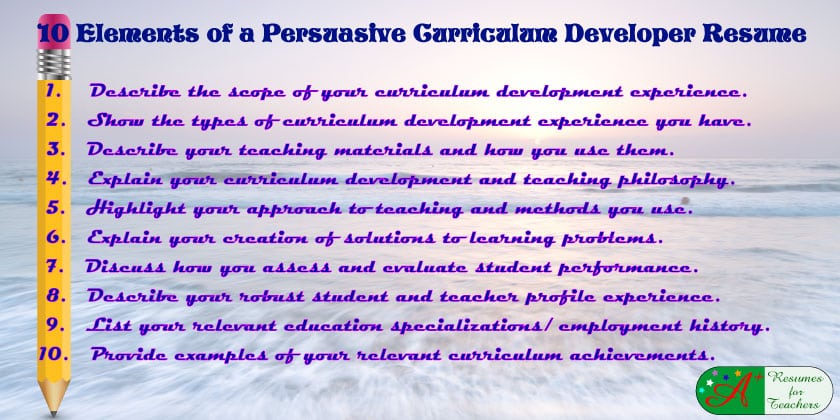
10 Elements of a Persuasive Curriculum Developer Resume

Designing school curricula will involve progressive steps, starting with defining the educational philosophy, reflecting on the education approach, and integrating teaching methods.

1. Describe the scope of your curriculum development experience.

Many teachers can develop lessons that provide an opportunity to show instructional leadership. Communicate how integrating educational goals, learning approaches, and teaching methodologies can help you meet the big-picture learning objectives.

The learning system you develop must be integrated and progressive to adapt to changing learning needs.

Have you developed curricula for a subject, grade, school, or district? If so, note how many students the curriculum covers and their learning profiles. Demonstrate how you can work with district and school guidelines and develop teaching lessons that meet and teach the state standards.

Review this curriculum developer job description on Study.com to determine the position’s requirements.

2. Show the types of curriculum development experience you have.

Most curriculum development integrates different kinds of curricula to meet learning objectives. Was the content-driven curriculum designed for a particular subject and grade?

Student-driven development considers the students’ strengths and weaknesses, learning styles, and challenges. The purpose-driven curriculum targets specific learning problems. For example, a class may have lower-than-average math scores or special education needs.

Include your curriculum development experience in the core competencies or areas of knowledge section. This resume section follows the profile at the top of a curriculum developer’s resume.

Examples of areas of expertise or knowledge may include:

Curriculum Design

Lesson Development

Performance Assessment

Developmentally Appropriate Content

Differentiated Instruction

Learner-focused

Special Education

Student Enrichment

Remediation

Find more resume keyword examples to include when writing a teacher’s resume or CV.

3. Describe your teaching materials and how you use them.

A linear curriculum typically involves following a textbook. The multi-dimensional curricula more commonly used in today’s classroom could include books, videos, apps, and the internet. The text may or may not dictate the sequence of lessons. Material assembly often requires considerable coordination across, for example, district materials used (e.g., a popular math app), the teacher’s preferred material, and new technology.

The most effective curriculum specialist resumes include examples as evidence and proof of knowledge and experience.

Show how your choice and use of learning materials add value. Are you on top of technological educational changes—one of the most significant challenges for curriculum developers? You will show your deal to a school district if you demonstrate how you have improved learning outcomes by integrating innovative technology into the curriculum.

Following are some online teacher educational resources I use to gain ideas and inspiration for teaching materials.

4. Explain your curriculum development and teaching philosophy.

Your teaching philosophy will substantially impact the direction of the curriculum you develop and is of prime importance to a district or school.

Unlike your education philosophy statement, your view toward curriculum development should be less personal. A 600-700 word summary of your teaching philosophy may be submitted with your resume and cover letter.

It should mention the teaching approaches, methods, and styles you employ. How you define the process of learning and learning solutions is relevant. Review education philosophy writing tips to ensure you have included vital points.

5. Highlight your approach to teaching and the methods you use.

The district will want to know if you have experience in the teaching strategies and methods it uses or plans to use in the future.

Your teaching approach and style are a foundation of curriculum development, and you will design your lesson plans and materials. To connect with schools, list specific teaching methods or techniques such as class participation, demonstrating, inquiry-based learning, cooperative learning, direct instruction, differentiated instruction, learner-focused, class action research, debriefing, and peer-to-peer learning.

6. Explain your creation of solutions to learning problems.

A leading curriculum specialist solves learning problems while responding to learning styles, strengths, and weaknesses. As always, examples of learning problems and how you solved them are far more influential than a blank.

Problem identification is part of the performance assessment process. An example demonstrating the integrated approach of continuous curriculum development, student performance and success assessment, problem identification, and solution development will establish an integrated, progressive system with a working feedback system.

This may include remediation solutions for learners falling behind and enrichment for those ready to move ahead of the rest of the class.

7. Discuss how you assess and evaluate student performance.

Influential curriculum developers change school curricula when necessary. Integral to this continuous improvement process is a performance assessment system that identifies learning issues.

The effectiveness of the performance evaluation system will determine how responsive the curriculum is to learning needs.

Curriculum developers should show a capacity to use self-reflection and evaluation in education.

Provide examples in your resume to show knowledge of curriculum design.

Show how the performance system is aligned with the curriculum.

Demonstrate mastery of learning assessments – foundational knowledge, core competencies, task performance, and real-world problems.

Research the methods used by the school district and, if applicable, use their concepts, such as balanced and authentic assessments. The more you tailor your curriculum developer resume, the easier it will be for the school community to match their needs with your skills and abilities.

8. Describe your robust student and teacher profile experience.

Mainstream students have different learning needs than special education students. Most curriculum specialists or developers today need to show the ability to develop a curriculum for the inclusive classroom involving a diverse set of learning styles and interventions (e.g., remediation, enrichment). Teacher experience and specialization should showcase your strength in curriculum development.

9. List all of your relevant education specializations and employment.

Curriculum developers come from many different backgrounds. Opportunities exist to transition into and out of education. A developer of corporate training programs may be seeking to transition to teaching. Many possibilities exist in ESL curriculum development or other areas of education.

A fast-growing ESL market overseas can allow you to gain experience. Another high-growth area is curriculum development for technical training. List any areas you specialize in – science, technology, environment, math, online instruction, music, or physical education.

10. Provide examples of your relevant curriculum achievements.

Curriculum developers competing for jobs could use the same terms to describe teaching and assessment approaches and methods. You can distinguish yourself by providing examples.

Performance metrics, in particular, are influential in a resume or cover letter.

Describe how much you improved learning outcomes.

Have you introduced new teaching methodologies or innovative uses of technology?

How did they affect student performance?

Curriculum developers have many transferable skills and are often in demand in education and other sectors. If you want to work as an independent contractor, see how to write an education consultant resume and market yourself.

If you are a teacher wishing to transition to a curriculum specialist position, your cover letter and resume should communicate your qualifications, related experience, and passion. Remember, as a curriculum developer, you will have many projects simultaneously. Broad teaching knowledge is an asset and should be communicated in your curriculum developer resume.

To demonstrate your mastery of primary teaching methods, take workshops related to them. Become a performance assessment specialist. To gain experience, take volunteer positions in curriculum development. Develop the curriculum for your summer camp or daycare program. Another idea is to take an entry-level position in the ESL job market.

Explore our expertly crafted resume and cover letter samples to spark inspiration and discover unique ways to make your curriculum specialist application stand out.

Need help creating a compelling and attention-grabbing resume, CV, or cover letter for a curriculum developer role? We’ve got you covered!

Take a moment to browse our tailored resume packages and individual services — designed to highlight your strengths and help you land your dream position.

Curious about who’s behind the magic? Visit our About Me page to learn more about Candace Alstad-Davies. There, you’ll also find glowing client testimonials and answers to frequently asked questions.

Do you have questions or need a little guidance? I’d be delighted to help! Reach out to Candace directly at candoco@telus.net or call her at 780-513-0010. If you’re calling from North America, please use our toll-free number: 1-877-738-8052.

Let’s connect and take the next step in your career journey together!


Teacher Assistant Resume Writing Tips – Sample Accomplishments and Keywords

Try these teacher assistant resume writing tips and steps to land a job interview quicker. If you secure an interview and job offer, you can look forward to your first day as a teacher’s aide or paraprofessional.

As an educational assistant, do you visualize the classroom’s physical appearance?

Imagine the fresh, eager faces who will eagerly be awaiting your assistance and the teacher-mentor who will guide you in your first months in your teaching support career.

If you do not yet have a list of your ideal classroom, I recommend making one before writing your resume. Once you have a clear picture of what you want in a teaching assistant position, it will be easier to write a resume targeting your desired position. Don’t forget the importance of writing a new teacher cover letter for your application.

I have the following tips for writing your teaching assistant resume and landing an interview.

One Teacher Assistant Resume Writing Tip is to Include the Correct Keywords

Before you write your teacher assistant resume, consider listing teaching keywords and skills to include in your resume and cover letter. Keywords are like magnets in an educational assistant’s resume and are top resume writing tips.

Incorporating the right keywords will serve several essential functions, including helping you to:

  • Match your resume with the right open teacher’s aide positions. Hiring managers will search their database of resumes to find teacher’s assistants or education aides. Interview screeners may also type in ‘teacher’s aide’,’ education assistant’, ‘instructional assistant’ or ‘paraprofessional.’
  • Distinguish yourself from other teacher assistant applicants. Choose the words you use in your resume carefully. One mistake teachers who write their resumes make is using the same old-fashioned terminology in the work experience section. They write the description of their job and don’t include searchable keywords or phrases.

Below, we will discuss how to back up your keywords with evidence.

Here is a sample list of keywords for teacher assistants. Of course, as you write your teacher’s resume and cover letter, new words will flourish.

Incorporate Relevant Titles/Positions, If Possible

First and foremost, the position(s) you are targeting should be sprinkled throughout your resume and other job search documents:

  • Teacher’s Assistant (TA)
  • Teacher’s Aide
  • Educational Assistant
  • Paraprofessional

Only include words that align with your teaching skills, abilities, education, and work experience. Other titles or areas you wish to assist in teaching could include daycare teacher, part-time instructor, preschool teaching career, infant room leader, and counselor.

Search teacher assistant employment ads and find the most common job titles. It may suffice to use ‘teacher’s assistant’ with a few mentions of ‘teacher’s aide.’ Let the education job market inform your keyword choice.

Citing Grade and Subject Area

Cite the grade level and subject you are interested in teaching. Several choices may include:

  • Elementary
  • K-12
  • High School
  • Middle School
  • Secondary
  • Special Education
  • Science
  • Music
  • Physical Education
  • Resource Rooms
  • Day Care Programs
  • Head Start Programs
  • Private Educational Support Programs
  • Early Intervention Programs

Include Special Certifications/Training

If you have obtained or plan to get special certifications in any of these areas, be sure to mention them:

  • Cognitive Behavioral Therapy (CBT)
  • Therapeutic Crisis Intervention (TCI)
  • Early Childhood Education (ECE)
  • Subject Area Specialization: Art, Science, Physical Education, Math

Cognitive Behavioral Therapy is in high demand. You may also come up in a separate search for autism teaching assistants, therapists, or CBT assistants. In this case, you may want to mention CBT several times in your resume and cover letter.

What is Your Teaching Approach

The school will want to know about your educational philosophy (here is a teacher belief statement example) and teaching methods.

Don’t miss listing any classes and, workshops, and certifications in areas such as:

  • Differentiated Instruction
    Student-Centered Learning
    Peer-to-Peer Learning
    Project-Based Learning
    Reality and Real World Pedagogy
    Incorporate Your Top Teaching Skills (Soft)

While reviewing teacher aide or assistant job ads, note what qualities they seek in a teaching assistant.

In-demand skills can be identified by examining current job ads for educational assistant teachers:

  • Team player
  • Cooperative
  • Organized
  • Empathetic
  • Independent
  • Adaptable
  • Caring/Compassionate
  • Verbal and Written Communication Skills
  • Punctual

Our teaching skill tips for career switchers are also helpful to those seeking teaching assistant resume writing tips. They can benefit anyone seeking entry-level teaching positions.

Don’t Forget to Include Teaching Skills (Hard)

Hard skills are critical in education beyond simple computer and audiovisual skills. Today’s classroom uses many unique learning programs and methods. There is an abundance – be sure to list the following:

  • Learning programs (math, reading literacy, and so on)
  • Learning apps
  • Technology

Research the school and district in advance and see what tools they use in the classroom. Getting an interview is about matching your skills with those needed by the school where you wish to secure employment. Tailoring your resume, cover letter, accomplishments, and keywords to meet the school’s needs and requirements could require adjusting your resume, cover letter, and keywords for each job.

Another Important Teacher Assistant Resume Writing Tip

Uncover and Communicate Transferable Skills (Hard)

Transferable skills are among your best assets when applying for entry-level teacher assistant positions. You can facilitate and simplify entering a career in education with transferable skills. Here are examples of transferable skills you may have used in your personal, professional, and volunteer life:

  • Tutor
  • Counselor
  • Coordinator
  • Instructor
  • Lecturer
  • Guide
  • Organizer

Review resume keywords to include in your resume to ensure you match your prospective employers’ teaching needs.

Present Accomplishments in Your Teacher Assistant Resume to Communicate Evidence of Expertise

The hiring manager reads many resumes with the same teaching skills listed repeatedly. How can you stand out from the other teaching assistants in the job applicant pool? The key is to back up your claims with evidence.

Evidence may include:

Examples of Accomplishments for a Teacher’s Assistant

These sample teacher’s aide or assistant achievements provide examples of both positions held and programs used.

As a reading, literacy instructor-led reading circles at summer camps and tutored elementary-level students after school.

  • We have integrated many reading programs into lessons, including Success for All, Peer-Assisted Learning Strategies (PALS), and the leading elementary-level reading apps.
  • We implemented Applied Behavior Analysis to teach a non-verbal student how to navigate an augmentative communication device when asked questions.
  • Utilized various informal and formal assessment strategies to analyze student readiness, determine student progress, and effectively adapt instruction to meet and exceed State Standards.
  • She collaborated with librarians to develop an after-school reading club, which grew by 15% each semester.
  • Tutored below-grade students in math and successfully integrated them into inclusive classroom math lessons.
  • Helped students develop a reward and peer support system using social media to increase class attendance and assignment completion.
  • Established outdoor science program focused on learning about the natural world through inquiry methods.

Incorporate Quantitative Results in Accomplishments

Use complex numbers, the most powerful evidence you can present whenever possible.

  • In conjunction with the teacher, I increased elementary-level reading scores by 10 percent in an inclusive classroom of typically developing and exceptional education learners in the first semester.
  • Boosted class participation by 20 percent and punctuality to 98 percent by empowering students through student-focused learning.
  • Received top marks on teacher evaluations with distinction for lesson ease of use and performance assessments.
    Teacher Assistant Resume Summary/Profile

Last but far from least important is the teacher assistant’s resume profile or summary. I often recommend writing the resume summary after assembling your list of keywords and accomplishments. This process helps you prioritize what to emphasize in your resume profile.

The reader will first see the title of your resume summary. These keywords are super influential as they will be the first to appear in a job search. Do not hesitate to change them to suit the desired teaching assistant job position.

Teaching Assistant

Elementary School – Special Education – Cognitive Behavioral Therapy

Those four terms have captured three of the most in-demand positions in teaching.

Now, you are ready to write a teaching assistant resume summary. Here, too, job ads come in handy.

Ask yourself, does my resume profile reflect the teacher assistant position profiles in the job ads? Have I highlighted the skills and qualities they are seeking in this position?

Review tips on how to write a compelling resume profile.

Note how the writer has included substantial evidence of her teaching ability in this teacher assistant resume example.

“Commended for excellence in innovation, creativity, organization, and proactive talents.”

Provide impressive evidence of your teaching ability by placing a quote praising teaching performance from a school district below the profile summary.

If available, hard numbers are often listed in bulleted accomplishments in a resume. Sneak in evidential information, like the above skills summary, to make your resume stand out from other applicants.

Need some educational resume writing help making a stellar resume, cover letter, or CV curriculum vitae? Take the time to review and order one of our resume packages or individual services.

Learn more about Candace Alstad-Davies; from that page, you can review testimonials and frequently asked questions.

If you have questions, please connect by sending an email to Candace or call toll-free at 1 877 738-8052.

I would enjoy chatting with you and helping to move your educational career forward.

10 School Teacher Resume Writing Tips to Ensure You Show Your Value

School teacher resume writing tips to help you land teaching job interviews and job offers. The resume you include in your job application represents you in your absence. Don’t underestimate the importance of writing a resume to target the new position you have your heart set on. Whether you target a primary, middle school, or high school teaching position, you must have a powerful resume.

Ensure the resume you submit for the school teaching job you wish to secure communicates your top teaching skills and success stories to prove you have those core competencies.

Let’s get started. 

Resume Tips for School Teachers to Elevate Job Offers

1. Make sure your resume for a school teacher makes YOU stand out.

Even though it may seem like you are selling your teacher’s resume and cover letter first, you are selling yourself first and foremost. Your resume must look appealing; you must ensure you come across as a desirable candidate.

While developing an attractive design, ensure that you include all pertinent information, for instance, education, credentials, work experience, professional development, etc. Assess the school district’s job advertisement, if available, and ensure you have touched on all required qualifications in your cover letter.

2. Highlight the job position you are applying for or your field of interest.

 
Immediately following your contact information should be the job title you are targeting. Make it more significant than the rest of your text; treat it as you would a heading – bigger and bolder. For example, you may write Teacher Assistant, Teacher Aide, Science Teacher, High School Teacher, Elementary Principal, Professional Educator, or Adjunct Business Instructor. By doing so, you immediately draw focus to the position in question and leave the hiring manager with a clear idea of which part is of most interest. Tailor this to each job posting if needed.

3. Implement an area of expertise or core competencies section.

This area of knowledge section is crucial and, if written correctly, will set you apart from the competition. Focus on relevant and essential teaching skills needed to succeed in the job you are applying for and, of course, excel at using them.

Concentrate primarily on tangible or technical skills, i.e., competencies required for job performance. These skills could include classroom management, student motivation, parental communications, differentiated instruction, reading strategies, digital skills, etc.

Examine soft skills such as problem-solving, organization, time management, relationship management, and self-reflection. List your qualities in a chart or bullet point format to make them stand out from the rest of your text.

4. Craft a well-written body that explores your work experience.

Use headings for Professional Experience, Teaching History, Work Experience, Teaching Contributions, Relevant Experience, Business Experience, etc.

This section is where you will list the places you worked, as well as the location, dates employed, and your job title. Make sure those items are bolded or one font size higher to make them stand out and reflect their significance.

After, you will lay out your job responsibilities concisely and matter-of-factly. Usually, this would be organized chronologically, from newest to oldest. The organization of your teacher’s resume will depend on your background. If you are a career change or re-entering the education sector, you may need to bring the prior relevant experience up front and center.

5. Highlight accomplishments.

One of the top school teacher resume writing tips is to showcase your relevant achievements. Immediately following your job responsibilities, think of a few key accomplishments that stand out in your mind that you can adequately articulate in your resume.

An example would include increasing student grade point average, reducing absenteeism, securing a grant, increasing the grade level of a few at-risk students, etc., depending on the position you are targeting.

Regardless of the achievement, make sure you explain how you accomplished it. List these in bullet point format to set them apart from the rest of your duties. Try to find at least a couple of achievements for each position.

Learning how to write an application letter for a teaching job in a school will make all the difference in your job search. Share on X

6. List your most significant strengths that show your expertise relevant to the position.

Analyze the job advertisement, if available, and see how the specified requirements correlate with the strengths you have demonstrated in a previous position. Perhaps you excel at collaborating to assess a situation and devise an appropriate reaction or solution.

Maybe you are great at interacting with parents and working with them to meet student’s unique needs. On the other hand, you may be proficient in differentiated instruction to ensure you reach all learners to optimize learning outcomes.

7. Keep your writing compelling and concise.

Succinct your writing for both of your job application documents. You do not want to drag on when explaining your job responsibilities. Keep everything brief and to the point.

If your experience is in the same industry as the job you are applying for, then the hiring manager should know what each job entails. The same goes for the introductory paragraph of your resume. One section or half a dozen or so bullet points should be enough to capture you as a professional.

8. Include anything relevant and discover your transferable skills.

When writing your resume, remember anything you have done (paid work, volunteer experience, additional education) that pertains to your desired position. Transferable skills are qualities you have developed in one job that directly correlate with or will help you perform the targeted position’s responsibilities.

If you are a career changer, assessing your transferable skills is crucial! Evaluate your communication, interpersonal, time management, leadership skills, and anything else you think may give you an advantage.

9. Sell yourself immediately.

Since most school districts have many resumes to sift through, they can’t devote their time to reading every one of them to the fullest extent. For this reason, it is paramount that you sell yourself right away, in 10 – 12 seconds. When you feel ready to submit your documents, take 15 seconds to scan them and ask, “Would I hire myself?” If the answer is “no,” you need to stand out more.

10. Hire A+ Resumes for Teachers – of course, us. 🙂

Let us create a resume and cover letter to skyrocket interviews. You may think, “Why should I invest in having someone else write my teacher resume and cover letter?” But what if that professionally written resume lands you your dream job?

Please don’t take the chance of submitting a sub-par document only to have it ignored and leave you with a lost opportunity. If you are 100% confident in your documents, send them immediately.

If you are not entirely satisfied with your abilities after reading these ten tips or don’t have time to create the resume you need, don’t hesitate to contact Candace Alstad – Davies. She is the Founder of A+ Resumes for Teachers – and has specialized in educators’ job search marketing documents and career coaching for 23+ years.

Or you can do it yourself by instantly downloading our eBook for $19.95 by clicking the link below

91 More School Teacher Resume Writing Tips and Resume Templates

Be honest with yourself by asking these questions:

  • Have you been procrastinating on writing your resume?
  • Are you strapped for time and don’t want to miss deadlines?
  • Are you happy with the job search documents you have?
  • Do your resume and other written materials communicate the VALUE you can bring to a school district and its students?
  • Are you a better educator than your resume and cover letter depict?
  • Are you getting calls for interviews?

I hope you found these educational resume-writing tips valuable. Please share this post with your friends, colleagues, and social media connections. 

Your resume, cover letter, and LinkedIn profile are the only thing representing you in your absence. Make sure they do the JOB they are supposed to – that being – to get interviews!

Do you have time to research what makes an impressive resume? If you answered no, then reach out to get resume writing help.


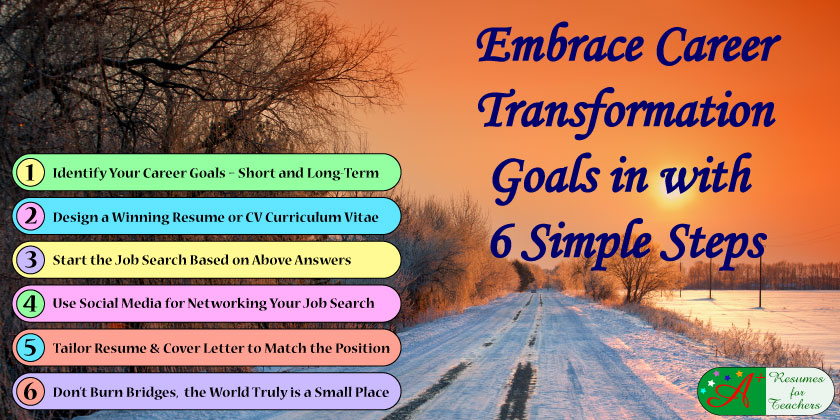
Embrace Career Transformation Goals with 6 Simple Steps

Did anyone have time to reach their career transformation goals in 2026? 

It’s time to look forward to 2026, and I hope the future has something good in store for us!

Start the New Year Off With a Bang! 

Write Down Your Career Transformation Goals to Make 2026 a Smokin’ Hot Success

Entering into a new year is usually a time to reflect on our past personal and career accomplishments and future goals. It is the chance to work on ourselves as individuals, hence why we set New Year’s Resolutions.

Take a moment to pause and reflect on your current status.

Are you unhappy with your job?

What things would you change if you could?

Are you meeting your full career potential?

Do you enjoy your job?

Would you like to advance in your career?

Do you need to rejuvenate your career in education?

Recognizing job dissatisfaction will help you determine the steps you need to take to advance your career.

Making a career-related resolution is simply setting a goal.


Discover the secret recipe is to ensure your goals are achievable and within reach. Stop stalling and take control of your career!

Below are six steps to help transform and enhance your career.

1. Identify Your Career Goals – Short and Long-Term

Do you have a particular position, promotion, or career in mind? If so, that’s fantastic! You’re already one step ahead of the game. However, if you’re still indecisive about the professional path you should choose, it’s time to take action and make a choice – or at least test out the waters. Review education career trends to help teachers and other educators understand which jobs will be in demand.

It’s okay to switch careers! Go ahead and test the waters.

It used to be that once you landed a job, you were stuck with it. Times have changed, though.

There is nothing wrong with moving to a different company, district, or position.

Maybe you have thought about moving from teaching to administration. This is a common career transition.

Don’t let anything or anybody hold you back from pursuing a career you want.

If you are uncertain where you would best fit professionally, analyze the traits you possess or the issues that matter to you.

• Skills
• Education
• Career Experience
• Interests
• Personality
• Goals
• Financial Needs
• Age / Retirement Goals

Speaking with a Career Coach would be wise if you are still uncertain about what field to enter or change.

Find out more about me – Candace Alstad – Davies – career coach.


It’s the perfect time of the year for a career transformation to get your life back on track and living the life you always wanted.

2. Design a Winning Resume or CV Curriculum Vitae

After identifying the positions you wish to focus on, it’s time to prepare your resume! You might be asking, “Why would I create my resume before I’ve found a position to apply for?” It is better to be prepared than not. What if you find the ideal job posting but discover it closes within a few hours?

If you don’t have your resume ready, you could miss out on an opportunity of a lifetime. Furthermore, the busy hiring season will be upon us in no time – take this opportunity to get ahead of the game and the competition for jobs.

When developing your initial resume, keep it relatively generic and versatile. Tailor it toward the field of interest. For instance, if you want to teach Junior High Science but are willing to take a position in a different grade level or subject matter, you will want to create an education-based resume.

Or maybe you are ready to embark on a career in higher education and need to write a CV targeting an adjunct college professor position.

Focus on your related job responsibilities and accomplishments, regardless of the age or topic you taught. You can refine your job application documents when you have a specific posting in front of you.

Once you have built a winning resume, you will want to write a generic cover letter to accompany it. Submitting a general cover letter is typically not advisable, but it is better to submit this than nothing if you are in a time crunch. Again, when you find the job posting you wish to apply to, it is time to tweak it to match the needs and goals of the school district or company in question.

Another bonus of designing a resume ahead of time is identifying your unique skills and talents and selling yourself as a potential job candidate. Completing a resume can help you with the job search and identify areas of interest that require your expertise.

3. Start the Job Search

You have a job in mind, and your resume is ready. Let the career transformation begin!

It’s always easier to set and accomplish goals by writing down the steps you will take to reach each stage.

This is a fantastic stage to let your imagination run wild and work toward transforming your career. If you do not need a new job but wish to try something new, you can take your time finding something that is just right for you. However, if you are unemployed, you will want to get on the job hunt immediately! Search often, as organizations are constantly updating their job boards.

The Internet is one of the best ways to broaden your job search. Websites such as Monster.com, Workopolis, Indeed, CareerBuilder, and others let you search by location, job type, and more. Other sites are region- and career-specific, tailored to your unique needs.

When browsing job ads, look for requirements and Assets (if applicable) that are within reach. Find postings that match your credentials and desires as much as possible. Do not exclude a job posting because you do not meet all or most of the criteria – there is no harm in applying.

On the other hand, don’t submit a resume to any and every job you come across – be selective, as you don’t want to waste the potential employer’s time or your time.

4. Use Social Media for Networking

Another method to employ during your 2026 career transformation is social networking. Using social media is the most efficient way to conduct your professional networking. The goal is to establish an active group of professional contacts who can vouch for your skill sets and help you land a new position.

LinkedIn is a website that lets you connect with others in your field, post your resume and credentials, and attract the attention of prospective employers. The key to using LinkedIn to its full potential is establishing an engaging, searchable LinkedIn profile right from day one. Like in an academic resume or CV, you want your educational experience, credentials, skills, and relevant accomplishments to shine on your profile page.

List your education, current/prior jobs and responsibilities, career achievements, professional affiliations, areas of expertise, and relevant skill sets. You can also use this website to communicate with others, solicit information regarding potential job openings, and learn more about how people have succeeded in your chosen field.

The key to using social media for networking is to be active, engage others, and use it regularly.

5. Tailor Resume and Application Letter to Match the Position

Once you have found the job posting(s) you wish to apply to, you need to tailor your resume and cover letter to the desired position and the organization’s unique needs and goals. Part of your career transformation is to ensure your documents speak to the reader. Reach out, grab the reader’s attention, and demonstrate a true asset you will be to the organization.

The best way to get a handle on modifying your documents is to look at the company or the school district’s website. Researching the school district is an essential component of a successful job search.

For instance, the school district should list its mission statement, student population, and goals for the upcoming school year. Use these valuable pieces of information to pique the reader’s interest while addressing their needs. Adjust your job responsibilities, professional accomplishments, and skill set on your resume to highlight your suitability for the position.

Tailoring your cover letter to meet the school or organization’s needs will increase your chances of getting an interview.

6. Don’t Burn Bridges

After you have landed a brand-new job in 2026, leave your old job on a positive note. Regardless of how you feel about your former position – good or bad – make sure you don’t burn bridges. Never speak ill of former employers or companies, as you never know when you may see them again. The world is also small, and you can’t be sure who’s friends with whom.

Keep your relationships professional and positive at all times, and you should not have to worry about this coming back to bite you later.

Be the career transformation rock star you were meant to be. 2026 is your year.

Don’t become stuck in the same career rut as last year. Act now, regardless of the new path you wish to take.

Don’t let your life or prospective career opportunities pass you by!

Email me (Candace) or call toll-free at 1-877-738-8052.

Are you looking to transform your career?

I can help with all your career needs. You can review our resume and coaching services. 


How to Test a Second Career Option Without Jeopardizing Your Job

Are there any second career choices you have always wanted to pursue? If so, seriously examine each of them. Testing the waters confidently and secretively to determine if a second career in an entirely different position or sector is common.

Whether your career interests you in education or the business sector, it’s time to reflect on 2023 and determine if a career move in 2024 sounds exciting.

Have you ever thought you would like to try a different career?

Only to stop yourself because your career focus has never been in that direction?

You aren’t alone.

Going after a second career in education or outside of education can be a huge decision. You may find out you need to refresh your career in education with a different role.

Approach this potential career dream by staying safe BUT still applying for positions in the area of interest to see what career opportunities appear.

Secure a Second Career Before Leaving Your Current Job

If you have one, keep your current position and target your resume and application letter toward the desired role. Make sure you show your passion in your cover letter. Submit your documents and see where your job search takes you. Career opportunity doors will open, and you will scrutinize the job leads and offers.

Remarkable surprises and big dreams happen with a single step.

Prepare for Resume Rewrites

Having a targeted resume and application letter is your first step?

A second correctly formatted resume is vital to success if you wish to target multiple career directions to see where the opportunities arise.

If you need to apply to more than one job area or industry, then writing a second objective resume will be crucial to your job search. A second resume will help you effectively target multiple career directions to optimize job interviews, thus job search results.

This type of adaptable CV or resume will allow you to quickly reply to job postings, regardless of the job target. A resume should always be tailored to fit the position you are applying for – a second objective resume facilitates exactly this.

Examples of Adjusting Job Search Documents

For instance, if you are an elementary teacher who wants to pursue corporate training opportunities, you can have one resume for each job target. Therefore, if you are considering applying for positions in completely different fields, a second objective resume is essential.

Another example is when you are teaching and are interested in transitioning into an educational leadership position. Make sure you have two resumes and cover letters. Targeting positions using the correct resume keywords and relevant skills and accomplishments gets results.

There are many reasons why a person might wish to apply to multiple career opportunities, some of which may have entirely different or somewhat similar career focuses.

Reasons for a Second Target – Objective Resume

  • Diverse educational background
  • Differing personal and professional career interests
  • An already extensive list of prior positions
  • Transferable skills
  • Change in careers
  • Looking for a new challenge
  • Recent graduate
  • Uncertainty about which career path to take

If one of the reasons above applies to you, you must write a 2nd objective resume. For instance, perhaps you have spent the past 16+ years in the corporate world but now find the challenge lacking and are looking to make a more significant impact on society by educating others.

As such, you have chosen to enter the field of education. However, you are not sure if your credentials and experience will be enough to land you a job, so you would like to hedge your bets and still apply for positions within the business world. The best course of action for you would be creating multiple resumes.

Have a Second Career Resume Ready

Don’t let last-minute job applications stop you from creating a second objective resume.

Perhaps you have come across the ideal job posting at the last minute. Are you prepared to apply to it with a quality resume? Your resume should not be generic but, as mentioned above, should be written to fit the particular job that is of current interest.

If you have already developed a second objective resume, your document should need little editing, thus making applying relatively simple. If you have already created a second objective resume, it is easy enough to repeat the process repeatedly as you find different job openings in your other job targets.

After you have completed your first resume – and proofread it several times – it is time to start on your second objective resume. The introductory paragraph and your expertise section should be tailored to fit your second career choice. The order in which you place your accomplishments, work experiences, and even your education should also reflect your career choice.

I posted an article specific to tailoring your teaching cover letter to the school district’s needs. Allocating time to target your application letter and resume will increase your chances of landing an interview. When the letter reaches the decision-maker’s desk, it will communicate you are an expert.

Result: They picked up the phone and called to request an interview!

So, what exactly is a second resume focus?

A second focus uses your first top-notch resume, skills, talents, and experience and morphs them into a document to use for a different career opportunity. Your key and stand-out qualities and credentials should be present in your resume, regardless of the job posting. Distinct features and experiences must be highlighted and brought to the forefront of your resume to capture the reader’s attention to the particular position they have available.

Different features and experiences must be highlighted and brought to the forefront of your alternative career resume to capture the reader’s attention and secure an interview for their available position.

For instance, with a teaching resume, all teaching-related experience and skills should be highlighted. In a corporate-targeted resume, the teaching-related skills would be moved behind anything related to the business world. A transition I have seen increasing is transiting from

A career transition I have seen increasing is transitioning from teaching to corporate training.

On the flip side, I have witnessed numerous clients switch from business to teaching. Ask yourself questions before deciding if this career option is viable.

How to Create a Second Objective Resume

If you know you will be targeting two different career areas; you will need to work on two different resume versions. Start by making a list of your education and credentials, job experiences, areas of expertise, soft and hard skills, community involvement, professional development, and so forth.

Next, organize them into a comprehensive job application document that is easy to read, catches the reader’s eye, and effectively communicates vital information. When putting together the document, always keep your job target in mind.

When writing your introductory paragraph at the top of your resume, keep one career focus in mind – the same goes for the section dedicated to your expertise areas. Generate the reader’s interest by listing relevant accomplishments first under each job title.

You can repeat this process multiple times if you have several different job targets. Even if you have different job targets within a particular profession, such as elementary teaching and science teaching, you should have different resumes specifically targeting each position.

Writing targeted job search documents will increase your chances of landing interviews. When the recipient glances at your resume for the first time, it must show you know your career direction. It’s imperative to show that you are qualified and passionate about your specific job target. This will show that you can meet the needs of the school district or organization.

If you are writing a resume and cover letter specific to a new teacher, consider reading other posts I wrote about first-year teacher resume writing tips or smokin’ hot hacks for writing a beginning teacher resume with no experience.

Additional cover letters are also necessary, sometimes referred to as focused or targeted cover letters. Brush up on writing your letter by reading and implementing effective job application writing tips to make your application stand out.

When developing a refocused resume, write a cover letter to accompany it. Always refrain from submitting a generic cover letter—they are not effective. So, once again, tailor your documents accordingly! A second objective cover letter can be created using the methods mentioned for resumes.

You will want to highlight your key skills, talents, education, work experience, and other pertinent credentials as they apply for the job. The skills and abilities you want to draw the reader’s eye should be chosen based on the position of interest. When discussing your greatest strength(s), mention qualities that a hiring manager will find relevant and crucial.

If your biggest strength has nothing to do with the job you are applying for, do not waste this precious space on it. Change your cover letter to fit each resume accordingly.

If you transfer from teaching to an administrator role, it doesn’t have to be stressful or difficult if you approach it correctly and positively.

Organizing your job search will save you time and frustration. Don’t underestimate this critical step to landing a new position.

Always start with a targeted, relevant resume and cover letter that shows the reader you are ready and capable of an educational leadership role such as assistant principal or school principal. If you start with an unfocused, mediocre resume and cover letter, your job search will drag on and on – don’t let that happen to you.

Finally, when submitting your job documents, ensure that the resume and cover letter match one another in formatting and the job posting or description! If you follow these guidelines, you will be off to a great start in finding your next position, regardless of your chosen job target.

Whether your dreams are “big” or “small,” you should give it your all to make them come true!

Do not let anyone stop you from achieving your goals, especially yourself. Moving on to a second career, especially if you are taking a decrease in pay, may seem beyond crazy to some people.

That is fine. Let them think you are crazy. 

Too often, you will find individuals, whether friends, family, or co-workers, who quickly diminish your hopes and dreams. Many times, it’s because they are jealous or have been unable to realize their dreams.

Push these naysayers and negative attitudes aside and focus on the positive.

Need information on writing a letter of resignation?

I like discovering and using positive mantras to keep me going and push through the tough times. 

Need help to write a winning resume, navigate your job search, improve your interview performance, or develop a career strategy?

Contact me (Candace) via email or call toll-free at 1 877-738-8052, or you can visit our resume and coaching services. If you call or connect via live chat or email, you will always get me – no one else. 🙂

Wander over to the About Me page to learn more about Candace.