5 Ways to Rejuvenate Your Education Career to Love Life

Are you still in love with your education career, or have you found it’s starting to take its toll on you? Unfortunately, if you are stuck in a job or a career path you dislike or one that has lost its luster, you may discover a ripple effect in your personal life.

Discontentment in the academic workplace may cause a depressed feeling at home, a lack of enthusiasm for activities you once loved, and even distance yourself from friends and family members.

As well, disinterest and dissatisfaction in your education career can cause added stress, not only on the job but in all areas of your life. In short, if you are suffering from work dissatisfaction, it’s important to figure out how to revitalize your academic career as quickly as possible to improve your overall wellbeing in all aspects of your life.

If you are in a slump, it’s time to revitalize your education career and become the happy and productive person you once were!

Get The Zest Back in Your Education Career and Improve Your Life With These Strategies

1. Take a personal inventory.

Are you living up to your potential at work? Are you bored and looking for a new challenge? Is it time to ask for more responsibilities and analyze your educational leadership skills? I’m serious. Taking on new tasks can be a positive and rewarding challenge. This change may re-energize you about your education career while impressing your boss.

2. Set new challenging goals.

As mentioned above, if you feel you aren’t living up to your full potential, it’s time to set some new goals. Regardless of how big or small, achieving goals is a great way to motivate yourself and boost your confidence.

3. Learn something new.

When you have some spare time during your day, take a moment to uncover new information about the company or district or pick up a new professional skill. Apply this concept to your home life! Then you can use your new skills to take on new challenges in your position, which could lead to greater job satisfaction.

4. Develop better relationships in the workplace.

Sometimes collaborating and communicating with others will make you feel good about yourself and your job again. Friends in the workplace! A little social time while at work and a lunch break or after-work socializing can do wonders for a person’s self-esteem, happiness, and stress level. People can make or break a work environment, so do what you can to cultivate strong working relationships.

5. Analyze your education career choice.

Are you doing your dream job or on the right path to achieve your dream position? Is there a different career you would rather pursue? It would be best if you analyzed whether it’s the job that needs revitalizing or your entire career. It may just be time to make a move and try something different. Take the time to review these ten hot teaching career trends and determine if any strike your interest.

If you think you may want a different academic job, think before you leap!

Many educators do transition out of teaching into corporate training and find it incredibly rewarding. Don’t limit your research to training adults in the business sector; there are many alternative career choices for teachers.

The biggest factor in making a career change is to uncover relevant accomplishments and core competencies to target the sought-after position requirements. When your career transition resume lands on a hiring manager’s desk, you want it to communicate your value in that role. NOT the position you currently and previously held.

There will be significant aspects of previous roles, but locating transferable achievements and a strong skill set is critical. Applicant tracking systems play a substantial factor in if your resume is selected to be reviewed by a human. Keywords to include in your resume and cover letter need to be researched and included, if relevant, and communicate your background.

Before you decide to quit your job and change careers on a whim, make sure you have everything set in place. You don’t want to make such a drastic life change without fully thinking it through. Things to keep in mind include:

Important Things to Keep in Mind Before Changing Your Education Career

Finances:

do you have the savings and financial freedom to be unemployed while you decide what you want to do or look for a job in a new field?

Support from your spouse/partner/family:

Make sure that your family is on board with your plan. Any big life decision will be made infinitely easier with the support of your spouse and family.

A job lined up:

When you quit your present job, do you know where you will work? Maybe you have decided on what you’d rather be doing with your life. Make sure there is a demand for workers in that field.

Proper education and training:

Changing careers often entails retraining or going back to school. Before leaping, find out what credentials you will need to enter this new profession. Factor in the time, effort, and money it will take to become qualified in your desired profession.

Mental preparedness for a new challenge:

Making a career change can be exciting and can reignite your passion for getting out of bed and working in the morning. However, any significant life change comes with its challenges. Be honest with yourself; what it will take to reach your goal before deciding to make the change.

Realistic expectations for your new career path:

Every career and job has its advantages and disadvantages. No job is perfect. When you are dissatisfied with your present situation, it is easy to romanticize other fields and professions. Before you make the all-important decision of changing career paths, make sure you understand the good, the bad, and the ugly about your new career choice. You may wish to learn how to use self-reflection and evaluation in education to help determine what you enjoy about your current position.

Writing an academic resume will be a top priority if you stay in the education sector but seek a new role and employer.

“I’ve learned that making a ‘living’ is not the same thing as ‘making a life’.” ― Maya Angelou

Continuous Learning to Love Your Educational Career

I am grateful to enjoy my career and interact with clients to help them succeed in their professional lives! I want other professionals to feel as enthusiastic about their career path as I do. My goal isn’t to only help clients land a new job. It is to assist people like you in finding meaning and pleasure in their careers.

October 1st is the start of the Social Media Marketing Summit, in which I’m enrolled. Involvement in this seminar will bring energy, enthusiasm, and knowledge into my professional and personal life. Continuous learning through various methods encourages me and prepares me to embrace and implement changes. My business will continue to move forward, and it is instrumental in being the best version of me. Bottom line: Learning and career satisfaction is critical to happiness.

If you would like help with your education career direction, academic resume, goals, or job search, please contact me at candoco@telus.net or call 1 877 738 8052. I’d be happy to help!

When Writing a Cover Letter for a Teaching Job Are You Guilty of Doing This?

How do you approach writing a cover letter for a teaching job?

If you’ve finished writing your resume and are happy with the end product, it’s time to tackle that all-important teaching cover letter. Make sure it shows your personality and passion for education.

I know it is not easy to fit all you want to say into one short teaching application letter. As your cover letter serves as a school district’s first impression of you, you want to make it great. Writing a cover letter for a teaching job to show passion will pay huge dividends.

Often, to impress, teachers tend to get long-winded when writing their cover letter. But longer doesn’t equal better. Remember, you have room on your teacher’s resume to include additional skills, keywords, and accomplishments.

If you are guilty of writing a cover letter for a teaching job that is too long, you must change your method now.

Don’t worry! Many teachers make this same mistake, and it’s nothing that cannot be fixed.

When Writing a Cover Letter for a Teaching Job, You Need to be Concise

Your cover letter is a school principal’s first impression of you as a candidate for the available teaching position. Therefore, your cover letter’s style and message are essential in determining whether or not an employer will read your resume and call you in for a job interview. So, the writing of your cover letter is critical.

Hiring managers tend only to glance at cover letters and resumes to decide whether or not the applicant should be brought in for an interview. You have 15 to 25 seconds to grab their attention. Since they see 100+ applications for each open position, they only scan to select the few lucky candidates. This is why it is critical your application letter for teaching is written in an easy-to-read format and that it is also brief in length.

Create a Cover Letter Template

Tailor your first cover letter to apply to other school districts. Call it your teaching cover letter format or template if you like. Ensure this template cover letter is powerful and an excellent starting point so you can easily tailor it to meet the needs of each submission.

Take the time to review many of our sample cover letter templates or examples.

When writing a cover letter for a teaching job, please limit it to one page and include four or five short paragraphs. Many people make the mistake of including lengthy autobiographies within their cover letters, regurgitating much of the resume’s information. This is a waste of the reader’s time. You want to include unique and original information that shows your enthusiasm, passion, and personality.

To avoid creating a lengthy application cover letter, briefly address four key topics: your introduction, the position you are applying for, what makes you the perfect candidate, and a closing paragraph requesting an interview. By including no more than these four topics, you will not bore your audience with a long-winded letter.

If you’re unsure of what you should include in your teaching cover letter, here are some tips to help you:

Your Teaching Cover Letter Should Be Specific

The first paragraph of your letter should include some essential details:

  • Which position do you wish to submit your application for?
  • What is the job reference number? (If you have one)
  • Where did you hear about the vacancy?

The second and third paragraphs should include the following:

  • A summary of your skills, experience, and credentials
  • Your teaching and classroom management style
  • A few critical achievements in the classroom and the school community
  • What you can bring to a teaching position

The concluding paragraph should include this:

  • Thank the reader for the time and consideration of your application
  • Reiterate your interest in the position
  • Ask for an interview/meeting and follow-up.

Reviewing these excerpts from sample application letters for teacher positions would be beneficial.

What Can You Offer the School Community and Students?

Researching the school district or organization will affect what you communicate in your letter. You should explain why your skills and attributes benefit the school community and what you can contribute. What you include needs to be relevant; if you discover that the school is big on music and different languages, mentioning any experience in those areas will add value to your candidacy.

Be Genuine and Let Your Personality Shine Through

The beauty of writing a cover letter for a teaching job is that you can make it personal. It’s a chance for the selection committee to get a glimpse of your authenticity. Don’t be tempted to download a second-hand cover letter template to use. The reader will know, and you’ll come across as lazy and unimaginative.

Injecting some personality into your letter of introduction doesn’t mean filling it with irrelevant anecdotes, but putting thought and creativity into your writing is critical. Try to connect with the reader and let your passion for teaching and learning shine through.

Learn more about Candace Alstad-Davies by reviewing this about me page. While you are there, you can review testimonials and frequently asked questions.

Professional resume writing help is always available. We also write many other documents, including cover letters, teaching philosophies, LinkedIn profiles, and CV curriculum vitae.

Take the time to review and order one of our resume packages or individual services.

If you have questions, please connect by sending an email to emailing Candace or call toll-free at 1 877 738-8052.

Save

Save

Critical Components of a Middle School Social Studies Teacher Resume

Effectively targeting your teaching content area when writing your middle school social studies teacher is paramount to landing a job interview. Many teachers believe that customizing their resume for a teaching position is sufficient. However, it’s essential to acknowledge that different teaching areas entail unique content and approaches.

Reflect on the multifaceted nature of teaching roles: the elementary educator’s focus on foundational concepts contrasts sharply with the high school math instructor’s emphasis on complex mathematical principles. Meanwhile, the special education teacher’s role involves catering to diverse learning needs. Consequently, when tailoring your resume for a middle school social studies teaching position, it’s crucial to meticulously incorporate relevant experiences, skills, and achievements that demonstrate your ability to navigate the unique challenges of the classroom.

By highlighting your proficiency in curriculum development, student engagement strategies, and interdisciplinary approaches, you can showcase your readiness to excel in this dynamic teaching environment.

Keywords Are Important!

Crafting a compelling resume for a middle school social studies teaching position requires a nuanced understanding of school districts’ specific needs and preferences. One effective strategy to enhance your resume’s effectiveness is to conduct thorough research into the expectations and priorities of potential employers. This can be achieved by carefully examining school district websites, particularly sections dedicated to middle school education and social studies curriculum.

By analyzing job descriptions, curriculum guidelines, and mission statements on these websites, you can gain valuable insights into the teaching methodologies, content areas, and essential skills highly valued by school districts. Pay close attention to the language used in these documents, as they often contain keywords and phrases that indicate what hiring committees are looking for in prospective candidates.

Incorporating these keywords and phrases into your resume can significantly improve its visibility and relevance to hiring managers. Highlighting your proficiency in curriculum development, classroom management techniques, differentiated instruction, and assessment strategies can help demonstrate your suitability for the position.

Furthermore, it is essential to stay updated on current trends and developments in education. This includes familiarizing yourself with the latest pedagogical approaches, educational technologies, and best practices for promoting student engagement and achievement. Your commitment to ongoing professional development and lifelong learning can further strengthen your candidacy.

In addition to tailoring your resume to align with the specific requirements of each job application, it’s also important to craft a compelling cover letter that showcases your passion for teaching and your unique qualifications for the position. Use the cover letter as an opportunity to expand on your relevant experience, highlight your achievements, and convey your enthusiasm for positively impacting students’ lives.

Taking a proactive and strategic approach to resume writing can increase your chances of standing out as a top candidate for middle school social studies teaching positions.

Critical components when writing a social studies teacher resume #socialstudies Share on X

Of course, you should only include keywords and items you know and use while teaching. Don’t put keywords on your resume because you know a school district wants to see them. Ensure that your resume accurately reflects your skills and experience.

For your resume to become searchable, you must front-load your middle school social studies teacher resume and cover letter with a list or a summary of highly optimized keywords. Usually, only the first 100 words or so of your uploaded documents are searched by the applicant tracking systems. However, even though keywords should be emphasized at the beginning of your resume, there is no reason why you can’t use keywords throughout your resume and cover letter to optimize further and ensure a highly searchable document.

Examples of keywords to include in your middle school social studies resume:

  • Multidisciplinary lesson plans
  • Literacy integration
  • Cooperative learning
  • Curriculum development
  • Multicultural education
  • Socratic method
  • Jigsaw
  • Graphic organizers
  • Integration of technology
  • Group discussions
  • Formative assessments
  • Peer-partner learning
  • Debates
  • Class discussions
  • Group projects
  • Visual resources
  • Historical artifacts
  • Role-playing
  • Data analysis
  • Global perspectives
  • Cross-curricular connections
  • Think-pair-share

These are some potential keywords you can incorporate into your middle school social studies teacher resume and cover letter. Expand on this list of keywords by looking for buzzwords in teacher job descriptions and employment ads. The first keywords mentioned above are most likely relevant to all teaching positions.

Highlight Your Teaching Skills in Your Middle School Social Studies Teacher Resume

In addition to including keywords in the introduction, you should use some throughout the rest of your resume, especially in your professional experience section. Your resume should showcase your skills and talents in helping students learn and retain social studies subject matter.

Your resume should demonstrate how you use teaching methods such as cooperative learning, technology, debates, and group projects. Or possibly use the Socratic method in your social studies lessons to help students engage in learning, actively participate in historical, economic, and geography activities, and retain relevant information as shown by performance on state exams, class projects, and end-of-unit tests. Communicating this information will help show the prospective school that you know about these critical concepts and keywords and use them in your teaching to make a difference in your student’s academic success.

Using keywords for an optimized and targeted resume or cover letter is crucial because it can dictate your online presence and your capacity to be easily found by potential employers. Teaching is a very competitive industry. Hundreds and thousands of applicants in the same field may compete against you for the same middle school social studies teaching position. Using subject-related keywords in your resume will give you the edge you need to become more noticeable to employers.

If you’d like to see some examples of utilizing keywords in education resumes, look at our education resume examples.

6 Tips for Writing a Higher Education Academic CV

These writing tips will show you the fundamentals of writing an academic CV to secure a position as a college instructor or university professor. An academic curriculum vitae, or CV, is a lot like a resume; however, it is longer and more detailed.

Higher education instructors typically have amassed more publications, presentations, and potentially professional affiliations than the average classroom teacher. Therefore, choosing to use a CV provides the job candidate with a better format for showcasing their relevant credentials. Don’t forget how important the perfect cover letter is for applying for higher education jobs. 

If you are a beginning teacher, you may wish to check out how to write a new teacher resume or CV with no experience.

It gives you space and freedom to list things without necessarily explaining or expanding upon them, i.e., jobs can come in a list format without including the responsibilities that went along with them. However, if you wish to highlight a few teaching accomplishments that went along with select jobs, you may do so. Furthermore, a CV allows the reader to skim through the document to find the information needed easily.

Discover these six tips for creating an effective higher education curriculum vitae.

Include a Focused Professional Academic Resume Profile

A professional summary, or introductory paragraph, provides you with the opportunity to highlight soft skills that don’t easily fit into the traditional areas of a higher education curriculum vitae. For instance, you may want to include descriptors that you know are your top characteristics to show what you value in your talents.

They may include diligent, goal-driven, collaborative, compassionate, student-focused, or dedicated. Your academic curriculum vitae profile also allows you to convey your strengths in meaningful statements, not just cold, hard facts, like in the rest of your CV.

Below are sample one-line statements from an introductory paragraph that might spark your interest:

* Goal-driven, professor with 10 years of hands-on teaching experience and a commitment to higher education.

* Well-rounded instructor dedicated to helping all students develop a genuine appreciation for higher learning.

* Hardworking academic leader with a talent for facilitating all types and levels of learners to ensure student success.

* Student-focused educator with the ability to incorporate real-world examples and present students with potential career choices.

* Results-oriented professor with a demonstrated capability to help students cultivate the skills, information, and motivation needed to succeed in today’s working world.

* Dynamic educator with a talent for cultivating a highly inclusive and interactive learning environment, where students are eager to be engaged and actively participate in class discussions.

Academic CVs Can Include an Areas of Expertise Section

This is up to you, but I recommend this section, which is similar to a profile. This section is dedicated to your areas of expertise and highlights your hard skills directly related to the academic field. Ensure you are aware of the different academic CV or resume formats you could use.

Come up with 8-10 core competencies to include in either a list or chart format. These talents will service as keywords and could also be beneficial to integrate into your higher education cover letter or application letter.

What you include in this area will depend on your background and what position you wish to secure in higher education. If you were writing a CV to transition from a college instructor to a dean position, you would focus on skills relevant to the sought-out profession.

If you are entering higher education in a new college instructor job, you will include a different skill set. It is critical to tailor the CV’s content to match what the education institute is seeking a new faculty member to bring to the community.

General examples of areas of strength to include in a college adjunct professor curriculum vitae could include:

  • Mental Health Awareness
  • Student Connections
  • Real-world applications
  • Differentiated instruction
  • Higher-order thinking
  • Creative problem-solving
  • Post-secondary careers
  • Student motivation
  • Confidence building
  • Multidisciplinary lessons
  • Academic Policies
  • One-on-one assistance
  • Classroom management

Integrate Presentations
When you present topics or papers to an audience, you utilize many of the same teaching skills required when instructing a class of students. You must be able to grab the audience’s attention, communicate the subject at hand, and answer questions that might stem from your discussion. If you have been asked to deliver talks or presentations, you have been recognized as a source of knowledge or expert in your field; therefore, it is a good idea to include all presentations you have delivered, particularly as they relate to the post-secondary topic you wish to teach.

Highlight Publications in an Academic Curriculum Vitae CV
Publications are written form of presentations; if published in an academic journal, your credibility soars. As such, if you are applying for a position as a college instructor or adjunct professor, you must integrate your publications in your higher education curriculum vitae. Make sure you write these journal articles in the proper format, including the title, journal name, date, and so forth. This process is the one when including presentations in your CV.

Include Your Thesis Statement
Within your academic CV, there will be a section dedicated to your formal education and credentials. If you have obtained a Master’s Degree or doctorate, you will want to include your thesis’s title. If your thesis directly correlates to the subject you wish to teach, you may want to incorporate a brief synopsis – if your summary is more than a few lines long, you can showcase it at the end of your document.

Use Quotes or Testimonials
Another resume writing tip is implementing quotes from fellow academics or former students to demonstrate your teaching skills concretely. You may use these in your higher education CV or application letter. Quotes should be one or two sentences that highlight your commitment to education, profound teaching skills, or dedication to helping students succeed. They can either be placed at the end of your document or strategically used as section breaks if they fall oddly between pages. Do not forget to include the name of the person giving the testimonial.

Implement these resume or CV writing tips to increase your education job interviews.

Need help, don’t hesitate to reach out to us toll-free at 1 877 738-8052 or email. Learn more about Candace or how the resume writing process works.

Save

Submitting the Correct Application Letter Format for Teachers is Paramount

One of the critical aspects of advancing your job application is using the correct application letter format for teachers or other educators. An academic application letter, also known as a cover letter or letter of introduction, introduces the reader to you.

It gives them either an excellent first impression or a mediocre or a bad one. If you do not know how to develop a proper application letter, you will surely provide the reader with a negative first impression. Result – you will likely kiss your chances of a teaching job interview goodbye!

The most appropriate application letter format for teachers is a targeted letter. You want to understand your audience, grab their attention, and appeal to their needs. Your teacher-focused cover letter lets them know what a school district will be missing if they don’t give you an academic job interview – at the very least! Before you begin writing a targeted teacher application letter, the first thing you need to do is to research the school district.

Items you should look for when researching the school include:

* Type of schools within the district (i.e., Title I, Magnate, Montessori, STEM)

* Details on the student population (i.e., inner-city, ESL, special needs, gifted)

* District/school mission statement

* Community involvement and public relations

Once you have cultivated a better understanding of the school or district you are applying to, you can craft an application letter that aligns with their unique goals and needs. For instance, if you are looking for a school with a high rate of ESL students, you will want to mention any additional languages you speak, multicultural and international travel experience, language instruction skills, ability to differentiate instruction, and so forth.

On the other hand, perhaps you are applying for teaching jobs at a Title I school. Your application letter should demonstrate your ability to reach out to all types of students, work with the community, and raise funds to improve the school.

Your academic application letter should demonstrate your ability to reach out to all types of students, work with the community, and raise funds to improve the school.

Incorporating the school’s mission statement, or giving the nod to it, is a sure way to land your resume in the “to read” pile. By including or discussing the mission statement, you show the reader you understand what the school is all about and are eager to promote it. Educational administrators want to know they are hiring like-minded teachers who are a good fit and work hard to achieve the same results.

An application letter for teachers should include relevant teaching keywords.

Industry or job title keywords are another aspect to consider when integrating your application letter format for teachers. Buzzwords are popular, current, and sought by hiring administrators. These keywords should be incorporated correctly into your educator application letter and resume. Some examples of trending academic terms are growth mindset, digital leadership, reflective teaching, digital learning, blended learning, differentiated instruction, interactive classroom, and student-guided learning.

Initially, the letter of introduction and resume may be sent through the applicant tracking system (ATS) before a hiring authority retrieves them. When they land on someone’s desk, the recipient may scan the job application documents looking for one or more of these terms; if they are omitted, you may be passed over for another teacher candidate.

Have a correctly formatted application letter ready to submit immediately for a teaching position.

Sometimes, using a targeted application letter format for teachers isn’t practical. What if you have just become aware of an excellent academic job opportunity? The only catch is that the post for the teaching job closes in a few short hours. You may not have time to do the in-depth research you should. Rather than risk not getting your application in, you can submit a generic cover letter unique to your background, core competencies, and educational accomplishments. This is the only time a generic or non-targeted application letter would be better than a focused one.

This is the only time a generic or non-targeted application letter would be better than a focused one.

I don’t like the term “generic” for an academic cover letter because it shouldn’t be boring. You must write your application letter to show your passion, personality, and authenticity. Therefore, it is a good idea to have one already developed and on hand, ready to use immediately. An untargeted letter will likely be shorter than your targeted letter; it will incorporate the school district’s name but not its unique goals and needs, and it probably won’t align with its mission statement or motto.

When developing a top-notch teacher application letter to submit immediately, you should focus on your most outstanding talents and skills applicable to any teaching position/school district. You can review these excerpts from sample cover letters for teacher positions.

Strengths that any great teacher must possess are:

* Classroom management skills

* Capability to design creative and engaging lesson plans and activities

* Methods to use differentiated instruction to promote students’ success

* Desire and ability to teach digital literacy and promote digital citizenship

* Commitment to student learning and success

* Talent for cultivating a positive rapport with students and building their confidence

* Collaboration with students, peers, administrators, and parents.

* Capacity to effectively analyze a situation and think critically

In addition to your strengths, make sure your application letter, whether targeted or generic, highlights your academic credentials (i.e., Bachelor’s Degree, Master’s Degree), teaching certifications or licenses, relevant core competencies, and commitment to student education and the legacy you wish to create in the school community. Include your name and updated contact information (address, phone number, email, LinkedIn page) at the top of your document to match your resume.

Finally, make sure you proofread your academic application letter several times.

How Applicant Tracking Systems (ATS) Screen Education Candidates Using Keywords

If you are submitting your education resume online, it will most likely pass through one of the applicant tracking systems. An applicant tracking system (ATS) does most of the work that a human resources specialist used to do. It scans job application documents looking for select information and particular words.

The system and software scan job application documents from teacher or administrator candidates by entering select criteria and particular words. You must incorporate the correct education keywords throughout your school administrator or teacher resume and cover letter to make sure it passes the electronic test and makes it to human eyes.

You may have the top credentials out of any of your peers; however if the school district uses one of the applicant tracking systems and your job application documents aren’t full of keywords, chances are slim you will be offered a job interview.

In some ways, it is unfair that this is how potential teaching job candidates are selected for an education interview. Still, with the increased pressures and responsibilities that everyone faces in their jobs, technology has become the way to go.

This way, screening applicants provides relief to the human resources department while (hopefully) selecting the best candidates for the position. Since most applications are submitted online, it only makes sense that an ATS is used to streamline the recruiting process.

Most of the time, when you come across an education job advertisement, you will be directed to a website or online portal to submit your application.

You will fill out various fields and forms. You will be asked to either submit your searchable online text version resume and cover letter as an attachment or copy and paste your documents into provided fields. It is within these areas that you must incorporate keywords to make it past the applicant tracking systems.

Another point to note: if you are asked to copy and paste your job documents right into the electronic application, make sure they are online-friendly and do not use strange symbols, thus allowing them to convert and display correctly.

How to select keywords to get your education application past the applicant tracking systems

Keywords can change over time, as they are usually educational buzzwords that demonstrate the job candidate is knowledgeable of trends in education, remains up-to-date on effective teaching techniques, and stays on top of their professional development.

Examples of Education Resume Keywords

* Growth mindset
* Differentiated instruction
* Inclusive classroom
* Classroom management
* Technology integration
* Interactive classroom
* Student-guided learning
* Personalized learning
* Reflective teaching
* Research-based practices
* Instructional strategies
* Collaborative Environments
* Teacher based teams
* Data-driven analysis
* Blended learning
* Coding
* Digital literacy
* Embedding technology

You will note that some of the above examples are traditional topics (i.e., classroom management). In contrast, others are current buzzwords (i.e., growth mindset) – this demonstrates a healthy blend of proven techniques and new, innovative methods. Furthermore, this is not an exhaustive list, but one to get you started. Don’t underestimate the importance of including keywords in your education CV or resume.

Discovering current education keywords to get past the applicant tracking systems.

If you are looking for additional current keywords, check out popular online education sites such as Edutopia. Locate keywords in the titles of professional development courses, seminars, workshops, and in-services that you have attended.

If authoritative educators are presenting these, you should get current keywords. It is unnecessary to use all of the keywords, but you must incorporate some relevant to your background and knowledge area.

Other education keywords to keep in mind when trying to make it through applicant tracking systems will focus on your education and credentials.

These should be highlighted in your resume and application letter for teaching and can easily be inputted into the online job application or form.

Even though keywords are important, whether your resume goes through human hands, an ATS, or a combination, they are not the only thing you should focus on when writing your resume. Writing a solid resume and cover letter to portray your credentials, experience, and skills in the right light is still paramount.

These two job search documents should convey passion, enthusiasm, and drive. Keywords can be incorporated in the profile or introductory paragraph of your resume, as well as throughout your instructional cover letter.

Qualities and skills you want to showcase in your education application documents include:

  • Passion for education
  • Infectious enthusiasm
  • Goal-driven mindset
  • Patient and caring demeanor
  • Creativity and a willingness to try new things
  • Well-rounded and dynamic
  • Hard-working and diligent
  • Communication and interpersonal skills
  • Teamwork and leadership skills
  • Organization and time management skills
  • Critical thinking, analytical, and problem-solving skills

Again, not all of these traits need to be integrated into your job application documents, and not all may apply to you. Try to highlight at least some of the above characteristics in your resume and cover letter, as well as during your teacher job interview.

Educational administrators want to know they are hiring well-rounded teachers committed to student learning and student success and are willing to collaborate to learn and grow along the way to make this happen.

Partner with us if you need help with your important resume writing project. For 16 years, the teacher resumes we create for clients get results, even in a tough job market.

Review our resume writing services or check out our eBook store.

If you require more information or have any questions – email Candace or call toll-free at 1-877-738-8052.

Discover the Key to Writing an Early Childhood Teacher Resume

These top resume tips will make writing an early childhood teacher’s resume easier. As an early childhood educator, you deal with particular situations and issues other educators don’t encounter.

Educating the youngest student population is a huge responsibility. You will be helping to form the basis of their learning, which they will carry with them throughout their education journey.

Effectively reflect the importance of your role as an early childhood teacher in your resume. Your document should adequately convey your skills and credentials as an early childhood educator. A keyword-rich, accomplishment-based resume is one of the most powerful tools you have for taking advantage of career opportunities.

A well-written and visually appealing early childhood teacher resume can help you stand out. The secret to writing an early childhood teacher resume is communicating your accomplishments and expertise in teaching and caring for young children.

Accomplish Writing An Early Childhood Teacher Resume with These Resume Writing Steps:

1. Quantifying your accomplishments

Don’t just say what you’ve done. Show how you did it and what the results were. Always use numbers when you can. For example: “Increased students’ recognition of alphabet letters by 60% through interactive letter games and songs.”

2. Including relevant keywords and teaching terms

Industry buzzwords are essential to include in your resume and cover letter. Search job postings, school websites, and curriculum standards for relevant keywords. Incorporate the keywords you are familiar with and use them in your teaching.

Insert the correct terminology in the job descriptions and a “core competencies” section where you can list your top relevant teaching skills. Keywords include classroom management, play-based learning, phonemic instruction, guided reading, and cooperative learning.

3. Target your early childhood teacher resume toward the job postings you selected

By targeting your resume toward job postings, you will ensure it includes the items a school district is looking for in an early childhood teacher. Whatever the school lists as the position’s duties, desired skills, and credentials, you should include them in your resume if they apply to your work and volunteer background.

An Early Childhood Teacher Resume Needs to Stand Out

Always remember that many job candidates will apply for the same teaching position. The better your application, the more likely you will outshine the competition. Include relevant content that specifically targets the skills of a teacher.

As you start writing your early childhood teacher resume and cover letter, you should gather all your credentials and significant past accomplishments. Start by developing a rough draft resume, then improve upon it by adding new thoughts and ideas as they come to your mind.

The resume should always have three essential parts: skills, professional experience, and education. In each of these parts, you should not spare any substantial details. Each section of the resume should communicate you are the best person for the early childhood teacher job. Many people overlook what may appear as small achievements and experiences when these could be just the type of expertise a potential school is looking for to tip the scales in your favor.

Why Should a School Hire You?

Ask yourself what makes you better than other candidates. This will form an excellent foundation for developing an early childhood teacher resume that will catch the recruiter’s eye. Do not fall into the trap of only listing or highlighting your academic capabilities simply because you are applying for a teaching position.

Mention some of your top relevant soft skills. Many people may be qualified to be early childhood educators as far as their academic credentials are concerned. Still, they may not have the temperament to work with young children. Warmth and patience are essential characteristics for early childhood educators to possess. Demonstrating these traits in your resume and cover letter is vital.

Don’t Forget to Proofread

Your resume’s language, spelling, and grammar must be excellent and professional. Poor language use in a resume could result in an application for a teaching position being eliminated from consideration.

After writing your early childhood teacher resume, go through it again to make sure whatever you have written is factual and there are no exaggerations or misleading information. The truth is critical when looking for any job. Ensure you have documents or professional references to back up any claim you have made on your resume.

Are the dates correct? Were you the only one in charge of a successful project you cited in your resume, or were you part of a group that provided leadership for the project?

Take credit for your achievements, but be careful to give credit to others who played a significant part in reaching your career goal. Taking more credit than is correctly due to you will paint a negative picture in potential employers’ minds.

Start Applying

Now that you have completed your early childhood teacher resume, you can start applying for positions. When you apply, you have an accompanying cover letter written specifically for each job. Targeting your job search documents will help solidify you as a top-notch candidate.

Do you need additional help with writing your early childhood teacher resume? Call Candace toll-free at 1 877 738-8052 or send an email.

Review an early childhood teacher’s resume example for more resume writing ideas.

How to Discover Your Education Accomplishments to Write a Credible Resume

Uncovering and including education accomplishments in your academic resume are two of the best ways to land an education job interview. By including teaching or administrative leadership-related achievements, you can concretely demonstrate in your resume why you would be an asset to any school district. You may not think you have many accomplishments that stand out, but if you dig deep enough, you will find several!

The most effective way to uncover education accomplishments is to use the CAR acronym – Challenge, Action, and Result.

Think of a time when you faced a particular challenge at school or in the classroom. What was the action you took? What were the results of your action? When developing these achievements for your teacher resume, try to think of the relevant teaching skill set you exhibited and incorporate it into your job application document. Also, use as many facts as possible – numbers and facts help portray a more vivid picture for the reader.

Below are three examples of how you can turn CAR accomplishments into concrete classroom achievements to proudly display your educational resume or academic application letter.

Challenge: My 3rd-grade class started the school year reading just below grade level.
Action: I canvassed the students to discover what books they found most intriguing and designed lessons based on this information.
Result: By the end of the school year, students were reading at- or above grade-level.

Resume Job Accomplishment: Students started the school year reading below grade level. Determined students’ unique literary interests to effectively incorporate books and activities to engage and excite the learners. Administered formal reading assessments at the end of the year – all students completed the year reading at- or above grade level.

Challenge: My 5th-grade class was very unruly at the beginning of the school year.
Action: I worked with the class to establish a reward system that would help keep them focused and motivated.
Result: By mid-term, student discipline did a complete 180-degree turn, with very few disciplinary referrals.

Education Resume Job Accomplishment: Students started the school year as a very unfocused and disruptive group. Collaborated with students to create a reward system that would boost their focus, motivation, and enthusiasm. For every day the class went without incident or a major disruption, they earned one star. When 30 stars had been accumulated, students were given a class pizza party. By mid-term, student focus had improved immensely, resulting in several pizza parties and only one disciplinary referral.

Challenge: I suspected a kindergarten student had special needs and was not getting the proper support he required.
Action: I collaborated with the Special Education Teacher and the student’s parents to administer several assessments.
Result: The student proved to be on the spectrum (Autistic) and required additional assistance from his parents, the Special Education Teacher, and me.

Resume Job Education Accomplishment: Coordinated with parents and the Special Education Teacher to successfully assess and diagnose a suspected student being Autistic. Worked with colleagues, parents, and the student to provide him with one-on-one support and additional resources in the home, thus ensuring he was able to reach his full potential.

These education accomplishments should be listed in a bullet point under the respective job position in your resume. If you have faced the same challenges in different positions and handled them in the same way, there is no need to repeat the achievements – use the space to highlight different professional achievements.

There are certain things that all school administrators look for in potential teaching candidates.

Education Accomplishments – Focus Areas

Main themes to focus on when uncovering your CAR education accomplishments related to teaching are:

* Classroom Management
* Student Behavior
* Literacy and Reading Levels
* Student Success Rates
* Differentiated Instruction
* Student Assessment
* Parent Involvement
* Individualized Instruction and Assistance
* Growth Mindset
* Creative Lesson Planning
* Multicultural Themes
* Multidisciplinary Lessons and Activities
* Technology Integration

You do not need to touch on all of these education keywords. Still, you try to incorporate as many as possible within your educational accomplishments and throughout other areas of your resume and cover letter. Once these classroom achievements have been polished and utilized appropriately in your resume, they can be incorporated into your teacher cover letter too.

If you are trying to discover your school administrator accomplishments, you need to ask yourself questions to uncover your success stories related to educational leadership.

Reviewing the abundance of teacher resume samples on the site will help explain how accomplishments should be worked.

The education accomplishments relevant to teaching exceptional for building credibility in your job application documents are essential for your teacher job interview as well!

Many educational job interviews are conducted in a BDI format – Behavioral Descriptive Interview.

This type of interview is designed so the interviewee can concretely demonstrate his or her skill sets, talents, and experience. Your answers in a BDI interview should be set up and executed in the same manner as your resume, using the CAR acronym. When preparing for your instructional interview, practice answering various kinds of questions with the CAR method. Develop more than one answer for each question, as you may be asked to provide the interviewer with numerous answers to the same question or types of questions.

12 Excerpts from Sample Application Letters for Teacher Positions

How to write a cover letter, a.k.a. a letter of application for a teacher, that convinces the reader to move on to your resume and ultimately land a job interview. To help you, I’ve assembled hard-hitting excerpts from application letters for teaching positions.

Use your academic cover letter to introduce yourself as a professional educator, highlight your hands-on teaching experience, demonstrate your talents and skills, and portray your unwavering commitment to education. These various teacher application letters’ selections include individuals focusing on elementary education, special education, substitute teaching, and school administration.

A cover letter for a teaching position should be designed and written to showcase your greatest strengths as an educator. Display concrete examples of how you have actively engaged students, implemented creative lesson plans, and differentiated instruction.

Below you will find excerpts from the various sections that make up the sample application letters for teacher positions: introduction, body, and conclusion (or concluding paragraph). Remember that your letter’s structure is important: it should contain an introductory paragraph, one or two body paragraphs, and a concluding paragraph.

Sample Applicant Letters – Three Introduction Paragraphs

  • It is with great pleasure to present my resume to you for a Special Education Teacher position with ABC School District. I have earned a Bachelor of Education in Elementary Education and Florida Teaching Certification. As a hardworking and dedicated teaching professional, I am confident in my ability to become a valuable member of your academic team.
  • I am excited to present my well-rounded resume to you for the position of Elementary School Teacher. With a Master’s Degree in Education and 12 years of teaching expertise, I am confident in my ability to be an asset to your exceptional teaching team.
  • With over ten years of hands-on teaching experience in the classroom, a Master of Art in Teaching Degree, and an Administrative Credential, I am eager to transition into Assistant Principal’s leadership role. My enclosed resume will demonstrate my commitment to education, excellent leadership skills, and my passion for academics.

Six Examples of Sentences in an Application Letter Body for a Teaching Position

  • The enclosed resume will highlight my career accomplishments and showcase my expertise in education. I have had the opportunity to instruct a diverse student population, including those with ADD/ADHD, autism, developmental delays, learning disabilities, non-compliant behavior, and physical challenges. As a result, I possess the ability to remain calm, patient, and persistent. I administer frequent assessments, communicate regularly with parents, and adapt instructional techniques to facilitate students’ changing goals and needs.
  • Being a versatile educator, I have had the fantastic opportunity to teach an academically and socially diverse group of children from grades one to five. I have developed excellent communication, interpersonal, organization, and problem-solving skills, enabling me to effectively teach any elementary grade level. I have proven my ability to adapt quickly to a changing student population while maintaining a well-behaved and focused learning environment.
  • My teaching style is very flexible and student-focused. I take the time to get to know my students individually, allowing me to tailor my instruction according to their unique learning goals. I design adaptable lesson plans, exciting hands-on activities, and engaging thematic units to spark students’ interest, attention, and imagination.
  • I facilitate student learning by developing innovative lessons that students can find relatable, understandable, and memorable. I utilize strategies centered on the latest research-based instruction to incorporate engaging activities effectively and relevant materials that capture my students’ interest.
  • By integrating exciting technology, meaningful manipulatives, and cooperative learning projects, I have provided students with a well-balanced educational experience that promotes academic, social, cognitive, and physical development.
  • My greatest strength as an educator is my ability to actively engage the class. By incorporating up-to-date technology, appropriate literature, and meaningful thematic units, I can effectively facilitate all learners’ types and levels while sparking their interest in education.

Three Examples of a Conclusion Found in Sample Application Letters for Teacher Postings

  • Being a very innovative and dedicated educator, I welcome the opportunity to meet with you to discuss how my extensive experience and skills will benefit your academic program. Thank you for your time and consideration, and I look forward to hearing from you soon.
  • As a collaborative and student-focused teacher, I welcome the chance to discuss how my expertise, skillset, and passion will benefit your academic program. Thank you for your time and attention, and I look forward to speaking with you soon.
  • I am a resourceful, dedicated, and determined instructor willing to lead extracurricular activities. I am confident you will find me to be a valuable member of your team. I can be reached by telephone or email and welcome the opportunity to speak with you further.

With these examples, you will now have a great starting point from developing your academic application letter or cover letter. Use these example sentences to help you write a compelling letter that will get school districts’ attention.

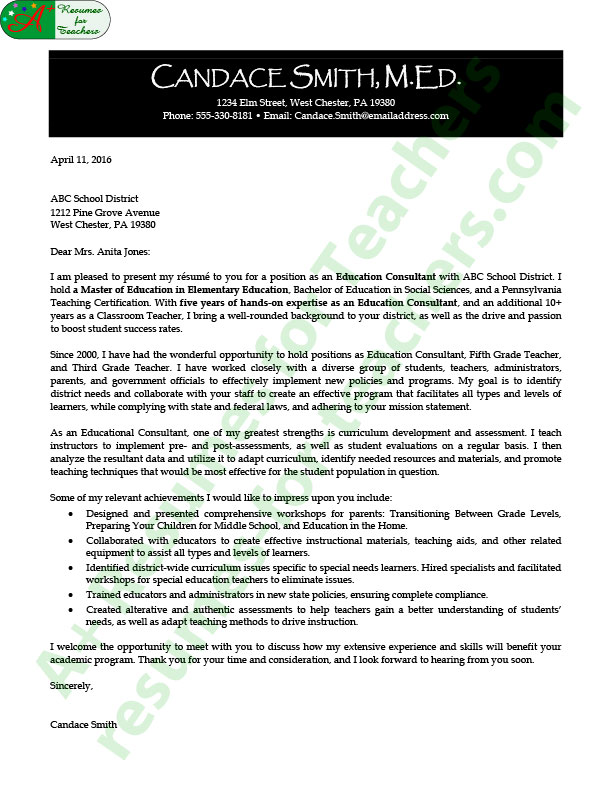
Below you can view an application letter sample for an Education Consultant. It will provide you with a full version of how the letter should be written and formatted.  

education consultant application letter sampleI hope you enjoyed these sample application letter excerpts. On our website, you can review full versions of various sample cover letters for teachers or school administrators.

Whether you are writing a new teacher resume or an educational leadership resume, the font and design should match the application letter.

Do you need assistance with writing your academic resume or application letter?

As a professional resume writer with dual certification in resume writing, I know what it takes to grab potential schools’ attention.

When it comes to your future educational career, seeking out a career coach’s help is always a great idea.

We can help you with your teacher’s cover letter, resume, LinkedIn profile, interviewing skills, and numerous other services. Find out more about Candace Alstad – Davies.

Feel free to contact me or call 1-877-738-8052 to speak to me directly.

5 Ways an Application Letter for a Teacher Can Communicate Passion

Your application letter must convey passion if you wish to secure your desired teaching position. Hiring school administrators are looking for love, enthusiasm, energy, and commitment when hiring new teachers.

These qualities help ensure students’ academic experience will be well-rounded and meaningful to optimize learning. The traits above indicate an educator who can inspire and motivate students to learn, grow, and reach their full potential academically and socially.

Keep all these things in mind when developing your teacher’s cover or application letter.

An Application Letter for a Teacher Position Must Convey Passion and Dedication

Tailoring your educational cover letter to meet the school district’s needs is an excellent starting point. Do this by researching the school district or organization. What you uncover will help you focus on what a school administrator or hiring authority will look for in a candidate.

Highlight Relevant Accomplishments in Your Application Letter for a Teacher Job

Discussing professional teaching achievements is an excellent way to communicate your devotion to teaching and will provide concrete results and evidence of the value you can bring to a school district.

When determining and writing about your job accomplishments in your application letter for a teacher, use the acronym CAR (Challenge, Action, Result). Describe a challenge you faced, the action you took, and the results of your move. Within these CAR accomplishments, demonstrate the passion for the subject matter and the drive you put toward achieving your goal.

For instance:

“The class was showing little enthusiasm for the geography portion of the curriculum. I surveyed the class to discover their unique backgrounds and lineages. This information was utilized to design interesting activities that showcased our multicultural group, engaged the learners, and sparked students’ imagination.”

“A particular student was struggling with math. He was unable to attend the after-school sessions I had organized for students. Instead, I scheduled daily time slots before the school day began in order to provide him with the individualized assistance he required. The student was able to quickly grasp the material, and go from a near-failing grade to an 85% on his final exam in math.”

CAR achievements make great content for your teacher’s resume as well! Just take out “I” and utilize past tense action words instead. Furthermore, try to provide facts and statistics like the second example above.

You can review teacher application letter example excerpts to give you some ideas to write your own.

Emphasizing a Willingness to Go Above and Beyond

Highlighting your desire to go above and beyond the call of duty is another excellent technique for communicating your passion and dedication. A strong application letter for a teacher should show your belief that the job does not end when the school bell rings at the end of the day.

Communicate that you are committed to providing after-school support, seeking additional resources, and attending extracurricular events to establish a thriving school community. Your passion for the profession should be evident in your actions and words.

It could be an excellent time to check out this post titled A to Z Cover Letter Writing Tips for Teachers.

Attending Courses and Other Professional Development Initiatives

While some workshops and in-services are mandatory for teachers to follow, others are not. If you have sought additional courses or seminars, include them in your teacher’s cover letter and resume. Dedication to professional and personal development goes a long way when administrators determine which candidates should receive a job interview.

Showcase all post-secondary degrees you have earned and courses you have taken while expressing your desire to learn more and grow as a professional educator. If you have earned a Bachelor’s, Master’s, or Doctorate Degree, make sure they are prominent in your educational application letter and teacher resume.

Utilizing Quotes and Testimonials

By incorporating quotes from teachers, administrators, parents, and former students, you can create an excellent application letter for a teacher. These testimonials should convey your passion, diligence, and commitment to the students in your class and the school as a whole. Do not be afraid to ask for a teacher’s letter of recommendation or supporting words from one of your administrators.

These professional quotes can also be integrated into your teacher resume to substantiate your dedication to education and definitively portray the talents you possess that make you a versatile and driven teacher. The letters of recommendation themselves can be submitted in your teaching portfolio or during your job interview.

Blatantly State You Are a Passionate Educator

Incorporate the words a school hiring administrator is looking for: passion or passionate, dedication, commitment, goal-driven, hard-working, diligent, and so forth. Whichever words you choose to incorporate in your teacher’s cover letter, make sure they are accurate. For example, use sentences in your application letter such as:

  •  As a collaborative and student-centered teacher with seven years of hands-on classroom expertise, I am confident in my ability to become a valuable and passionate member of your academic team.
  • The enclosed resume will highlight my career accomplishments, showcase my passion for education, and demonstrate my commitment to helping all students succeed.
  • As an excellent and enthusiastic instructor, I welcome meeting with you to discuss how my teaching expertise, talents, and passion will benefit your academic program.

This recent post titled  Teaching Job Application Letter Writing Tips With Examples should be interesting.

Writing a teaching philosophy statement is another excellent method to communicate your passion, personality, and authenticity. Don’t miss out on this extra opportunity to sell yourself to land a teaching interview and, ultimately, a great teaching job offer.

Don’t hesitate to reach out if you need help with your job search documents.

For 16+ years, we have enjoyed helping academic professionals secure their dream position easier and with less stress.

Learn more about Candace Alstad-Davies, an academic resume writer and owner of A+ Resumes for Teachers.