Are You Considering Changing Careers to Teaching? 10 Questions to Ask

Find out what questions to ask when considering changing careers to teaching. First, understand a career transition takes work and is usually more involved than a regular job search.

These strategies will be helpful if you consider transitioning out of the education sector. Before you do, you may want to review these ten education career trends for teachers to see if any of these are of interest.

It is necessary if you dread waking up every morning to work.

CLICK to play the podcast/audio version, and Candace will read the blog post’s contents!

  • Are you bored while you are at work? Is there no challenge to your daily responsibilities?
  • Are you tired all the time and experiencing job burnout?
  • Has your life changed in a significant way? Maybe your kids are grown, and money isn’t the motivator.
  • Do you want to make more money?
  • Do you wish to gain a broader base of knowledge?
  • Does the future look bleak in your current field or occupation?
  • Maybe you can’t stand your supervisor or boss any longer.
  • Are your coworkers hostile or bullies?
  • Does your position use too many of your weaknesses?
  • Did you have a brain wave and discover your calling?
  • Are you fed up with working for someone else and desire to be an entrepreneur?

If this sounds like you, you may need to start asking yourself what you want to do with the rest of your life.

10 Important Things to Consider When Changing Careers to Teaching

Whether you are not happy or feeling fulfilled in your current career, it may be time to make a change. Maybe you are a bit burnt out, or you chose your current job without completely understanding what it would entail, or perhaps you ended up in your career by chance.

You are not alone!

From personal experience, many professionals graduate from college and take the first job offered. Before long, it is ten years later, and they are in the same career without ever having chosen that career path for themselves. Often, life gets in the way of our career dreams. We take the easiest option, the least complicated, or the least risky choice at the time.

And it is easy to understand why. You may have student loans and other bills to pay and families to support. But somewhere down the line, you need to be happy in your career. After all, you will spend the majority of a considerable portion of your life working.

Why not be in a career that you would enjoy? The work we choose should be something that doesn’t seem like work because it’s so enjoyable.

10 solid tips for changing careers to education or transition out of teaching. #Education #Teachers Share on X

You are not alone if you’ve gotten stuck in a rut professionally. It can seem much easier and less frightening to stick it out in the job you’ve been doing. And as I’ve said before, we’ve all got bills to pay and families to support. It’s the safer choice. But is that any way to live your life to the fullest?

So, you’ve acknowledged that you are unhappy with your current situation and that a career change may be your best option. Acceptance and surrendering are excellent first steps. But before you do anything else, there are several things that you need to consider.

1. Evaluate Your Job Satisfaction

When you plan a career change, it is essential first to evaluate your level of satisfaction with your current job. To do this, keep a daily journal to track your reactions regarding everyday work-related situations and help you track the highs and the lows of your work life.

This review will give you some perspective on what aspects of your job you dislike. It will also, in turn, help you to decipher whether the issues you have are with the career field itself or with your coworkers, department, or company culture. Furthermore, it will help you make sure that it is time for you to start looking for a new career, and not just that you are undergoing a rough patch that a vacation could be the fix.

2. Why are You Making a Career Change to Teaching?

Making a life-changing decision can be a very daunting task. You want to make sure that switching career paths are what you want before you go ahead and do it. Remember the education you acquired and the various skills you had to develop to obtain your current job?

Choosing to change careers will require the same effort. Successfully making a career change can be worth it!

So ask yourself this question before you move forward. You need to make sure you are doing it for the right reasons.

3. Assess Your Skills, Core Values, Motivators, and Interests

To effectively manage your career change, you will need to evaluate your interests, core values, adaptability, work skills, and other related aspects by reviewing your vital roles in past jobs, projects, and activities.

Identify the skills you developed or implemented recently in your current job and whether you enjoy these tasks. If you don’t find satisfaction in many of the leading skills and responsibilities you maintain in your current field, you know that you need to make a drastic change.

4. Identify Potential Career Alternatives

Evaluate other career alternatives by networking with people like your friends, colleagues, family, or a counselor. Visiting O*NET Online or a physical library (they still have these) for career information can also help you obtain valuable career advice and help you discover viable options. It is best to explore all career options as long as they align with your skills and core values.

Take time to observe other professionals in a particular field of interest, so you can gain first-hand opinions about whether or not you will be successful in the line of work should you decide to pursue it. Conduct informational interviews with people in careers of interest. Perform an initial comparative assessment of various fields to identify a shortlist of potential job targets for research.

5. Complete an Initial Comparative Assessment

Conduct a comparative assessment of various jobs based on your skills or proficiencies to identify several niche targets for more in-depth research. Don’t make the mistake of jumping into another career only to find out it is also a poor fit—your new career direction to target your desires and match your values, motivators, strengths, and ambitions.

Read as much as you can about the fields you are interested in joining, and try to look for personal contacts that can help you along the way. Evaluate your job interests and skills through self-help exercises to know what to look for in your perfect job. Take time to review your employment records, including the contributions you made to your current employer, to identify the right skills you will need to develop efficiently.

6. Research, Research, and Research Some More

Keeping positive when changing professions is fundamental to success. Some people enter a different profession without understanding its unique challenges. Never enter a new industry or position thinking it will be easier than your last job. Chances are, this type of reasoning will not be correct or solve your unhappiness. You might enjoy it more, but all professions will have difficulties and challenges.

For this reason, it’s vital that you thoroughly research your new career choice so that you have realistic expectations. It will help you understand the skills and characteristics you will need to excel in this unique position. To gain more information about possible careers, you need to read as much as possible and find out if you have contacts in your network of friends and colleagues who already work in these fields that can help you with your job search.

7. Will You Need to Go Back to School Or Take Online Courses?

Depending on the new profession you will be entering, a career change often means retraining. If this is the answer, you may need to take night classes, attend weekend or online courses, or gain an additional degree, license, or certifications.

Depending on what will be required, these will take time, money, and effort for you to accomplish. Therefore, you need to consider this essential aspect of your career change. Be honest about whether you will take four years to gain another degree. On the other hand, four years is a short time to look at your life.

If entrepreneurship is your direction, you must evaluate how you will get new clients. Social media networking could be one solution, but this involves learning.

Sixteen years ago, when I decided to be a resume writer and a career interview and job search coach, I didn’t expect to need to learn all the new skills required to get clients to my website, such as SEO, technology, website development, and social media networking.

Grant it; I do LOVE this part of my career. I’m a very social person who has a QUEST for knowledge and finds technology intriguing. Just be sure to weigh the pros and cons before moving forward!

10 solid tips for changing careers to education or transition out of teaching. #educareers #careerchange Share on X

8. Evaluate Your Transferable Skills Relevant to Teaching

Do you possess the characteristics necessary to excel, such as patience, communication skills, organization, time management, problem-solving, etc.? Do you have transferable skills from past jobs that would help you in this new position? How do you react in situations of turmoil? How fast do you learn new concepts? Can you figure out problems on your own? Do you work well in both team-oriented and independent environments? At first glance, these questions may not seem relatable to your future or your present position, but if you dig deep and look at your current job responsibilities, you will find that you have many transferable skills and can make them work in a new career.

9. Make a Realistic Career Transition Plan

A career change is not something that will happen overnight. Making it happen will take time, effort, sacrifices, and money. You will need to put together a strict budget to ensure you do not run short of funds during the transition. The end goal will be worth the effort and risk (as long as you’ve done your research!), but you need to be realistic about your timeline.

For this reason, it is very beneficial to make a step-by-step plan. Your plan should include all the steps your career change will require, along with a realistic timeline for each. Breaking down the phases will help you stay on track, since you are breaking your primary purpose – changing your career – into smaller, more manageable steps.

10. Are You Able to Be Flexible?

Undergoing such a significant life change will require time and effort. To accomplish this, you will need to be flexible. For instance, are you willing to return to school, take an unpaid internship, or work multiple part-time jobs to gain experience and skills in your new profession?

Are you willing to come in early, give up your lunch hours, and stay after work to offer extra help to colleagues and take on new duties? Will you strive to develop skills and knowledge through self-study to ensure you are the best professional you can be in this new role? These questions need to be analyzed and answered before you commit yourself.

Making a career change is a significant life decision that shouldn’t be taken lightly or done in the spur of the moment.

Don’t let fear hold you back from finding the career that makes you happy!

Suppose you are enthusiastic about a particular profession, energized at the prospect of a career change, wish to give back to your community, have a passion for a field of interest, and make your mark on a new, exciting venture. In that case, you are ready to get started on your career change!

Now, it is your turn to comment on this post or share tips for making a successful career change to teach what worked for you and what didn’t.

If you are thinking about a career transition, what steps have you taken to get as much information as possible to make the career change successfully?

If you like this post, please share it with others.

You can review resume and cover letter education examples to get some ideas to write your own, or hire us to do the daunting task.


 

How to React Positively to Critical Feedback At Work

What response would you give to this teacher interview question? “Describe a time when you received critical feedback? How did this feedback change your actions, performance, or teaching style?

Tips on Answering this Interview Question

Interviewers ask this question to determine how well you respond to critical feedback and if you can adopt suggestions to improve your performance and grow from your supervisor’s constructive feedback.

How to Respond to This Interview Question

When answering this question during the interview, try to use an example that does not paint you in a negative light or may make a potential employer think you are ill-equipped to perform your duties as a teacher.

Describe a time when you received critical feedback and your response. #interviewquestions Share on X

Express the Positives of Receiving Feedback

Critical feedback is often purely negative versus constructive feedback, which provides you with positive and negative aspects of your performance, making critical feedback much harder to receive.

Giving and receiving productive performance feedback is the key to growing as a professional. If the input is negative, you need to think about the learning opportunities you can gain by implementing changes.

Learn all you can about how teachers use self-reflection and evaluation for growing as a person and in the classroom. 

Interviewers want to see that you receive critical feedback without being combative, argumentative, or defensive, regardless of whether it is justified. To not come across negatively, choose an instance where the feedback was indeed warranted and in which you adopted the feedback to improve your performance.

Use a Student Teaching Example of Receiving Feedback

I would recommend using an example from your student teaching, as this is when you receive lots of feedback and when you are still learning and perfecting your teaching skills.

For instance, if your cooperating teacher has given you critical feedback regarding your classroom management skills, describe for your interviewer what happened, what your cooperating teacher said to you about how you handled the situation, and how this feedback helped you improve your skills in this area.

An Example Response to this Interview Question:

While I was student teaching in a fourth-grade classroom, I received negative feedback from my cooperating teacher regarding classroom management. She told me that my classroom management strategy was lacking. Upon receiving this feedback, I asked her to explain what she meant and what areas I needed to improve.  She then told me that I struggled with some students because I failed to communicate my classroom rules and guidelines to my students. She said the students didn’t know what was expected of them, and therefore they wanted to continuously test the boundaries.

Once I understood what my cooperating teacher was telling me in her feedback, I was then able to implement her suggestions and change my approach to classroom management. I worked with my class to come up with classroom rules and expectations that we all agreed upon. I then posted the list up in the classroom for everyone to see. As a result, the students were clear about my expectations. If they did misbehave, they understood the consequence.


Teacher Job Interviews – 10 Strategies to Land a Job Offer

One of the complexities of navigating teacher job interviews is the diversity of interviewing styles you’ll encounter for various positions. Tailoring your strategy for different types of teacher job interviews will help you stand out and surpass the other academic candidates.

Interview preparation requires careful planning and thorough homework; nothing should be left to chance. Focusing on your plan will increase your effectiveness during your interview.

Determine the memory you wish the interviewers to walk away. When they decide on who to hire, they will recall the person you were in the room. Sprinkle your personality and passion throughout the conversation.  

Making any headway during job interviews boils down to how well you can adhere to the rules that govern the process. There are a million and one books that have been written on how to go through job interviews, and indeed the crux of all of them is the same: they all emphasize that you need a strategy – a planned and deliberate means to go through the session.

Teacher Job Interviews – Tips for New and Experienced Teachers

1. Learn About the Academic Learning Center

You must dedicate some time to researching and finding out all you can about the place you wish to work. That is relatively simple as most schools and districts now have comprehensive websites and information on the internet.

When you have a good grasp of everything about the school, ranging from the students who live in the community it serves, to the school’s most recent performance on standardized tests, to the recent successes or failures of school sports teams, you can participate in conversations with parties at your interview about a range of things that affect the school daily.

Communicate how you would improve or maintain scores for the population you’ll teach, congratulate the principal on a recent victory, or discuss your experience working with a specific student population that makes up a large portion of the school.

Not only are you able to have conversations and follow along with the chatting between interviewers before the formal interview begins, but you’ll be more prepared to talk specifically about how your experiences as an educator tie into what the hiring committee is looking for in an academic candidate.

2. Research the Academic Job Description

This is one of the most crucial steps to ace any education interview. Save job descriptions that you use to create resumes or CVs to apply for positions. That way, you’ll have something specific to study if you are awarded an interview. Use the qualities or experiences that the description is looking to tell your story, and use specific pieces to tie your experience to the position’s responsibilities.

If you don’t have a copy of the job description from when you applied for the role, you can also check out other resources.

Does the district’s Human Resources office post generic job descriptions online?

Is there another teaching position posted with a similar job description?

Do you have information that the district or principal shared with you at a teaching job fair that you can use to develop good ideas about the position requirements and how you satisfy them?

Finally, you’re going to be printing copies of your resume to share with the interviewers just in case anyway. What was it about the documentation that you submitted that made this particular school want to interview you in the first place? Whatever it was, you can find it in the application paperwork you already submitted.

3. Practice, Practice and Practice Interviewing

Preparing for any of your teacher job interviews is vital. Go over as many potential questions as possible and provide answers to them. Use your strengths as a learner to practice these questions, so they’ll stay in your memory and be easy to remember. Practicing will increase your confidence, and this will boost your competence.  

If writing things down helps you write out an ideal answer to each question.  If you prefer to talk things through, or if you prefer to simulate the interview conditions, get a friend to pretend to be the hiring manager and do a mock interview.

“The way to develop self-confidence is to do the thing you fear and get a record of successful experiences behind you.”

– William Jennings Bryan

Are you stumped trying to come up with potential practice questions? Check out our “ultimate teacher’s job interview crib sheet.” This fee-based eBook on teacher interviews has helped hundreds of educators.

Prepared Yourself for Tough Interview Questions

Some of these questions are directed to higher education jobs. You could be asked any of these questions at any grade level. 

How do you define good teaching at a college or university level? 

Explain how you would incorporate technology into your role? 

Do you have any current research initiatives? 

Describe the perfect work environment for you?

Communicate how your background and life experiences will be valuable to the academic department. 

Could you provide two examples of how you differentiated your instruction to help a struggling student? 

What would your last supervisor say about your performance? 

How would you describe your instruction style? 

4. Control Your Emotions

In the interview room, the committee will be watching out for your usage of body language. These tips will help you come off as both personable and professional:

  • Smile! A smile often will do you good and help you to relax.
  • Take deep breaths to help you relax.  Focus on breathing to distract you from any nervous feelings you may experience.
  • Maintain eye contact with the interviewers throughout the interview.  If you have a panel interview, switch from person to person. Start eye contact with the person who asked the question you are responding to.  If eye contact isn’t your strong suit, try to look at another part of the person’s face, like their nose or forehead.

5. Dress Impeccably

You don’t have to be extremely formal. When applying for a teaching role, there are two key things: being professional and neat. If you dress as you would for a day on the job teaching, assuming you have a professional, put-together look in the classroom, you’ll be fine.

6. Be Brief and Articulate

When you take a long time to answer a question or talk in circles, the interviewer(s) can get confused. They will miss the key point you were trying to articulate.  You want to provide a thorough and concise answer. At the same time, you need to be strategic with your words.

Rather than launching into an answer and figuring out where it will go after you’ve said a few filler words, it’s ok to ask for a moment to consider which example would be best, how you want to approach the question.

7. Show Your Authenticity

If you are hired, you’ll probably work regularly with the people who interviewed. If possible, find out what it’s like to work on the campus where you are interviewing. It’s also important for them to know who you are and what you are like. Rather than pulling jargon or buzzwords into the conversation, share your ideas in a way that feels natural to you.

Storytelling is the modern way of packaging yourself in the meeting. It provides the perfect method to grab the interview panel members to show who you are as a person. Communicate using relevant stories about why you are an excellent candidate to teach at their college or university. 

8. Show Courtesy and Positive Attitude

Your teaching interview begins when you step on campus, so it’s important to build the beginnings of good relationships with all the people with whom you interact.

Use proper language like “please” and “thank you” when communicating with the custodian who gives you directions to the appropriate office. Be courteous when you talk to the receptionist or the person who lets the interviewer(s) know you have arrived.

Convey a positive attitude and mindset in every stage of the job search. These two characteristics are pivotal to interview success and getting a job offer. 

Showing respect to everyone on your committee will demonstrate that you are a pleasant person to be around who shows respect to others.

Have you ever seen courtesy count as a negative in a teacher job interview?

9. Ask Questions

When the time comes, don’t be shy or scared to ask your questions to the interview panel; show some confidence and ask relevant questions about the teaching position or school. Make sure those answers could not have been found elsewhere, or it can be perceived negatively by the committee that you did not do your homework before coming.

Plan out some questions to ask in advance about things like the institutional culture, opportunities for professional development, or accomplishments the team is proud of, or challenges they have overcome.

10.  Follow Up After any of Your Teacher Job Interviews

Follow-up is important. Don’t underestimate the power of following up. Just like writing your teacher’s resume or preparing for the interview, it is a critical stage.

Keep in touch with the committee. 24-48 hours after the interview, you should send the interviewers a thank you letter. If you are pressed for time after your interview, you can even prepare a thank-you note in advance, add a sentence or two about a particular interaction plus a closing sentiment of thanks at the end after your interview, and then drop the envelopes at a post office or mailbox on your way home.

If you are interviewing for a teaching position with a long timeline between the interview and hire date, you can make a more long-term inquiry into the status of the hiring committee if you haven’t heard anything for several weeks. For instance, if you are interviewing in spring for a teaching position that doesn’t begin until August or September.

Are you looking to prepare for upcoming teacher job interviews? Find a variety of eBooks to help get ready for the big day.

Do you need to take your teacher resume to the next level before you can put these tips into action? 

Check out our resume writing and interview coaching services.

How to Break Free from Your Current Career

Looking for a career change and do not know how to start?  Breaking free from a job you hate is critical to life happiness. Do you feel tired all the time and dread getting up every morning to prepare for work?

Don’t delay. Take action to make a career transition to secure a job you will enjoy going to each day.

Whether you are not happy with your current teaching career or not feeling fulfilled in your present career outside of education, it may be time for a change.

Maybe you are a bit burnt out and need to have a career change. Does this sound like you?  Start asking yourself what you want to do for the rest of your life. Recognizing job dissatisfaction is a key component to taking steps to move your career and life forward.

If it seems that a career change is one of the best solutions, but you are not quite sure how to start, here are some tips to help to navigate a successful career change, either out of or into education.

If it a career change is on your mind, but you are not quite sure how to start, here are some tips. Share on X

Career Change Action Steps and Tips

  • When planning a career change, it is important that you first evaluate your job satisfaction in your current employment. This process will ensure it is time to look for a new career and not just undergoing a particular phase or rut in your life when rest or a vacation suffices to get you back on track.
  • Evaluate your job interests and your skills through self-help exercises so you will know what to look for in your perfect job. Take time to review your previous employment records, including the positive contributions you made to your current career, to identify the right skills you will need to develop efficiently.

Evaluate Suitable Career Options

  • Analyze career alternatives by talking about your working skills and core values with other people like your friends, family, or coach. Visiting physical or online libraries for professional information can also help you obtain valuable career advice. Think about performing an initial comparative assessment of various fields to identify a shortlist of career targets to research.
  • Gain as much information about possible careers you are interested in transitioning into by reading about the job and qualifications necessary. If you think you are qualified, try to uncover some contacts in your network of friends and colleagues that can help you out with your job search.
  • It is best to explore all career alternatives that coincide with your personal skills and core values. You can also observe other professionals in a particular sector. Extensive research will help you gain a first-hand opinion about whether you will be successful in a work line and if you should pursue it.

Considering various alternative options in every industry for which you are qualified to work can help you decide whether it is time for you to change your career.

If you are unsure whether you should leave your current employer for employment elsewhere, consider asking your superiors to transfer you to another department with slightly different job responsibilities to give you a change of pace. Consider gaining a new endorsement or teaching area to give you a change of pace – you may be in a bit of a rut.

I wrote a recent blog post you may wish to read:

How to Test a Second Career Option Without Jeopardizing Your Job

Find more information about making a job transition to prepare to move your career forward as quickly as possible with less stress.

Whether you need the help of a career coach or someone to write your job search documents to ensure they are in top-notch shape to increase interviews.

Most job seekers spend a lot of time researching how to write a resume that will get results. Having a stellar resume and application letter will save you countless hours and frustration during your job search. It is worth energy and effort to get it just perfect.

Need help?

What if I told you that, instead of spending countless hours trying to figure out what keywords to include, what design is correct, how to uncover and write accomplishments, and create passionate cover letters, you could hire me!

That’s right; I can take away all your stress, frustration, and hours of work trying to figure out the job search maze.

Candace is just a click away or a phone call – toll-free: 1 877 738-8052 or International: 780 513-0010. Or, of course, you can review our packages and pricing to get the resume help you need.


Teacher Interview – Secret to Secure a Teaching Job Offer

Teacher interview tips, strategies, and help to fully prepare and succeed. Landing a teaching job offer is your ultimate goal. Don’t miss preparing to WIN.

After putting lots of energy and time into your teaching job hunt, the phone is finally ringing with an invitation to an interview for the teaching position of your dreams.

School principals are interested in you (based on the excellent teaching resume showcasing the top-notch credentials and value you can offer).

Now is the opportunity to WOW the interviewer in person!

Things to Do Before Your Teacher Interview

One of the keys to successfully landing an education job is acing the job interview. If you can sell yourself, your teaching style, and your teaching experience, you have an excellent chance to secure a job offer.

The interview process is where many teaching candidates feel enormous pressure to perform. Have you ever walked out of an interview saying to yourself, “I should have mentioned this?” or “Oh, I could have explained that better.” Rest assured, you are not alone.

Most job seekers suffer from some degree of interview anxiety. It’s because we all know how much is at stake.

As with anything that is stress-inducing, it’s always better to be well prepared and practiced to alleviate interviewing jitters at your next teaching interview.

The art of completing a successful teacher interview lies in solid preparation, knowing yourself and your related success stories, and effectively communicating how you will perform in a particular teaching position.

Discover valuable interviewing tips to achieve victory in your education interview: Share on X

Practice & Investigate Before Interview Day

After you finish some research on the school district, it’s time to examine what you have learned.

Investigate the school’s mandate, vision, key personnel, mission statement, demographics, and educational priorities. Research to discover what the school administration expects from you as a new teacher, what experience is required to perform the work involved, and the characteristics the school district is seeking.

Find out if a test of your teaching skills or a written assignment will be a component of the teacher interview process. For instance, maybe you will need to present a demo lesson plan. Try to determine if the teacher interview will be one-on-one or an interview panel discussion. It wouldn’t be pleasant if you prepared to speak with just one person and end up fielding questions from a whole table of interviewers.

Dress Appropriately

What you wear to an interview will give the interview panel an impression of what you are like as an educational professional. Look the part of a professional educator. You have one opportunity to make an excellent first impression. Choose an interviewing outfit that is tidy, clean, ironed, and not too revealing. If possible, try and learn how teachers dress at school. But, when in doubt, some form of business suit usually works best. Due to allergies and sensitivity to smells in the workplace, it is wise to leave the perfume, cologne, or aftershave at home.

What to Bring to the Teacher Interview

It is a good idea to bring additional copies of your resume and cover letter just if an interview panel member does not have a copy. Also, bring copies of your professional reference list. Ensure your reference list is current and each person on the list is aware you listed them as a reference. Obtaining your references’ approval is paramount. Make certain they will provide an excellent reference. Don’t forget to bring copies of letters of recommendation and include them with your reference page.

Bring a Teaching Portfolio

Lastly, if you have a teaching portfolio, bring it along with you. The interviewer(s) may not wish or may not have time to review it, but at least you have it available. An organized teaching portfolio is an excellent tool to show the interviewers examples of your work and your students’ work and important documents like your transcripts, certifications, teaching philosophy statement, and other valuable items.

Don’t forget to act like yourself, remain calm, and maintain good eye contact with every person in the interview room. Be accurate and truthful in the responses you give to each interview question. If you don’t understand an interview question, it is better to clarify an interview question than to provide an answer that is totally wrong or off-topic.

Closing the Teaching Interview

At the end of your interview, the interviewer will ask if you have any questions regarding the teaching position or school community. Don’t miss this chance to ask questions. The research and preparation you did before the interview will make a big difference in the questions you should ask.

Have a few questions ready to show that you are genuinely interested in the position. Just remember, this is not the time to negotiate wages or time off!

If you would like more information on the interview process, we have an abundance of interviewing tips in our website’s interview section.

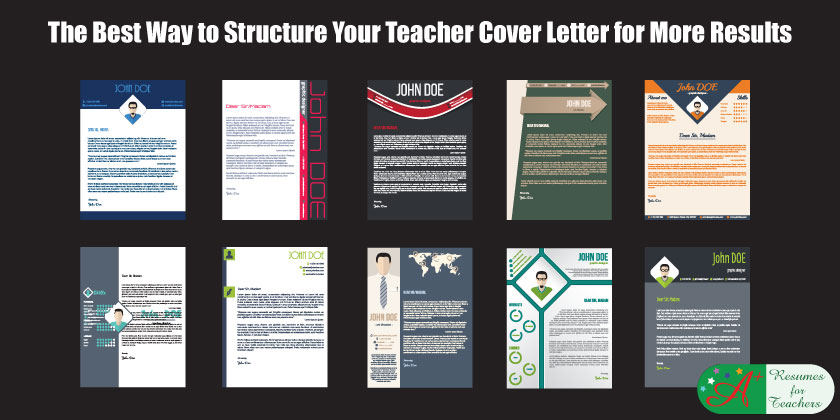
The Best Way to Structure Your Teacher Cover Letter for More Results

Structure your teacher’s cover letter correctly with these writing tips to grab the reader’s attention. Writing an application letter for a teaching position to accompany your resume can be tricky.

Knowing what to include and how to structure your cover letter can help reduce the stress of this daunting and frustrating task. The need to constantly alter the application letter for different positions you apply to can add to this critical job search component.

Incorporating these application letter-writing tips can help immensely, so let’s get started.

Whatever you do, don’t give in to the temptation of not writing an application letter!

Teacher Cover Letter Strategies to Incorporate

Failing to include a cover letter for a teaching position can look like you’re just not putting in the effort. And many schools will overlook your application completely if you opt to leave out a cover letter. Your teacher cover letter is your chance to introduce yourself to prospective schools and your possible new boss. You want to use this opportunity to put your best foot forward.

However, it can be challenging to decide exactly what to say in your cover letter, what to include, and what to leave out. If you’re finding it hard to put together your letter of introduction or letter of intent, you are not alone!

We’ll tackle this together!

Like any letter, your cover letter can be divided into three discrete sections: the opening paragraph, the main body, and a strong closing paragraph with a call to action. Submitting the correct application letter format for a teaching position will be paramount to get the reader’s interest to read further.

Let’s dive into the details of each section:

Opening Paragraph of a Teacher Cover Letter

This is arguably an essential part of your teacher’s cover letter. The opening paragraph is the first chance the reader has to form an opinion of you. If possible, address the letter to a specific person. Try to find out the hiring manager’s name or the name of the selection committee chair.

Spell the person’s name correctly; there’s nothing more likely to make a poor first impression than spelling the hiring manager’s name wrong!

View more teaching application letter writing tips with example paragraphs to grab some excellent writing ideas.

The first paragraph of your letter should state the position you’re applying for and the relevant job posting number (if applicable). Also, state where you heard about the vacancy; this is especially important if an existing employee has referred you, as this can give you an extra edge over the competition.

On the other hand, you may be applying to a position without a job posting, which is fine. This happens all the time.

You should include something interesting and important about yourself in the opening paragraph of your application letter to catch the reader’s attention. For instance, you may want to let them know you hold a master’s degree in education, have 15 years of experience, or specialize in response to intervention. Anything that will immediately pique your school’s interest should be included.

The Main Body of the Cover Letter

Your letter’s main body convinces readers that you are the right person for the job. Remember that if you don’t capture the reader’s interest in your cover letter, they may not bother to read your education resume.

Focus on the primary duties stated in the job description and the job posting you are applying for. Then, demonstrate your ability to excel in these areas by giving concrete examples of your professional work experience. This is where doing your research can pay off. The more you know about the school district, the better you can tailor your skills and attributes to match the school district’s requirements.

If the district or school has a website, read through it and gather information. Find out what’s critical to them and be aware of current projects and potential issues. If you can demonstrate in your letter that you’ve gone into trouble finding out about the school, this will likely impress the principal.

It's important to incorporate your authenticity in your cover letter - let your personality and enthusiasm shine. Share on X

Share with the reader why you want the teaching job. Communicate what you can contribute to the school district. Try to explain what draws you specifically to the career opportunity and how your skills and experience could benefit the school district.

Remember to showcase aspects of your teaching style and any big accomplishments you’ve made, whether it be student gains on state testing, introducing new technology or class resources, or tutoring students after school to help them reach grade level.

The Ending Paragraph or Conclusion

Your concluding paragraph should state that you would welcome the chance further to demonstrate your suitability for the position at an interview. Be sure to include your contact details, too, in case your letter separates from your resume.

After completing your letter, you should ensure it is proofread by someone with an excellent literacy standard. Even if you are confident in your abilities, it’s easy to be blind to your mistakes—always get it checked over before sending it.

If you would like more information, we have a variety of cover letter samples that you can view to gain insights into how to structure your teacher’s cover letter.

Learn more about Candace Alstad-Davies by reviewing the About Me page. From that page, you can review testimonials and frequently asked questions.

Do you need help writing a powerful application letter, cover letter, resume, or CV curriculum vitae?

You can send me an email or give me a call toll-free at 1 877 738-8052. I would enjoy chatting with you.

What Can You Tell Me About Bloom’s Taxonomy?

What can you tell me about Bloom’s Taxonomy?

During your teacher job interview, you will be expected to understand whatever teaching strategies, learning activities, or techniques that the panel may ask you to explain and comment on each question knowledgeably. This is why it is critical to review teaching terms, which can be called education buzzwords, before going to a teacher job interview. It is important to prove to the hiring committee that you are up-to-date with the latest education lingo, industry trends, teaching strategies, etc.

You may have heard the term Bloom’s Taxonomy, but maybe you never thought about what you would say if someone asked you to describe what it is or your thoughts on the subject. You may as well take care of that right now before being stumped in a teacher job interview by reading about it now. Here goes!

Bloom had the belief that education should focus on the mastery of subjects and the promotion of higher forms of thinking rather than the transfer of simple facts.  He created a framework of simple checklists to ensure that one utilizes the most appropriate type of learning methods to achieve an academic goal.

Blooms’ Taxonomy uses the “Knowledge, Attitude, and Skills” structure of learning and evaluation and is the most widely used teaching method today.  It provides a simple, clear, and effective teaching model for explaining and applying learning objectives, teaching methods, and the measurement of learning outcomes.  This model serves as a teacher’s checklist to ensure that your teaching is successfully planned to deliver material to students to optimize learning.

The well-known taxonomy of learning objectives is an attempt (within the behavioral paradigm) to classify forms and learning levels. It identifies three “domains” of learning, organized as a series of levels or pre-requisites. It is suggested that one cannot adequately address higher levels until those below them have been covered, making it serial in structure. As well as providing a basic sequential model for dealing with topics in the curriculum, it also suggests a way of categorizing levels of learning. Categorizing would be regarding the expected ceiling for a given program or grade level.

Bloom’s model is divided into three domains:

1. Cognitive (intellectual – knowledge) – the most used of the domains, refers to knowledge structures. It can be viewed as a sequence of progressive contextualization of the material.

2. Affective (feelings, emotions, and behavior) – the affective domain is concerned with values, or more precisely perhaps with the perception of value issues, and ranges from mere awareness to distinguish implicit values through analysis.

3. Psychomotor (manual and physical skills) – Bloom never completed work on this domain. There have been several attempts to achieve it. It draws attention to the fundamental role of imitation in skill acquisition.

Ultimately, with Bloom’s Taxonomy, the learner should benefit from the development of knowledge and intellect, attitude and beliefs, and the ability to put physical and bodily skills into effect. The Taxonomy goal is to motivate educators to focus on all three domains, creating a more holistic form of education.

Learn other job interview questions you could be asked in a teacher job interview and potential responses.

What can you tell me about Bloom’s Taxonomy? Please comment below on how you would answer this question in a job interview.


Identifying and Overcoming Potential Job Search Liabilities

Don’t let potential job search liabilities hamper your enthusiasm for landing a new education position. Some job-seeking educators feel their employment applications will not be rejected for job postings because of prior work experience or personal reasons.

Most job seekers believe these employment liabilities will significantly diminish their chances of securing an education position. It isn’t always the case.

How to Overcome Job Search Liabilities

The truth is that imperfections in work history or age discrimination issues are fast becoming a primary concern for many job seekers. They believe they have more than one obstacle to overcome. Identifying potential job search liabilities as a teaching candidate is necessary to improve your job search results.

Among the most commonly encountered concerns is the applicant’s age. Still, some teaching candidates have to overcome employment history gaps, consolidate a diverse career history, or have an educational background different from the new teaching career they want to pursue.

Age Concerns or Age Discrimination

If you identify your age as a job-search liability, ask yourself: Are you only using it as an excuse to procrastinate on starting your job search?

Job seekers who lack confidence or are confused about how to start their job search often see their age as a reason they are unable to obtain a teaching job in the first place.

If this is your case, you need to address this issue honestly. I will help you overcome it and get started on your job search immediately. Not all schools consider applicants’ age a barrier to hiring for teaching positions. As long as you have the right skills, you do not have to worry about being accepted due to your age because all that matters is your ability to perform as a talented educator.

How to Alleviate Concerns

I have had past clients worried about age discrimination, but you can alleviate any concerns by showing your eagerness to work for several years if you can get to the interview. Additionally, I would recommend highlighting your recent training, technology expertise, and professional development to demonstrate that you are continuing to learn and adapt your teaching methods. Some school representatives may think that older teachers don’t adjust to change—for the most part, this isn’t true.

Highlight your maturity, wealth of experience, and classroom success stories as assets. Tailor your cover letter and resume to meet the school district’s needs by showing your expertise in the areas they seek in a new teacher.

Regarding gaining interviews, your resume hides your age by only showing your recent professional experience. If you like, you can take the graduation date for your degree off the resume.

Limited Teaching or Children-Related Job Experience

If schools only hired people with enough job experience, the possibility of career advancement would be nil. Remember that many teaching candidates lack a job requirement or two, and you are not exempt. Do not be afraid to look for available teaching jobs where you do not have all the qualifications required by the schools.

Schools don’t always expect candidates to have everything they’ve listed in the job posting. The job posting lists the attributes they are looking for in their new teacher. The candidate selected effectively communicates their passion and possesses the qualifications required for the job posting. During the interview process, the candidate shares their success stories.

Showcasing Relevant Experience

More often than not, it is enough to showcase your specific teaching experience while emphasizing your extraordinary eagerness and enthusiasm to take on new challenges at work. Bear in mind that the decision to hire a teacher is usually based on your attitude towards teaching and your overall job experience.

Many schools are willing to hire a teacher with limited experience and work history if they demonstrate enthusiasm for teaching and a commitment to professional growth.

Be proactive and address any concerns by taking the necessary steps to prepare in advance, creating a positive job search experience.

5 Healthy Ways to Become a Better Teaching Professional

As a busy teaching professional, it is normal to neglect other areas of your life; however, when you do so, it upsets the balance of your life. Self-improvement is all about maintaining balance in our lives and striving to be a whole person. This is why it is important to dedicate to all the important areas of your life, not just your teaching career. These 5 ways to become a better teaching professional may help you get motivated to a better balance in your life – there is more to life than work.

Get Adequate Rest

Optimal rest can vary from person to person but not having enough is very counter-productive. Most people need 7-8 hours of good quality sleep each night to perform at their best. Quality sleep means deep, uninterrupted sleep, which can be hard to get for busy professionals with families, but it’s worth making a concentrated effort. Look for signs that you aren’t getting adequate sleep, such as impatience, irritability, inability to focus, exhaustion, and headaches.


Exercise

We, humans, are not meant to be sedentary. Too many of us lead very idle lives while consuming a high-sugar, high-fat diet. No wonder diabetes is almost an epidemic in the U.S.A. right now. We need to exercise. Whether that means a walk in the park or a trip to the gym or the tennis court, the point is to perform 20-30 minutes of exercise 3-4 times per week. Exercise keeps your mind sharp, improves your sleep, and helps you de-stress all positive side-effects.

Eat a Sensible Diet

This goes hand-in-hand with exercise. The bottom line is that by eating healthier, you will look and feel better. Now consider this: learning to control your hunger and cravings for “junk” food will build discipline that will spill over into other areas of your life.

Engage in Daily Meditation/Quiet Time.

The important point here is to take time away from your “to-do” list. If you have religious/spiritual inclinations, pray or meditate. If not, engage in relaxation, “me time,” or yoga. Trying to stop that ongoing chatter in your head is not easy, so relax and let go of the thoughts in your head and focus on your heart for a designated time each day.

Engage Your Creativity

This could mean playing a musical instrument, listening to music, dancing, building something, or gardening. If you have a hobby, pursue it. If you don’t, you may have to consider getting one. This serves as another great outlet to de-stress, cultivate new skills, and enjoy your personal time.

Attending to these 5 core activities will help to create balance in your life. Share on X This is essential to becoming more of what you want to be both a teaching professional and your personal life.

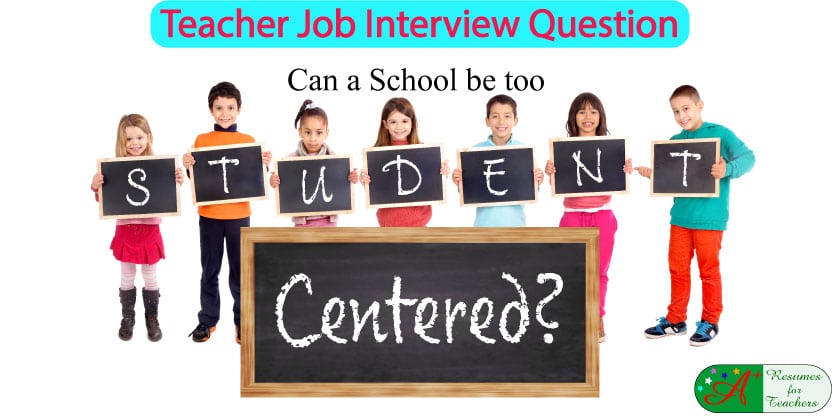
Can a School be too Student-Centered? Job Interview Question

Do you think a school can be too student-centered? How would you answer that school teacher or principal interview question? Learner-centered can be a term to describe this type of school community environment.

It is important that the response you give to the job interview question is truthful, relevant to the position, and shows value to the school district. The following could be a possible answer, or it may provide some ideas for you to tailor your response:

I think it is possible that a school can be too student-oriented if it is done at the price of ignoring other important areas of student education. A school’s primary focus should always be to help students achieve social and academic success. And a student-oriented school should use this concentrate in every area of education.

For instance, a student-oriented school should use this philosophy when planning – plans should be dynamic and may change with significant news events and individual student interests. Teachers always strive to create the perfect lesson, one that is student-centered and teaches to the state standards. Sometimes it does go as planned, and students don’t engage. When this happens, I need to adjust the direction of the lesson quickly.

When scheduling, it is important to allow for variations resulting from pacing projects, student moods, and checking-in; when pacing/achievement – high achievers should have opportunities to go deeper, more complicated, and more involved in the curriculum. When testing and assessing, tests should be used to determine each student’s specific needs and modify schedules and plans according to these requirements.

Assessments should provide feedback and guidance about what was successful and what to improve. With focus and activities, students should develop high-level skills, self-confidence, self-awareness, quality products, and student interests and questions guide lessons.

“Student-centered learning does have risks, but so do the alternatives. We do not have enough resources to be acutely aware of each student’s individual optimums or teach each student according to their individual optimum. Demanding perfect student-centered approaches from teachers will overwhelm them with more work than they can do. Also, when teachers place too much emphasis on students’ individual styles, they may use up too much time and fail to cover critical material.

On the other extreme, though, when schools demand curriculum-centered or test-centered learning, teaching tends to focus on the lowest cognitive levels. Students may get treated as test scores and academic rank, not as individuals.

Students tend to gain knowledge without gaining understanding. Students often become bored and limit their learning to short-term memory. Students may get higher test scores, but they don’t rise to higher achievement.

A balance must be found!  Student-centered education may fail to cover important material, but curriculum-centered education may fail to promote real achievement.