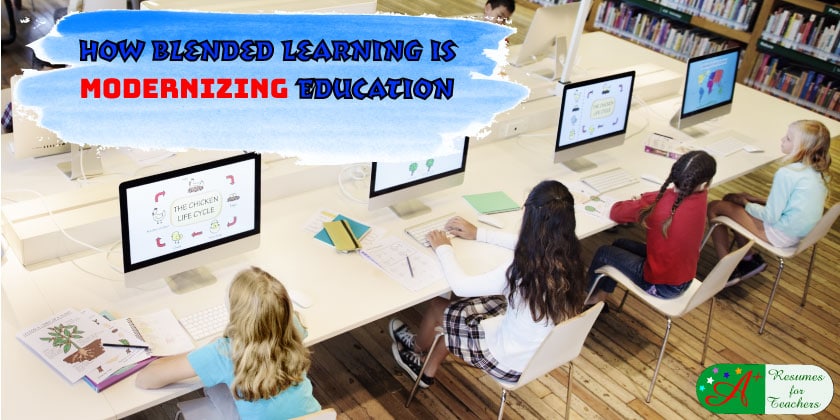
How Blended Learning is Modernizing Education

Now, the world revolves around the internet. Blended learning is trending and critical to the educational sector. 

Let’s discuss how it can benefit the education system and how it has helped modernize education.

Gone are the days where students have to handwrite papers, use slow and clunky typewriters for their assignments, or spend day after day at the library for each class and assignment that arose.

Imagine being able to find the quotation you are looking for with just a click of a button instead of having to search endlessly through volumes in the library.

Better yet, imagine making a mistake on your essay – you can hit “backspace” on the keyboard and continue with the assignment instead of fighting with a typewriter or starting all over again. These exemplify modern learning.

However, there is another angle in which we can look at modern learning, blended learning. Blended learning is an education program where a portion of student learning is facilitated by digital and online media and is controlled by the student to some degree. This program is changing the way we help students learn and create a better future for them. But, to see its potential, we have to understand what it is and how it works.

Blended learning combines traditional education systems (learning in a classroom) with technology-based ones, thus creating a blended program that focuses on moving with individual students and providing them with the assistance they need to succeed.

This school system accommodates each student’s goals, needs, and learning styles, while everyone is still in the same classroom. Blended learning is an excellent concept for providing quality education and differentiated instruction during the allotted class time.

Blended learning is changing the way we help students learn. #blendedlearning Share on X

Throughout the school day, each classroom gets a certain amount of time to use computers for educational purposes. When that time comes, each student has a separate account with his/her progress and profile saved.

When students connect to the tablet/computer and use their account, they can access all of their personal data. This example is the core of how blending working works. The computers/tablets enable students to work at their own pace on the lesson’s parts they require help. You could say it’s similar to having a separate tutoring session each day, using methods students enjoy.

You can even use technology to take your students on a virtual field trip. 

It allows the student to get the most out of the program, which directly corresponds to having a better understanding of the lesson and a higher intelligence level overall.

Instead of falling behind on classwork, students will be able to work through the difficult concepts at their own pace and understand them much better than they ever had before. In turn, this means a greater motivation to learn, higher test scores, boosted self-confidence, and a continued desire to succeed in the classroom.

In many middle schools around the country, this blended learning system has been very beneficial in English and Math—two skills at the core of education systems. Testing scores have gone up, and students are much better prepared for high school and post-secondary education as a result.

Another potential function of blended learning is adding programs for high school students. If students want to take an AP class not offered at their school, they can liaise with other schools that offer blended learning and learn that way. Many fantastic options with blended learning in high school help prepare students for a college education.

However, blended learning is just at its beginning. Middle schools nationwide are benefiting from the program, and it is slowly being introduced to high school curricula to see how it can best benefit the students there.

The results are already being seen on smaller levels in middle school students learning better, faster, and more enthusiastically. By bringing in computers and tablets to help them with concepts they struggle with individually, students cultivate a greater thirst for learning. This is all due to the idea that students get to use technology in school that they are both familiar with and love to use. The connection between school and technology is crucial moving forward in the world of education – this is the base concept of blended learning.

It is pointless to continue to use the concepts that helped students learn 50 years ago if they are not working on today’s generation. Blended learning brings out the modern technological world while keeping the morals and rigidity of the traditional methods that have served well over the years.

The trick is to keep all the external parts of learning the same but modernize how the education is delivered so students truly benefit from what is being taught and become inspired to pursue life-long learning. If we want students to be smart future leaders, we must ensure learning is exciting and engaging without removing its educational component.

Blended learning combines education and technology to get kids excited about learning and ensuring a bright future.

Therefore, we must zoom back to see how blended learning is changing education to help it move into the modern day. We can look at the easy answer, which is the added touches of technology that get the kid’s attention, but the real answer goes deeper. Because they control it, blended learning helps youth in today’s day and age have an education system that works for them.

Computer programs allow students to move at their own pace, so they get more out of the education system as a whole. If a student struggles with Algebra, he can use the daily time to work at it until he finally understands it; thus, he will have better scores in Math class and be a happier child.

Putting students in charge of their learning is an excellent idea with impressive results.

Blended learning allows that to exist in a way that works for the student. The student will still be learning the right educational topics programmed into the computer. Giving students control will enable them to get more out of the program that we are creating. Since it’s their future, they deserve to have a say in how they prepare for it.

Training in blended learning on a professional level is now a major “must-have” in teacher-training schools. Many programs are starting to implement it into their education systems, so today’s teachers can go right into the classroom educated on blended learning and ready to use it when the time comes.

Experienced teachers continue to take courses in blended learning to provide their students with a valuable learning experience. It is a tremendous asset to include these skills in your resume. Within ten years, blended learning could be in every school, and all teachers would be trained in how to use it to optimize student success.

Those who are applying for jobs in the area must include the keyword “blended learning” on their cover letter and resume and discuss it in an interview. This allows the interviewer to know that you understand blended learning and appreciate its benefits for each student.

Some school boards are interested in looking at applicants with that keyword in their resume. Including this skill will communicate to the hiring representative that you know how important blended learning is to today’s education systems.

Blended learning is a hot topic in educational research right now, and given the trend that is developing, it will be here to stay. Since today’s children’s future depends almost entirely on their formal education system, we must keep working to ensure it is the absolute best for everyone involved.

The research and test scores suggest that blended learning is the way to a better future for school-aged children today and in the future. Now, all we have to do is find a way to incorporate it into every school system in the developed world.

How Teachers Use Self-Reflection and Evaluation in Education

Do you consider yourself a reflective teacher? Learning to use self-reflection and evaluation in education to move your career and personal life forward to achieve your goals.

Self-reflection and evaluation are an essential part of my daily routine. Trust me, it works.

Improved class performance, small ‘thank you’ notes from students and their parents, and the appreciation of your peers and supervisors – these are items that testify to you being a good teacher. Go the extra mile to become an exceptional educator. Embrace and model two tools for your students: reflection and self-assessment. This process coincides with the growth mindset concept paramount in education and anyone’s life.

Understanding Self-Reflection and Evaluation in Teaching

As a reflective teacher, you know ‘reflect’ means to ‘contemplate’ and to think seriously. Reflection goes far beyond this meaning in an educational setting. It’s a critical self-regulation factor that motivates teachers to monitor their performance and evaluate their progress against specific criteria.

Through the self-evaluation stage that follows, they can recognize their strengths and identify weaknesses, which, in turn, allows them to formulate strategies for challenging situations. As this is an iterative procedure, teachers will soon begin to recognize improvement. Analyzing this further will enable them to choose more appropriate goals and develop reasonable plans.

Why You Should Reflect and Evaluate Your Work

It’s easy to become the victim of your ego when someone proposes you reflect on and evaluate your current process. After all, you are a capable instructor whom the school chose because of their capabilities, knowledge, and experience. Proposing self-reflection and self-evaluation isn’t to undermine your skills or demean you. It’s an invitation to reap numerous benefits that will transport you to the ranks of a “rocking with the times” teacher. Here is an article from the University of Washington on self-reflection on teaching.

Self-reflection is one of the most efficient ways to acknowledge that your teaching strategies can be improved. Instead of having others make snap judgments about your method without having the context to support it, it is you who collects and analyzes all data to ensure your teaching strategies improve if necessary.

“We do not learn from experience… we learn from reflecting on experience.”

― John Dewey

There is truth to the trending topic of teachers teaching the value of failing intelligently, one of the top 10 education career trends for teachers.

As for self-evaluation, this process allows you to step successfully into your students’ role, their parents and your superiors entrusted you to take care of with expertise. If you don’t take the time to evaluate whether or not your students understand what you impart, your effort and time will go to waste. This process is fundamental if you have ‘at risk’ students who need more attention.

Another reason to evaluate yourself is to enhance your skills as an educator. As an expert on a subject, you understand what you’re trying to say. Your students are another story, though. By asking for their feedback, you’ll be able to discover problems in your teaching style and begin fixing them. However, don’t request feedback if you don’t plan on improving accordingly.

Not only will you offend the people you’ll be working with for the rest of the school year, but you’ll teach your students that reflection and self-evaluation are useless tools.

Opening up to self-evaluation will help close the gap between you and your students. They’ll discover you are a learner with successes, failures, frustrations, and concerns. As a result, they’ll feel safe about sharing what they think. Remain patient and attentive while listening to students’ queries and celebrating mistakes, emphasizing they lead to learning opportunities.

Finally, combining your reflections and self-assessment results lets you gather better data and opinions while strategizing with your supervisor. They will guide you on the best methods and share valuable advice from their experience.

In addition to advancing your career through relevant information, regularly touching base with your supervisor will show your dedication to your students and job. Rest assured, your passion for reflective teaching and helping students won’t go to waste, and you may receive a better compensation package in the future.

The Process of Self-Reflection in Teaching

Once you decide whether to reflect on a specific feature of your teaching or a particular problem in your classroom, you can begin collecting information on the feature or problem. This knowledge lets you determine what you’re up against and take necessary steps, such as the following.

A Journal – A self-reflective journal is probably the easiest way to track the success level of the lesson. After class, jot down a few notes detailing your reactions, feelings, and any observations identified about your students. To ensure your assessment’s consistency, break down your journal into sections like lesson objectives, classroom management, and materials.

Video Recording – A valuable method to facilitate self-reflection, video recording is probably the best. It gives you an unbiased view of how practical your lesson was from both a teacher’s and a student’s perspective. While viewing the video footage later, you may encounter odd behavior you didn’t catch while teaching.

Student Observation – Students love giving feedback, so provide them with the opportunity to share their opinions. Hand out a survey or questionnaire that allows them to express what they feel about your lesson. Remember to write the questions in a way that enables them to express their thoughts thoroughly.

If you think your students won’t fare well writing their thoughts, conduct focus-group interviews or have an outside person take over instead to ensure objectivity. Ask the questions you have in mind and probe the students to get more detailed information and clarification. Only choose this path if your student-teacher relationship is strong and built on trust.

If you’d rather not be as direct, you can evaluate your technique and how well your students are learning by looking at their assignments and test results, provided they’re well-designed to measure students’ learning achievements. Conduct verbal tests after each class; ensure every student participates.

Peer Observation – Have a colleague observe your teaching. As the observation is more casual, you’ll be able to teach naturally, and your observer will be able to provide insight into your instruction. Since your colleague is as busy as you are, create a questionnaire using questions like those below so they can fill it out as they observe.

Was the lesson too easy or too difficult for the students?

Have you taught to make sure students understand the content?

Did any issues arise in class?

During which parts of the lesson did the students seem most engaged?

Which parts didn’t seem as impressive or compelling?

Do you think the materials used in class helped? Which were the most useful and which didn’t work in the lesson?

Do you have any suggestions for better materials I can use?

Were my lesson instructions clear?

Was I delivering the course material at a reasonable pace?

Did all the students participate in the activity?

How practical was the lesson overall? Do you have suggestions on how I can improve to encourage more involvement or increase learning?

How well do you think I managed to handle problems during instruction?

Do you think I was perceptive and sensitive to my students’ needs?

How were my attitude and delivery overall?

After collecting this information, you should begin analyzing it. First, look for recurring patterns. Did your camera record something that kept happening several times during your class? Are several students pointing out the same issue in their feedback forms? Jot down areas that need change and start looking for solutions.

Two excellent sources you should explore are:

Colleagues – Peers will offer valuable advice, especially since they may have faced the same issue. Even if they didn’t, they’d provide you with a list of tips on how to do things differently.

World Wide Web – You can use the Internet (capitalized, I think it’s a proper noun) to locate resources explaining and solving your challenges. Use the World Wide Web to find other teachers on blogs and social networks. By interacting with them, you can ask questions and discover exciting answers.

Remember that the goal of this is for you to improve how you teach. Therefore, make sure to implement any changes to your technique or delivery before your next

How to Effectively Plan Your Self-Evaluation

Subjecting yourself to teaching strategies and instructional techniques for your critical evaluation isn’t enough. After all, you’ll only develop a checklist that allows you to focus on ideas instead of formal structure. For the latter, you need self-evaluation. This more precise method requires more planning since it can help you improve the educational experiences you provide while highlighting the education you’ll need to develop your capabilities and teach well.

To plan for your self-evaluation, use the following five steps.

Define the Context of What You Will Teach

Describe the lesson’s objectives or course, detailing information about the purpose of the assessment and intended uses.

Identify the Stakeholders

Mention those involved (e.g., students, department, instructors, etc.) and list their needs. Recognizing this will allow the assessment process to grow more focused, maximizing the benefits of this procedure.

Establish Central Questions

Determine the purpose of the evaluation by devising broad questions. These questions will help you establish how the assessment should be conducted.

Mention How You Intend to Use the Assessment Results

Establish how you will use the results for each of your fundamental inquiries. Ensure users relate directly to the assessment’s purpose.

Create an Assessment Plan

In this step, you’ll create a plan which includes an overview of how the research will be implemented to reach the objective.

With a plan, you can begin your analysis through paper and pencil classroom assessments, document analysis (for syllabi, exams, etc.), observation, surveys, and even product analysis (examining portfolios or objects designed to demonstrate learning).

The Bottom Line to Advancing Your Career

Self-reflection and self-evaluation are necessary for any teacher who wants to become a capable educator and efficiently advance their career. Both practices are necessary if you value your students and effectively share your knowledge. Enjoy their benefits by practicing them regularly and acting on their outcomes. Start assessing your teaching skills before your next class to join the ranks of great all-star educators.

Using this beneficial strategy, include your experience and success in implementing self-evaluation and reflection when writing your resume and cover letter.

While on the blog, you can read ten resume-writing tips for teachers.

Learn more about Candace Alstad-Davies by reviewing this about me page. From that page, you can review testimonials and frequently asked questions.

Need some help making a stellar resume? Connect with us.

Send an email if you like, or call me toll-free at 1 877 738-8052.

I would enjoy chatting with you.

10 Hot Education Career Trends for Teachers

Educators have been scanning headlines to discover education career trends for teachers and education leaders and predictions for the upcoming year. Numerous second career alternatives or options are available for teachers wishing to leave classroom teaching.

Researching and understanding the new educational roles will help you keep current with the latest developments in education career trends and provide you with an edge and insight to be proactive. If you’re interested in learning about your current field and possibly the future direction of your career, below are career options for classroom teachers:

Education Career Trends and Options to Research


#1 Teachers Will Have Career Options Beyond the Classroom to Choose from 

The first of the educational career patterns is that teachers will not limit themselves to the classroom. They will expand their career options within teaching through one of the hot education jobs listed below or transition to entrepreneurship.


1. Education Consultant

In this role, educators will act as independent academic advisors whom parents or the school will hire. They’ll advise students on educational and career opportunities, enabling them to decide about schools and college majors.

To qualify for this post, you’ll need a certificate in educational consulting. As most schools don’t offer this program, consider getting certified online. Moreover, become a member of a professional organization like the Independent Educational Consultants Association or the Higher Education Consultants Association to improve your chances of getting selected for this position. Writing an education consultant resume and marketing yourself are two critical steps to moving in this direction.


2. Curriculum Developer

Also known as an instructional coordinator, a curriculum developer focuses on students’ topics and their educators’ materials in the classroom. If you opt for this job, you’ll be entrusted with observing teachers and recommending changes to improve student performance. You’ll also have to amend the school’s curricula, ensuring it aligns with the state’s standards.

Individuals interested in this work should have a master’s degree, preferably a Master of Arts in Education in Curriculum and Instruction or a Master of Arts in Curriculum and Educational. You’ll also need a valid teacher’s or administration license, so find out about your state’s licensure requirements.


3. Career Counselor

A career counselor analyzes individuals’ education level, work history, interest, skills, and personality to determine which careers they should pursue. In this role, you aim to balance job satisfaction and financial payoff, be it for jobless people, just entering the workforce, between jobs, or unhappy with their career choices. While a bachelor’s or high school diploma is accepted for this role, a master’s degree is preferable, especially if your state requires licensure.


4. Master Teacher

A master teacher is entrusted with various tasks as they’re supposed to set an example for other teachers. Besides mentoring both students and teachers and providing both with advanced instructional techniques, you’ll be entrusted with providing an opinion on the current curriculum and developing classes and courses for students. You’ll also establish accountability and evaluate the curriculum’s effectiveness by tracking student grades and progress. For the position, teachers with a doctorate are preferred. However, most states accept applicants with a master’s degree.


5. Virtual Instructor

Also known as an online teacher, a virtual instructor imparts knowledge through technological instruction systems and tools. They interact with students through computerized, audio, or visual equipment. While many deem this the challenging aspect of online learning, designing a compelling and enriching curriculum is why this role isn’t for everyone.

For this job, you’ll need a minimum of a bachelor’s degree and a teaching certificate. However, if you plan to teach post-secondary students, you’re expected to have a doctorate most of the time. On the other hand, professional experience is necessary for technical and trade schools.


6. Charter Schools Innovator

Another unique role, charter schools innovator, allows educators to devise innovative ways to teach students while being held accountable for advancing student achievement. As there’s not much information on this role, you may need to contact a charter school for more information.


7. Instructional Leader

As an instructional leader, you’ll establish goals, manage curriculum, monitor lesson plans, and evaluate resources to ensure student learning and growth. As a school principal, assistant principal, program administrator, or departmental administrator, you’ll be entrusted with the school’s legal, financial, and administrative tasks.

To be chosen for this job, you’ll need at least a master’s degree to meet most states’ licensure educational requirements. To increase your chances of getting this job, opt for a Master of Arts in Instructional Leadership.

There will continue to be many professionals transitioning into the education sector. If you are one of them, you may wish to review these tips before changing careers to teaching.

And, if you need help with your resume, cover letter, LinkedIn profile to target these positions or any other career opportunity, just let us know. If you don’t know which education career direction you wish to venture into, it may be time to consider our career and job search coaching services.


#2) Education Tech Investment Will Continue Growing

After receiving 55% more funding last year, the education tech investment globally is expected to reach $107 billion this year. To ensure you’re ready for the tech your students will ask for, here are the five biggest education career trends expected in this area.

1. Adaptive Learning Software – This software will help teachers create personalized, practical lesson plans based on students’ data. Adaptive learning solutions will further predict which students may fall off track and be ready to move on to higher-level concepts.

2. Adaptive Learning Styles – Teachers must embrace new teaching tools rather than limit themselves to textbooks and chalkboard teaching styles. Through these, teachers can engage students through video, mobile, and other channels they are used to.

3. Classroom Flipping – Classroom flipping is one of the most vital education career trends in ed tech. It allows students to watch lectures or handle reading assignments at home and then work on their homework or assignments in class with their teachers. With 2016 offering better analytics and more interactivity, expect higher student engagement.

4. Increased Access to Resources Globally – Digital education resources are spreading like wildfire thanks to high-speed internet access. Students can learn anywhere and from any country as a result.

5. Virtual Reality Use in Classrooms – Virtual reality offers students immersive lab experiences, especially in science, engineering, and mathematics.


#3) K-12 and Post-Secondary Will Collaborate to Ensure Student Success

K-12 and post-secondary faculty are expected to work closely together, aligning what they teach to ensure students’ success in college and beyond. This is because employers often complain about graduates not being ready for jobs, while colleges blame high schools for sending students who aren’t capable of college-level work. With Common Core State Standards adopted in many states this year, this education career trend is coming your way.


#4) Students Will Become Creators

Traditionally, students were trained to consume a lot of information over twenty-some years of their lives. This educational process did entail engagement and interaction, but creation wasn’t part of it. This will change in 2016 as creativity and ingenuity are necessary in today’s workplace. Creativity is deemed an essential leadership quality and paramount to a successful business. Moreover, by allowing students to become creators, educators help them develop their problem-solving skills, enhancing self-esteem and contributing to their personal development.


#5) Alternative Credentialing Will Spread Further

Since 2015, the number of alternative programs offered by higher education institutions has increased. From Bootcamp programs to massive open online courses (MOOCs) for credit and mini-degrees like MIT’s MicroMasters, non-degree programs will complement an educational institution’s offerings, filling the need for the flexible, accessible training required for students’ vocational education. Therefore, if you’re an instructional leader or entrusted with the curriculum, you can adjust your schools to complement alternative credentialing in the future. This requirement is especially true if your students are adults in the workforce seeking new skills to improve their career options.


#6) Teachers Will Teach the Value of Failing Intelligently

Many entrepreneurs, especially those in Silicon Valley, have been openly sharing what went wrong with their ventures. Many leaders believe that failing intelligently is a skill and necessary to reach one’s full potential. Without it, they believe students would be unable to optimize learning and embrace change.

Many educational institutions didn’t allow their students to fail and learn from their mistakes, preventing them from succeeding in real life. Teachers need to understand that tests don’t simulate real-life or are connected to the workplace’s actual demands. Therefore, their goal should be to raise motivated learners with excellent problem-solving skills who can make a difference in the world.

In 2016, ‘real failure’ should become part of your syllabus. For instance, you can actively reward failure by incorporating routine reports of failure into students’ final grades. This strategy rewards risk and persistence while embracing failure as part of the learning process. For post-secondary teachers, courses such as engineering can introduce failure by allowing prototypes’ design and creation.

Since students are not considered trained professionals, their work may succumb to failure. Allowing students to fail before re-design and re-testing their work encourages them to take on the unknown, challenge themselves, and learn something new.

This process is an enormous part of incorporating the growth mindset concept into the classroom, which has been trending and escalating in education.

In my opinion, of all the education career trends, this is one of the best.


#7) Mobile Learning Will Rise Further

Towards Maturity reports that 47% of organizations have embraced mobile learning (a.k.a. m-learning), indicating this method’s popularity with learners. Implemented in classrooms, this method uses handheld computers, smartphones, and PDAs to enhance group collaboration through communication applications, improve learning experiences for distance education, and provide audio recordings of lectures.
Educators embracing m-learning should be aware of the following education career trends that may make waves this year:

• Use of HTML 5 – Unlike Flash, HTML 5 promises mobile learners a versatile, faster, and robust experience. Therefore, you’ll need to make changes to your mobile learning course to prevent your audience reach.

• Integration of Big Data Analytics – Big Data allows educators to understand learner preferences and improve their training strategy. App analytics will allow you to track your mobile traffic, device usage, and the mobile training program’s strengths and weaknesses.

• Adaptation for Wearable Tech – Wearable tech devices such as Google Glass and Oculus Rift have become popular due to their affordability and user-friendliness. As they make their way to classrooms, you’ll need to ensure that your m-learning course can effectively run on these.

• Integration of Geo-Location Features – Adding geolocation features allows teachers to provide relevant online training to the global audience. The system detects the learner’s location and delivers the course or online training materials to choose native language subtitles and culturally appropriate activities.


#8) Education Gamification Will Make Learning More Fun

Gamification, or the use of game design elements in other contexts besides games, promises great potential to educators and their students. Turning coursework into games allows students to develop persistence, courage for risk-taking, attention to detail, and problem-solving.

Using elements such as levels, points, achievements, virality, loss aversion, discovery, and infinite play, students will excel.

One of the best examples to showcase the power of gamification in education is North Carolina State University, which used this method in course development and set students on the right career path.

Integrated into the establishment’s Sports Management Course, the gamification module challenged students to collect points across 14 skill sets required for their real-life career paths. Students who participated in the module had better midterm scores, and their quality of responses improved. Therefore, educators need to consider gamification if their budgets allow it seriously.


#9) Education May Finally Become Aligned with the Economy


As education is a key differentiator in developing the workforce, it is closely related to creating and sustaining economic prosperity. Realizing this, albeit a little late, local and national leaders are pushing to ensure a closer alignment between educational systems and economic development initiatives. The partnerships and interactions between governments, employers, educators, parents, and students will allow the collection of data that can create a better understanding of the global workforce.

Employers, administrators, and policymakers should further support the alignment between jobs produced by global economies and the graduates produced by local educational systems.

While this is a significant change, it’ll take some time to feel its effects. This is because the current educational systems need to respond boldly, whereas leaders should support predictive tools, student-center processes, and device learning. Once these are in place, all stakeholders will benefit, and the country’s educational system and the economy will improve.


#10) The Demand for New Assessment Methods is on the Rise is the Last of the Education Career Trends in This Post. 

The central interest of all learners is to receive feedback on their performance. However, students can only benefit from feedback if it’s timely, objective, and relevant to them. Unfortunately, end-of-unit or end-of-year assessment approaches fail to meet the timeliness criterion, whereas generic feedback on a topic or class assignment fails to be relevant. Keeping this in mind, educators and researchers are working on new assessment processes considering the learning-centered approach to the current education system.

Student-owned e-portfolios and awarding badges for chunks of learning are offered to students and teachers alike, which are flexible mechanisms to recognize learners’ achievements. More techniques are expected to come your way, especially with Big Data and analytics becoming a prominent part of education.

While it’s too soon to determine which education career trends will prevail nationwide, you can begin by making a difference in your classroom. Please select what you can apply to your small world and assess its success with your students. Remember to give these changes enough time for everyone to adapt before striking them as ineffective.

Now it is your turn; please share your thoughts on these or other education career trends.

28 Ways to Incorporate a Growth Mindset Concept in the Classroom

As a teacher or principal, do you incorporate a growth mindset concept into the school classroom or community?

This is one of the top trending topics in student education at present. I am beginning to advocate for this strategy in my personal life, and researching and learning more about it truly inspires me to stay up late.

Stanford University psychologist Carol Dweck discusses two types of mindsets: fixed and growth. Students believe their basic abilities, intelligence, and talents are just fixed traits in a fixed mindset. Whereas in a growth mindset, students believe they can achieve any intelligence level or acquire abilities or talents through study and hard work. Therefore, the key to developing a motivated and driven group of students is to facilitate and nurture a growth mindset within the classroom.

To promote a growth mindset within the learning environment, teachers must first subscribe to the concept themselves. If you find you are struggling with developing a growth mindset, seek out other educators and resources to help put you on the right path to success. Once you have opened your mind up to a whole new world of possibilities for yourself as an individual, as well as a teacher, you can begin to help students come to the same realization.

28 methods for developing and promoting a growth mindset concept in the learning environment:


  1. Explain what a growth mindset means. Start by explaining to students what a growth mindset is. Break it down into fundamental terms, as I have done above. Compare fixed and growth mindsets and demonstrate why the latter is much more effective.
  2. Show students that they are not limited in their abilities or defined by specific parameters; there is no limit to what they can achieve. You may have to reiterate this regularly, ensuring students truly believe it.
  3. Help students set reasonable goals. Once they have met and surpassed these goals, congratulate them, and explain how they can accomplish similar results for additional talents and skills. The key is to set reasonable goals, which can be accomplished with hard work and studying.
  4. When students realize they can achieve greater success than they originally thought, they will feel a sense of empowerment. Facilitate and encourage this feeling of empowerment, self-confidence, and motivation. This has a bonus effect, which will leave students with a positive impression of going to school and help prompt them to become life-long learners.
  5. Replace students’ sentences of “I can’t do this” or “I’m not good enough at this” with “I will be able to do this” and “With a little more work, I will be good enough to achieve this.”
  6. Utilize the word “yet.” Take the sentence mentioned above, “I’m not good enough at this,” and add “yet” at the end. You now have “I’m not good enough at this, yet!” Every time a student engages in self-deprecating behavior, add the word “yet” to encourage him or her to not give up.
  7. Minimizing or removing this negative behavior will help keep students focused and on-track. Concentrate on classroom management as you normally would, but remember a bonus to keeping students well-disciplined and focused – a growth mindset.
  8. Once students have learned to stop reprimanding themselves, others will follow. This will also negate the toxic behavior that can easily run rampant in a classroom environment. Let positivity flourish and be contagious amongst your students (and other staff members as well!)
  9. Model a growth mindset in front of your students. As the old adage goes, “monkey sees, monkey does.” Students will learn to break free from their fixed mindset and reach new heights if they see you are doing the same. Use yourself and past experiences as good examples to encourage them along.
  10. Foster a nurturing environment where students feel free to take risks, ask questions, and share ideas. Remind students that without taking risks, they are not growing but are instead remaining stagnant and unchanging.
  11. Promote creativity, brainstorming, and outside-the-box thinking. Creativity and innovation are key to helping students expand their skill sets and knowledge base.
  12. Encourage students to learn from their mistakes, as well as those of fellow students. Discuss what students learned from the outcome and how to correct their actions or answers the next time.
  13. Treat your “mistakes” as opportunities for growth. If you make an error in front of your class, use it as a teachable moment and a learning opportunity that your students can appreciate as well.
  14. View challenges as chances. Not only should mistakes be looked upon as opportunities, but difficult tasks as well. This will spark a desire for self-improvement and increase self-esteem and confidence once these challenges are overcome.
  15. Promote self-reflection and self-assessment amongst your class. Have students take a personal inventory of their current skills, how far they have come since the beginning of the school year, and where they would like to be by the end. Ask students to share their assessments with you and provide any support to ensure they can reach their full potential.
  16. Encourage students to not only take time for self-reflection in class but at home and in the following grades as well. Self-reflection should be practiced regularly. A growth mindset should be maintained for life.
  17. Differentiate instruction. Facilitate all types and levels of learners to ensure all students can learn, grow, and succeed in their own right.
  18. Tell students to compete with themselves, not others. As long as students are growing and developing throughout the school year, then they are succeeding. Explain that it shouldn’t matter what someone else achieved on the test, just how well the individual student performed and improved.
  19. Remove class averages. Do not tell students what the average score was for any of the exams. If a student is below the class average, they may feel incompetent or incapable of success. Instead, focus on whether or not students’ learning has increased overall.
  20. Show students the value of the process instead of the result. By providing students with an exciting and interesting academic experience, they will value the learning process more than simply the knowledge they gain.
  21. Make sure students take ownership of their learning. Demonstrate why students must play an active role in the learning process, maintain focus in the classroom, and contribute to class discussions.
  22. Reward student effort. Instead of rewarding the class for a specific mark on the exam, reward them for all putting in a solid effort to study and write the test.
  23. Delay gratification in the classroom. Students do not need to receive immediate praise for a job well done or a high test score. By delaying reward, students are forced to develop grit, maintain extra determination, and seek approval from themselves and not others.
  24. Incorporate assignments or projects that will not have a perfect outcome. Before students begin, tell them this is a test of endurance and effort, not results. Reward students based on their drive, not their aptitude.
  25. Ask students to set new goals once one is accomplished. By continually setting a higher bar or seeking to learn a new skill, students will not become complacent but seek to better themselves regularly.
  26. Provide students with positive distractions during difficult tasks, tests, or assignments. This may include giving them a chance to get up and stretch, chew gum, have a snack, and so forth.
  27. Explain the concept of a growth mindset to parents. If parents are provided with a tool to help their child flourish and succeed, they will likely use it. By introducing this concept to families, they are likely to embrace a growth mindset and ensure that their children do the same.
  28. When students have completely adopted a growth mindset, point it out to them. Congratulate these individuals on this incredible accomplishment. Be patient, as the other students will soon follow!

Since growth mindset has become so popular in the academic world, it can be seen as an educational buzzword. And what should we do with educational buzzwords? Incorporate them into our resume!

By utilizing this term in your job application documents and other key concepts, you can prove to the reader that you remain on top of instructional trends and keep an open mind to new ideas.

The trick to integrating buzzwords such as growth mindset is to weave them in casually. For instance, under the Areas of Expertise section in your resume, you should list growth mindset if it applies to you – if it doesn’t, then do all you can to research and practice the concept. If you attend conferences, workshops, or in-services that focus on a growth mindset, you can include that under your Professional Development.

Within the section devoted to your Teaching/Administrative Experience, highlight this topic as a teaching focus. For example, you may want to say,

“Foster a growth mindset within children by encouraging students to learn from their mistakes, demonstrate creativity, and gain a sense of ownership over their personal development.”

or

“Help students set reasonable goals and develop new goals when one has been accomplished; thus promoting a growth mindset within the classroom.”

To make it stand out even more, including this teaching strategy as one of the bullet points under the applicable job. You may even go so far as too bold the words “growth mindset” within your resume. Please don’t go overboard with font formatting (bold, italics, underline), but use it to make sure key elements stand out in your documents.

A growth mindset should be incorporated in your cover letter as well. List this as one of your greatest strengths as an educator, a concept you promote within the classroom or a topic you like to collaborate with fellow educators. Reiterated this in the thank-you letter, which is sent post-interview. The act of facilitating a growth mindset should be written into your philosophy of education statement too.

In fact, once you subscribe to the view of a growth mindset, it will form a large part of your educational philosophy. You do not need to dwell on the issue within your document, but make sure it is incorporated at least once or twice, whether directly or indirectly. Explain why it is so crucial for children to possess a growth mindset instead of a fixed mindset, and demonstrate how you promote this within the learning environment.

When it comes time for the teacher job interview, what are you going to talk about? A growth mindset! As mentioned above, by utilizing terms like this, you can prove concretely to the interviewer that you remain up-to-date on educational trends and effective teaching techniques. However, don’t just talk the talk; you need to walk the walk. Instead of simply throwing around the term, demonstrate how you practice and facilitate a growth mindset.

During your demo lesson plan, integrate activities and assignments that promote a growth mindset in your students. When discussing how you handle disciplinary issues within the classroom, explain to the interviewer that you treat these issues as learning opportunities for the entire class.

When writing about student assessment, mention that you have eliminated class averages and concentrate on the individual student’s growth instead. If you are talking about student motivation, speak to your methods to facilitate student empowerment, self-confidence, self-esteem, and ownership of their learning.

Please share this post if you think a growth mindset is needed in the classroom to spread awareness.

How to Discover Your Strengths and Weaknesses to Communicate Positively

If you’ve just graduated from college, you’ve probably been consumed by the hectic academic schedule making it impossible to give some thought to what your strengths and weaknesses are in the workforce.

NOW is the time, for various reasons – you must take the time to do this thought-provoking exercise.

Why is it so important? Being aware of your personal strengths and weaknesses is a prerequisite to the other steps you must take to market yourself as the top-notch classroom teacher you know you can be.

For example, how can you prepare your mission statement, resume, or teacher portfolio if you don’t really know yourself?

Another important reason is this: You’ll almost certainly be asked to tell about your strengths and weaknesses during your teacher interviews.

The one that is virtually always asked deals with your strengths and weaknesses. More than likely, it will be put to you in the form of a command rather than a question:

“Tell me about your strengths and weaknesses.” Think about this for a minute: What is the interviewer really asking? What the interviewer really wants to know is this: “Why should we hire you?

What can you do for our students and school community?

Why should we choose you over the rest of the candidates we’re interviewing today?”

When you’re asked about your strengths and weaknesses, you should consider it an open-ended question, a golden opportunity to sell yourself—or, as we hear so often these days, a chance to be your own publicist. You need to tout your strengths and minimize any weaknesses by presenting them as strengths. This is actually quite easy to do, as you will see.

As an educator, if asked your strengths & weakness, it's a chance to be a publicist. Ideas here #EduInterviews #EduCareers Share on X

Your Strengths

You have many specific skills and positive character traits. Some are tangible; others are intangible.

Your tangible skills include those related to the teaching profession in general —including your ability to teach on the elementary or secondary level—and specific skills, such as your ability to work with bilingual or gifted children. Other examples include:

Your amazing skills in creating thematic units to grab and hold the students’ attention.

Maybe it is your ability to manage student behavior with group work.

You will list most of these job-related skills on your application and resume, so the interview panel will already be familiar with them. However, you might have many other tangible skills that are not shown on your resume, but that will greatly enhance your chances of being hired.

For example, you might have coached Little League, taught swimming lessons, or been a camp counselor. Or perhaps you worked your way through college by tutoring struggling students. These all require skills that are transferable to the classroom. Your hobbies often involve transferable skills as well. For example, you might enjoy working with puppets, playing the guitar, surfing the Net, playing chess, sewing, or crafting.

By the time you’re through discovering your skills, you’ll be oozing with self-confidence.

Next, we come to your intangible skills. These could also be called “invisible” skills because they have to do with your personality, character, and ability to get along with others.

  • Are you patient? Caring? Trustworthy? Loyal? Responsible? Self-disciplined? Honest? Positive?
  • Do you have a sense of humor?
  • Do you get along well with others?
  • Do you have a strong work ethic?
  • Do you really love young people?
  • Are you excited about becoming a teacher?
  • Are you a dependable, punctual person?
  • Do you enjoy working in a team?
  • Do you get a charge out of motivating students?

If so, let the interview panel know. They may never know unless you tell them!

How about your leadership qualities?

Are you a good organizer?

It is VERY IMPORTANT to be prepared to illustrate your skills with specific examples. For example, tell about the time you worked with a group of parents to coordinate a fundraiser or how you initiated a neighborhood-watch program in your subdivision.

Remember, the interview panel is looking for reasons to hire you, reasons why you’re the one they want on their staff. So give them all the information they need to make the right choice.

Why are these intangible qualities so important? Because the interview committee already knows your academic background, including your college major and minor, what credentials you hold, and what you’re qualified to teach. You wouldn’t have been called for an interview in the first place if you didn’t fit their needs in a professional sense. What they really want to know about—and what they can find out only during an interview—are your intangible strengths: those positive qualities that say you’re an enthusiastic, likable, dependable person.

Be prepared to give specific examples of your strengths if asked. It’s also a good idea to put one at the very top of your list, just in case you’re asked, “What is your greatest strength?” Unless you’ve thought about it ahead of time and rehearsed your response, you might be caught off guard.

If you tell the panel that your greatest strength is your dependability, for example, be prepared to explain how you’re always the first one in the parking lot in the morning because you don’t like to be late for work. If your greatest strength is that you relate well to kids, tell them how much fun you had teaching swimming lessons last summer and how well you got along with the children and their parents.

A word of caution: Don’t get too carried away with the details; make your case and move on. In 30 seconds to a minute, you can, with practice, build a powerful case for yourself when asked about your greatest strength. Don’t beat it to death!

Determining and Communicating Your Weaknesses

After you’ve told the panel about your strengths, expect to be asked about your weaknesses. Fortunately, your weaknesses or “limitations” don’t have to work against you at the interview table. You know your limitations, but don’t be too quick to plead guilty to weakness if you can turn it around and convert it into something that will make you look good.

When you’re faced with the question “Tell us about your weaknesses,” don’t get negative and immediately begin to explain how you don’t like to teach science because it’s always been difficult for you, or that you never quite had the interest in science, but are fine with other content areas.

Don’t mention your lack of understanding of the role standards play in teaching students.

Right away, you’ve turned off the committee and told them just about all they want to hear on the subject.

The fact that multi-subject teachers feel more prepared to teach some subject areas than others is a given, so try to stay away from specific academic subject areas or job-related classroom skills. Instead, talk about your most “angelic” weakness—one that can be turned into a positive. Here are some examples:

Don’t say:

“I’m a poor manager of my time.”

Do say:

“Sometimes I have so many good ideas and things I want to accomplish with the kids that I get frustrated when I run out of time.”

Don’t say:

“I’m such a nitpicker that it gets in the way of my progress.”

Do say:

“I’m too demanding of myself—and sometimes giving myself a break will be better for my health.”

Don’t say:

“I never seem to be able to reach my goals.”

Do say:

“My expectations for myself and my students are high, and with time constraints, I feel I don’t always reach my goals.”

Don’t say:

“I have very little patience with people who waste my time.”

Do say:

“When working or planning with others, I sometimes get frustrated when the time is not used efficiently—going down too many rabbit trails. I have had to teach myself to be patient.”

Whatever you do, don’t confess to a weakness in classroom management or a certain subject area. You’ll only be digging a hole for yourself! Instead, take one of your most “innocent” and “harmless” weaknesses and turn it into a positive.

5 Ways to Integrate Technology into the Classroom

Educators – especially teachers who integrate technology into the classroom – must be tough to keep up with all the strategies.

When writing resumes for teachers, administrators, media librarian specialists, technology specialists, or any other education positions, I’ve read so many ways they find success with integrating technology into the classroom. The hiring trends for education technology jobs are on the rise.

Technology integration takes skill, patience, practice, and ongoing learning. Learning technology is a 24/7 type of quest to keep up. This is why it is important to pick and choose what to learn to optimize your students’ learning.

Unique Ideas to Integrate Technology into the Classroom to Optimize Student Learning

21st-century learners know technology plays an ever-increasing role in society. Students are the first individuals to learn about and adapt to new products. Therefore, it only seems natural to integrate it into the classroom.

Technology has numerous uses and benefits that can help enhance your classroom and improve the learning experience. By using various products, software, and websites, as a teacher, you will reach out to your students in a way like never before.

Discover practical and cutting-edge methods to capture students’ attention through integrating technology into the curriculum.

How to capture students’ attention through integrating technology. Share on X

It will engage the learners, accommodate multiple intelligences, and leave a positive and lasting impression of education. Not only will these tips help your students, but they will also assist in your professional development as well.

Visit a Virtual Zoo

If you are not close enough to visit a decent zoo, there is an online alternative. For example, the San Diego Zoo has posted several videos on its website that introduces individuals to its vast array of wildlife. Students can tour the zoo and view pandas, polar bears, elephants, and apes’ habitats. There is also a list of interesting science experiments that students will enjoy, particularly the younger ones.

Discovery’s Animal Planet also has some videos and links that will help you educate your students about various animals and their natural environment. There are many other websites that you can find that will help you teach an informative and engaging class on the science of animal life. You may also want to ask your class if they would like to make their virtual zoo that includes maps, photos, and written information.

Keep Education Alive During the Summer

Education does not, and should not, have to stop during July and August. By encouraging your students to keep learning during the summer, they will have a much easier time adapting to school when they return in the fall and will not have lost valuable knowledge and skill sets during the summer months.

The trick is to make summer learning fun, exciting, and rewarding for the students. Remind your class that there are plenty of engaging websites, online games, and software programs that they can continue using throughout the summer.

Since it is a fantastic idea to promote outdoor activity during the warm weather, ask students to create their photo or video projects based on landscapes around them or the family vacations. Collaborate with colleagues to design exciting return-to-school projects to be completed during the summer before students enter their new classroom.

Promote or Lead a Technology Camp

Another tip for integrating technology into the classroom is to support or lead a technology camp. During the summer months, many children enroll in one or two camps during July and August. Instead of sponsoring or teaching at a sports or physical activity-based camp, choose one focused on technology instead. Not all students are interested in sports; some wish to learn more about various forms of technology.

Your technology camp can integrate numerous pieces of equipment and software programs depending on the resources and funding. It can also incorporate other academic areas such as Social Studies or Science while keeping students up-to-date and learning about different inspirational programs and devices. Let the camp be student-focused. Ask for camper input and discover what individuals would love to hear about. Run the camp classes like you would a typical classroom, but with a greater focus on having fun and a lesser focus on meeting certain academic benchmarks.

Host a “Cyber Safety Awareness” Lesson

Many students spend a good portion of their free time surfing the web, updating their Facebook page, or communicating with individuals via an electronic form. Technology is the way of the future, and the newest generation is embracing that concept extensively. However, students need to be aware that certain aspects of the Internet can have a detrimental impact on them if they do not make the right choices.

For instance, you need to clarify to students that when they are updating their Facebook page, it is not a good idea to post identifying information about themselves (i.e., full name, date of birth, address, etc.). They should also be very cautious of what kind of photos they post and whom they decide to share certain information or documents with. Reinforce the idea that whatever is posted on the Internet can be distributed to others and may cause harm the future.

Discuss Cyberbullying with Your Class

Though the online world can be a fantastic and informative place, it can also be a bullying setting. Bullying does not just happen on the playground at recess, the local mall on weekends. It also occurs very frequently on the Internet. It would help if you talked with your students about this issue, regardless of their age.

Understanding how to recognize cyberbullying, avoid it, and stop it is critical to stopping this horrible trend. It can occur on websites such as Facebook, Instagram, Snapchat, Pinterest, email, text, or instant messaging. Make it clear to students that unwanted contact, harassment, or slander is not acceptable and will not be tolerated. Express to the class that if they have a concern or feel that they are being bullied or harassed, that they should approach you or another teacher or administrator as soon as possible.

Instruct Students on the Use of  Intellectual Property

When students are using the Internet for research, they need to understand that they must give credit to that person in their essay or report if they use another individual’s words or thoughts. If they don’t, it’s considered plagiarizing and a severe offense. It is so easy to copy and paste what’s on the Internet. Let your class know that it is okay to do that, but they must include footnotes, endnotes, and a bibliography attributing these ideas to their rightful owner.

The same goes for other forms of intellectual property. Songs, videos, designs are copyrighted for a reason. If a student wishes to use someone else’s song or video in their presentation, they cannot call it their own and should not even be downloading it without prior permission. Reinforce that plagiarizing and copyright infringement will not be tolerated and could result in a failing grade or suspension.

Always remember that technology is the way of the future, and you and your colleagues need to embrace this idea. Integrating technology into the classroom can be a challenge but tons of fun and an excellent way to increase your skills.

Make a strong connection with students by reaching out to all learners’ styles and levels and producing an interactive and engaging classroom; integrating technology is a must. However, keep in mind that technology is not solely for the students; it can be an excellent tool for you as an educator. It can make your life much simpler, help you discover new ideas, and help you communicate with others on a more active level.

Teach.com has an excellent article about methods of integrating technology into the common core classroom.

Hopefully, you will be excited to implement these new and exciting ideas. So have fun and get your class revved up about learning!

Your technology knowledge and ability to implement in the classroom should be incorporated into your teacher resume, cover letter, and LinkedIn profile. It could be the difference between securing an interview or not securing one.

Learn more about the education career eBooks we sell. One is called 50 ways to integrate technology into the classroom. 

Save

5 Classroom Tech Tools That Look Great on Your Resume

The number of teachers using classroom tech tools is on the rise, rapidly increasing each year.

Technology is becoming such an integral tool in the classroom. Its’ benefits are numerous. Technology can help to present lesson concepts, can help to demonstrate examples, and can help students to practice skills through hands-on technology activities.

After examining all the different ways that technology can be incorporated into classroom lessons, it’s no wonder that teachers are using more and more technology to enhance their students’ learning.

Classroom Technology Tools to Include On Your Resume

While not all schools are equipped with 1:1 classrooms, there are various classroom tech tools you can learn to prepare you for being in a tech-based classroom.

Still, not all of these tools require you to be teaching in a 1:1 classroom. In some cases, just one computer is all you need, so learning how to use each one is a good idea.

Google Classroom

Need: One or no computers (students can use at home)

A whopping 40 million teachers now use Google Apps for Education (GAFE), and 70 million assignments have been created with Google Classroom. This is a tool that you’ll want to have experience with. Not just because of its popularity but because many apps are integrated with Google Classroom.

Here are a few great resources to learn more about Google Classroom:

• What Every Teacher Needs to Know About Google Classroom
• 20 Best Google Education Resources for Teachers
• Google Classroom: 6 Tips to Level Up

Whooo’s Reading

Need: One or no computers (students can use at home)

Whooo’s Reading is an independent reading motivation tool that encourages students to read more daily with social, gamified, and incentive features. Once students log their reading, they answer an open-ended comprehension question sent to you for scoring.

Within your data center, you can see how much students are reading, their average scores, and the Lexile data of the books they’re choosing. This allows you to personalize your student book recommendations and hold students accountable for their independent reading.

Padlet

Need: 1:1 classroom or used at-home, after hours

This tool gives every student a chance to speak up, even if they don’t like speaking in front of their peers, thanks to interactive collaboration software. Not only can you use Padlet to facilitate class discussions online, but you can also share lesson resources, post and answer questions, and more.

Here are a few fun ideas from Education World for using Padlet in your classroom.

eduCannon 

(Update: 10/01/2017 – seems the website is not available)

Need: One computer or used at-home, after hours

Students love being assigned videos for homework, and it’s a great way to engage both struggling and eager learners. However, it can be difficult to hold them accountable for paying attention and remembering the information. Instead of quizzing them after the video, keep them focused while the video is happening with eduCannon.

With this awesome tech tool, you can insert images, questions, and short quizzes into the video. As students are watching, they have to stop to complete the task before continuing. It’s free to use, so you can get plenty of experience with it, whether you’re in a classroom or not.

Classkick

Need: 1:1 classroom

This tool allows you to interact with your students in real-time while doing individual work in the classroom. With Classkick, you monitor the work students are doing and send instant feedback with encouragement or push them in the right direction.

To get students going, create your own assignments, adding text, images, audio recordings, or links to websites and videos.

There are hundreds of classroom tech tools and apps that teachers use, and these are just a few of the most popular and effective options. Learn how to use them well, add them to your resume, and apply for your dream teaching job.


Bio: Jessica Sanders is the Director of Social Outreach for Learn2Earn, a San Diego-based education organization that offers Read-A-Thon fundraisers and reading motivation tools for teachers and schools. She grew up reading books like The Giver and Holes, and is passionate about making reading as exciting for young kids today as it has always been for her. Follow Learn2Earn on Twitter and Facebook, and check out their new ebook, How to Bring Technology Into the Classroom, for just $2.99 on Amazon.com.


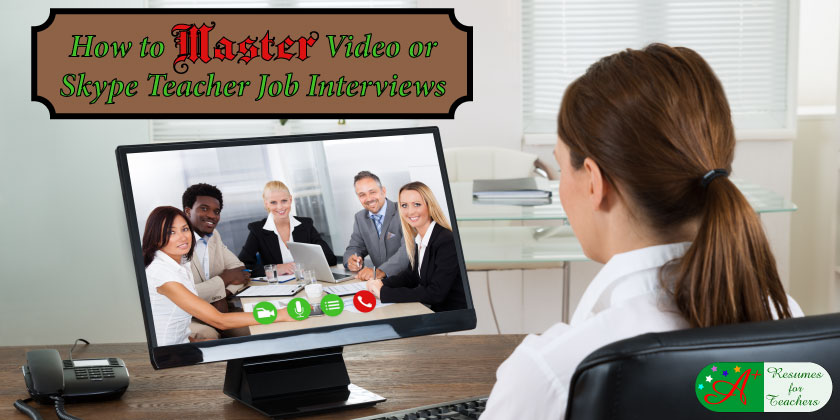
How to Master Zoom or Skype Video Teacher Job Interviews

Zoom or Skype video teacher job interviews are skyrocketing; if you need a video job interview coach or consultant, contact us.

Zoom video conferences or online academic job interview meetings have been a game-changer for recruiters, school districts, employers, and job seekers.

In recent years, Skype or Zoom video has been a popular platform to conduct interviews, and now there are many other types of video meeting conferencing tools or applications.

As you would know, one of the most crucial parts of the job search process is the interview. There are many types of meetings in the education sector. Whether you have one or two sessions or conversations, this is the last stage before being offered the position. If possible, determine how you will be evaluated at the meeting and know what you need to do to ace it.

Types of teacher job interviews:

• Telephone Screening Interview
• Dinner Interview
• Behavioral Descriptive Interview
• Stress Interview
• One-on-One Interview
• Panel Interview
• Follow-up Interview
• Video Conference Job Interview

This post will take a look at the Skype and Zoom video conference job interviews.

As global competition increases, so do the applicant pool and some positions out there. Technology has allowed a person in one city to apply and interview for a job in another geographical area easily.

Using video conferences for a job interview is being implemented worldwide. It’s essential to be prepared for the possibility of a video interview, particularly if you are knowingly submitting resumes in cities other than your own.

How is a webcam interview similar to an in-person teacher job interview?

• Dress cleanly and appropriately, from head to toe. Try to stay current with business fashion trends.

• Act polite and professional during the entire course of the interview, just like an in-person interview.

• Prepare and practice as much as possible.

• Show up on time, if not early.

• Leave your cell phone, and other electrical devices turned off.

• Remain positive at all times, and refrain from bad-mouthing a former employer or colleague.

• Have a printed copy of your resume with you during the interview.

• The interviewer will allow you to ask questions of your own at the end of the conversation.

• The hiring manager will ask the same types of job interview questions, regardless of format:

15 traditional job interview questions:

1. Tell me a little bit about yourself?

2. What is your work style or work ethic?

3. Why are you the best person for this job?

4. Why do you want this job?

5. Do you work better independently or in a team?

6. Where do you see yourself in five years? Ten?

7. How do you handle stress?

8. What is your ideal work environment?

9. What do you know about our school or organization?

10. Could you provide the reasons for wanting to work for us?

11. What have you learned from past mistakes?

12. What was your most significant work accomplishment? Why?

13. Was there a time you had to make an unpopular decision? (behavioral descriptive question)

14. Tell me about a time when you had to persuade someone to accept an idea of yours. (behavioral descriptive question)

15. Give me an example of a time when you needed to motivate a team of people to get a project or job completed. (behavioral descriptive question)

As with any job interview, preparation is essential!

Practice answering the above questions in front of the mirror, in front of the video camera, and with family or friends. Keep in mind there are different stages of a teacher job interview. Ask others to provide you with constructive criticism, particularly regarding the pace of your speech, facial expressions, and content of your answers.

How is a webcam interview different than a regular face-to-face job interview?

Confidently execute a webcam interview.

Be prepared for other distractions in the background:

  • Spouse, children, and pets.
  • The phone ringing
  • The doorbell ringing
  • Be prepared for technological problems, such as a lost connection to the Internet.
  • It is up to you to choose a well-lit, clean, and organized room to conduct your interview.
  • There are more aspects to consider when choosing an outfit for the interview:
  • White or sparkly clothing may reflect the light and cause glare; the same problem can occur with flashy jewelry.
  • Red clothing articles can appear to “bleed” on the screen.
  • Choose a solid pastel or neutral color or a simple pattern.
  • Dress from head to toe. Even though you are in front of the computer, you may have to stand up at some point to get something, and you don’t want the interviewer to notice your fuzzy pajama bottoms or slippers.
  •  Dress for the role you are seeking. Treat it like a formal interview to ensure you act professionally.

Have the house to yourself during your video meeting. If this isn’t possible, secure a closed-door room, and make sure the other occupants of the house know not to interrupt you. Put a sign on the door as a reminder to them.

Keep all pets out of the room, as you don’t want a dog jumping up on your lap during the interview, a cat pouncing on the camera or keyboard, or a loud bird squawking in the background.

Once you have chosen the room to hold your interview, ensure that it is clean, tidy, and provides natural or non-harsh lighting.

Keep the windows closed to block out street noise as much as possible. Also, try to put a blank wall behind you, so the viewer on the other end has fewer distractions and can focus his or her full attention on you.

Furthermore, you must be proactive about potential technical problems and have a plan in place. Check and double-check your Internet connection, webcam, and microphone. Understand how all aspects of your webcam work, primarily if you haven’t used it before.

Skype and Zoom interviews are used for hiring teachers to teach internationally occasionally. Knowing what personal attributes the hiring managers or recruiters are looking for when hiring an international teacher.

Do a dry run with a family member, career coach, or friend on the other end of the video conference. As mentioned above, have the person provide you with constructive feedback about how you look and sound over the camera.

If the audio or video cuts out during the actual conference call, stay calm and professional and not yell or curse. The person at the other end may still be able to see and hear you. If you can’t continue your job interview, attempt to contact the interviewer by telephone or email and reschedule the meeting.

Other issues to consider when conducting a webcam interview:

• Look at the video camera, not the screen.

• Speak in a clear and audible tone. Pace yourself when answering questions to enunciate, and make sure the interviewer can hear you clearly on the other end.

• Introduce yourself as you would in an in-person interview.

• Choose a chair that forces you to sit upright and maintain a good posture and be comfortable for the conversation’s duration. Do not slouch or become so relaxed that you forget you are still in a job interview.

• Minimize hand talking, as you don’t want to detract from the information you are providing, block the camera’s view, or accidentally knock the computer or camera around.

• Do not make unnecessary noise that the microphone may pick up on or amplify.

• Shut down other software programs that are not needed, guaranteeing fewer technical problems and the temptation to play on another program in the background.

• Have a glass of water within reach in case you become parched during the interview.

• A transmission problem can delay you in answering the interviewer’s question and them responding. Just pause a few seconds longer and wait for them to respond.

• Remember to smile! Even though you are looking at a camera, you are still talking to a human being on the other end.

There are more tips on video job interviews here.

Regardless of the type of teaching job interview you attend, please send a thank you letter after. Send this letter within 48 hours of the meeting. If there was more than one person on the other end of the video conference, send each person a message.

Address the job search documents appropriately to the right person with the correct spelling if you can’t remember the interviewers’ full names or positions, phone the human resources department to clarify.

A thank you letter is also an opportunity to highlight the major points discussed during the meeting. Create bullet points of five to seven of your best accomplishments or most essential traits such as job experience or education.

How to Amplify Your Resume Results By Turning Up Interest

Are you looking to increase your resume results? Do you know how social media channels can skyrocket the number of interviews your resume generates? And, of course, ultimately improve job search success.

First, look at LinkedIn and how it can help you get a new position.

The basics: LinkedIn is a website that connects professionals and businesses. Individuals can build profiles highlighting their career experience, formal education, skills, related interests, etc.

LinkedIn is an effective way to network, put yourself out there as a potential job candidate, research, target desirable companies, and hunt for jobs. It is an excellent personal network learning platform.

LinkedIn also provides suggestions for other professionals in your geographical area or with similar career or academic interests. This type of networking can be invaluable in helping you develop the skills needed to attain a new job or advance your career. Although there are different steps to land a teaching job, do not underestimate the power of networking!

So, your question:

How Can You Use LinkedIn to Further Your Career?

As indicated above, LinkedIn can be a powerful tool for furthering your career, particularly if you have already hit the ceiling in your current school or organization. Use the website to search for similar organizations or districts that are currently growing or are looking to expand in the future. Contact the school or organization directly or track down other individuals who may have an excellent lead or an in at a place of interest.

You will increase your candidacy for a targeting position if you have a well-crafted, keyword-rich profile. Ensure your page is concise, professional, and appealing to potential readers.

Do not downplay your career success, academic achievements, or certifications. Do not brag, exaggerate, or lie. The goal is to market yourself as an excellent employee and leave the reader to uncover more about you.

How Do You Boost Traffic to Your LinkedIn Page?

8 Excellent Ways To Boost Your Job Interview Results Share on X

A LinkedIn page is only effective if it attracts viewers.

Boost Profile Views with These Tips

1. Post a professional-looking photo.

a. Select the perfect picture for your profile to represent you in the best manner possible.

b. Dress professionally.

c. Keep your hair neat.

d. Ensure makeup and jewelry are tasteful.

e. Choose flattering lighting.

2. Use specific education keywords and phrases to grab the reader’s attention.

a. Keep them reader’s industry-specific.

b. Incorporate action words.

c. Don’t include overused keywords. Don’t use  “experienced” or “hard-working;” be more creative” and genuine than that.

3. Make your Headline Pop.

a. Convince employers to click on your page with just one headline.

b. Show employers what you can do for them.

c. Use particular titles such as “Analyst,” “Director,” or “Manager.”

4. Explain unfamiliar”acronyms” or terms that only industry-specific players would recognize.

a. If you are uncertain whether an acronym is well-known or not, spell it out to be on the safe side.

5. Use your profile to make job responsibilities and accomplishments stand out.

a. Don’t only list past job titles. Don’tates worked.

b. Utilize this space to highlight a few essential duties you held.

c. Showcase career achievements; quantify them with facts, numbers, and specifics as much as possible.

d. Demonstrate how these past accomplishments can translate to future success for another company.

6. Highlight More than Your Degree.

a. Include your degree, central, and minor if applicable.

b. Incorporate certifications.

c. List professional development opportunities such as courses, conferences, and workshops you attended.

d. Integrate professional organizations or affiliations.

e. List community involvement or volunteer experience.

7. Proofread Resume Profile

a. Misspelling words will show a lack of attention and perhaps a lack of caring on your part.

b. Proper spelling and grammar will demonstrate solid written communication skills.

8. Start Networking!

a. Don’t wait for others to Don’t your page; visit other individuals’ and companies’ profiles.

b. Develop partnerships with those interested in getting to know you on a professional level and who may be able to help you in the future.

What Are Other Types of Social Media Job Networking?

Since social media can play a significant role in today’s job search process, you should be on board. In addition to LinkedIn, Facebook and Twitter are two excellent websites to enhance your job search, make new contacts, and land your dream job.

• Facebook – Connect with me on my business Facebook page.

Facebook is a trendy social networking platform that many individuals, companies, organizations, and schools utilize.

o It allows you to connect with others, research companies, identify their mission statement, and discover job openings.

Use this website to reach out to like-minded individuals and boost your professional presence online.

If you are searching for a new job and your current employer is unaware of that, do not broadcast it on your page.

Facebook should be a positive tool, not a place to air grievances. Doing so could potentially negate any future career opportunities you may have discovered.

Always safeguard your personal information. Do not list your date of birth, phone number, email address, home address, children’s information, or the children’s information. Maintain a professional image at all times, and do not post anything you may regret in the near or distant future.

• Twitter 

Follow me on Twitter @Candace_Davies …  so I can follow you back!

  • It is an excellent way to communicate your idea or message concisely.
  • Many companies have started using Twitter to broadcast current and near-future job openings.
  • Use your city’s hashtag to search for jobs in your area.
  • Utilize keywords related to your job title or industry as hashtags for the job hunt or career advancement.
  • Type in the words of #jobhunt or #jobsearch, #hireme, #hiremenow, #dreamjob, or #hotjobs to search for job openings.

Online Networking Precautions

If you add a company as a Facebook “friend” or have an open status “as opposed to “friends-only”), potential hiring” managers ca” view your blog and photos. Even though it is your personal space, you always want to remain professional-looking. It is okay to discuss your personal life to some degree, but do not post anything that may seem sketchy or undesirable to employers, such as:

• Lewd images

• Unsavory stories

• Negative posts about current co-workers, friends, or family

• Trash-talking former employers

• Outspoken views on politics, religion, or other sensitive subjects

Certain companies have set up Facebook accounts to see potential candidates’ pages and assess whether candidates would be a good fit for their business. These sites can be an excellent tool for connecting with the right person. Just be careful what you post on the Internet, as news can travel fast and is hard to erase!

Don’t Let a LinkedIn Profile Replace Your Resume.

Regardless of how you find a job posting, you will still need to provide the company with a resume. A LinkedIn profile should complement your resume and entice readers to request your formal job application document.

• A resume allows you to share specific accomplishments. Use it to demonstrate numbers and facts when incorporating your achievements.

• Your resume should include your personal contact information (address, phone number, address, and email), whereas you should never advertise those items publicly on LinkedIn. Use private messaging on LinkedIn to talk safely with other individuals or companies.

• Keep your resume one or two pages long, but develop a more extended LinkedIn profile as needed.

Don't wait to develop your online professional presence, it takes a while to pump put the impact. Share on X

Don’t Wait to Develop Your On”inDon’tfessional Presence!

• Have you created a LinkedIn profile yet? Connect with me on LinkedIn.

• Are you getting the traffic and results you want?

• Do you wish you would receive more phone calls offering a job interview?

• Is your job just a job?

• Do you feel bored or stagnant in your current role?

• Are you looking to advance your career?

• Or perhaps you are looking at changing careers altogether?

If you need social media job networking assistance, we offer exceptional coaching services to help you advance your career! If you want us to create your LinkedIn profile, read about the service.

How To STOP 5 Resume Writing Mistakes NOW!

Resume writing mistakes you can fix immediately. Your education resume can be an effective job search tool to market you to the right audience. If written correctly, you should have a short job hunt.

An academic resume only works if you write and format it correctly!

Avoid These Resume Writing Mistakes that Many Educators Make

Have you sent out resume after resume with very few, if any, results?

Are you unsure why you are struggling to secure education interviews?

Have you used a “proven” teacher resume template but still can’t land a job?

Please sit back and read the mistakes job seekers make when creating their resumes. Also, read 13 academic CV curriculum vitae writing tips to fast-track your job application.

#1 STOP using resume templates or builders

Click on the arrow to listen to Candace read this post.

 1. Use a teacher resume template from MS Word or similar programs – Do NOT do this!

A Microsoft Word template may be suitable for a high school student searching for their first job. A bland template is not appropriate for a professional to use, particularly a teacher.

Teachers must be able to demonstrate creativity and outside-the-box thinking. By simply defaulting to a basic template, you will automatically lose points with the reader.

A resume should be a work of fine art; it’s an opportunity to make yourself stand out not only professionally but visually as well. The key is developing a concise, truthful, and eye-catching document that leaves administrators eager to learn more about you.

There are several strategies to get away from the standard resume template, including incorporating color, changing fonts, integrating a related icon, adding a border, and using testimonials.

Stop using templates, and avoid these other four resume writing mistakes educators make! Share on X

The resume sample is an excellent example of how to incorporate color and an icon. However, you may choose to use just one of these items or neither. It’s all about making the document fit your personality and the kind of teacher you portray.

Or you may wish to use a powerful testimonial, which adds evidence you are an outstanding educator.

Take the time to review this elementary teacher resume sample.

Or if you are looking for a teachers’ aide resume sample, you are in luck.

Jump on over to this excellent post about education resume formatting tips to please the reader’s eye.

Four resume writing mistakes educators make!

2. Unclear resume target, specialty, or desired position

If you find your resume is not gaining the attention you want it to, perhaps your specialty isn’t clear to the reader. Don’t try and hide what position you are applying for; make it obvious right from the get-go, so the reader knows to start matching up your experience and skills with the job they are hiring for. In addition to your name, your main area of expertise should be large, bold, and near the top of the page.

If you don’t focus your resume and cover letter on the position, you will miss job opportunities.

The introductory or profile paragraph should convey your related experience as well. For instance, in the school librarian/media specialist example below, you will note the writer’s apparent reference to library management and technology integration expertise. A hiring administrator knows the job applicant has these two critical skills.

If you are a brand new teacher, who doesn’t have a defined specialty to declare, you may want to replace the title of “School Librarian/Media Specialist” with “Seeking the position of School Librarian/Media Specialist.” Use the introductory paragraph to highlight a few relevant points to the desired position, including experience, skills, and proven methods or strategies.

Review the complete School Librarian / Media Specialist Resume Sample

An example of a School Librarian / Media Specialist Cover Letter Sample

 3. The resume is too long or too short

If your resume is too short, you risk leaving out crucial details that administrators are looking for; however, if your document is too long, you will lose the reader’s interest. An excellent educational resume should be one to two pages in length. Occasionally if the individual has lots of publications or professional development, it can be three pages.

Make sure each section contains any information you find pertinent to your job application without rambling. Your introductory paragraph or profile should be about four to six lines or bullet points in length. Even though you may have more to say about yourself, you want to get to the point right away and not come off as self-centered. Demonstrate what you can bring to the school district.

When writing job responsibilities, especially as they pertain to previous classroom positions, do not dwell on duties. The hiring administrator knows what is required of all teachers, regardless of grade level or subject matter. Turn ordinary tasks into superb teaching opportunities.

Example A)
Designed lesson plans that aligned with Core Curriculum Standards.

Turn into:

Developed intriguing lessons that actively engaged learners, reinforced skills, and prepared students for midterms and final exams.

Example B)
Administered assessments regularly.

Turn into:

Administered formal and informal assessments to track student progress. Used results to employ data-driven instruction and enhance students’ performance.

Example C)
Maintained a well-behaved classroom.

Turn into:

Worked with students to develop and institute classroom rules, which were clear, concise, and easy to follow. Provided positive reinforcement to maintain a focused and consistent learning environment.

4. Not emphasizing the critical, value-added areas in your resume

If you find you are running out of room on your resume, be choosy about what sections you include or emphasize in the document. If you neglect to highlight specific areas other than the common Career Experience and Education, your resume will surely go into the “not to be interviewed” pile. Some templates neglect to incorporate the following, but they are crucial to your success in the job search process:

• Areas of Expertise

• Accomplishments

• Professional Development

• Professional Affiliations (if any)

Additional segments you may want to include:

• Publications

• Community Involvement

• Technology Expertise

Since most people only focus on the mundane – Job Responsibilities and Formal Education – you will stand out from the crowd and surpass your competition. This doesn’t mean you should skip the sections on Experience and Education, but rather, use the above categories to complement and reinforce them.

An excellent example of how to integrate your Areas of Expertise section is conveyed in this Math Teacher Resume Sample.

Or you may wish to demonstrate your Key Strengths in a point form or table format similar to this Music Teacher Resume Sample.

Professional accomplishments are one of the most critical sections to highlight in your resume. These can be showcased in a bullet point format under each correlating job or can be summarized in their section within the document. Your accomplishments should be easy to understand, regardless of the current or past profession. They must also be applicable, factual, and succinct.

For instance, if you are an Elementary School Teacher, who has helped boost the overall class reading level, or achieved a high score on the state exams, highlight that, using numbers or facts as much as possible, as well as explaining how you achieved it.

Example A)
Researched and selected literature to actively engaged students to boost class reading levels by one full grade.

Example B)
Provided individualized instruction and after-school support to help a struggling student go from a failing grade to not only passing the class but achieving 85% on the year-end exam.

Example C)
Developed creative thematic units to effectively explain complex math concepts, which students typically consider boring. Demonstrated real-life applications and utilized multisensory activities to reinforce the concepts further.

When discussing topics such as Professional Development, Publications, and Technology Expertise in your academic resume, make sure they are relevant to education. If you have a plethora of courses or workshops under your belt, select the most recent or most applicable. Do not provide a whole page of in-services; be choosy and concise.

5. Disorganized or weak resume layout

Do you have the right qualifications for the teaching jobs you are applying for but find little interest in you as a candidate? Your resume’s physical layout may be to blame. Is your resume easy to read? Is it easy for the eyes to follow? Does your resume catch the reader’s eye and draw attention to the right points? Or is your document crowded, unorganized, and look unprofessional?

Don’t fill every inch of your paper with text. Employing white space is essential when arranging any material and appealing to the reader. Consistency is a must throughout your resume. Section headings should be the same font, size, and format (i.e., bold or underlined). Bullet points should be of the same shape (circle, square, dash) and indentation. Spacing must also be even throughout.

When choosing a font, make sure it is legible. Usually, 11 or 12 point is sufficient, depending on the font type. Stick to more traditional collections such as Times New Roman, Arial, Book Antiqua, New York, Garamond, etc. Do not use Comic Sans or Papyrus unless they are for your name. Do not overuse color or effects; you apply to be a teacher, not a graphic designer.

5 Serious Resume Mistakes Educators NEED to avoid getting interviews. Share on X

If you are interested, we have education CV and cover letter examples for your viewing,

I hope you enjoyed reading these 5 serious resume writing mistakes educators need to avoid to secure job interviews.

While you are visiting the blog, you can read 12 excerpts from sample application letters for teachers.

Learn more about Candace Alstad-Davies by reviewing this about me page. From that page, you can review testimonials and frequently asked questions.

Need some writing help to make a stellar application letter, cover letter, resume, or CV curriculum vitae?

Send an email if you like or give me a call toll-free at 1 877 738-8052. I would enjoy chatting with you.